
3.2 Seismic Analysis
Seismic analysis is a subset of structural analysis and is the calculation of the response of a building (or nonbuilding) structure to earthquakes. It is part of the process of structural design, earthquake engineering or structural assessment and retrofit in regions where earthquakes are prevalent.
A building has the potential to 'wave' back and forth during an earthquake (or even a severe wind storm). This is called the 'fundamental mode', and is the lowest frequency of building response. Most buildings, however, have higher modes of response, which are uniquely activated during earthquakes. The figure just shows the second mode, but there are higher 'shimmy' (abnormal vibration) modes. Nevertheless, the first and second modes tend to cause the most damage in most cases.
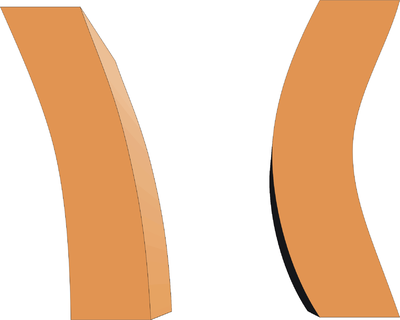
First and second modes of the building
Seismic Conceptual Design
Video from Dr. Chirag N. Patel (India)
https://www.youtube.com/watch?v=OQQGHpAszNc
How Structural Engineers Design Buildings for Wind and Earthquake
Video from StructurePlanet
https://www.youtube.com/watch?v=agAOoGI4pWs
Equivalent static analysis
This approach defines a series of forces acting on a building to represent the effect of earthquake ground motion, typically defined by a seismic design response spectrum. It assumes that the building responds in its fundamental mode. For this to be true, the building must be low-rise and must not twist significantly when the ground moves. The response is read from a design response spectrum, given the natural frequency of the building (either calculated or defined by the building code). The applicability of this method is extended in many building codes by applying factors to account for higher buildings with some higher modes, and for low levels of twisting. To account for effects due to "yielding" of the structure, many codes apply modification factors that reduce the design forces (e.g. force reduction factors).
Response spectrum analysis
This approach permits the multiple modes of response of a building to be taken into account (in the frequency domain). This is required in many building codes for all except very simple or very complex structures. The response of a structure can be defined as a combination of many special shapes (modes) that in a vibrating string correspond to the "harmonics". Computer analysis can be used to determine these modes for a structure. For each mode, a response is read from the design spectrum, based on the modal frequency and the modal mass, and they are then combined to provide an estimate of the total response of the structure. In this we have to calculate the magnitude of forces in all directions i.e. X, Y & Z and then see the effects on the building.
Combination methods include the following:
absolute – peak values are added together square root of the sum of the squares (SRSS) and complete quadratic combination (CQC) – a method that is an improvement on SRSS for closely spaced modes.
The result of a response spectrum analysis using the response spectrum from a ground motion is typically different from that which would be calculated directly from a linear dynamic analysis using that ground motion directly, since phase information is lost in the process of generating the response spectrum.
In cases where structures are either too irregular, too tall or of significance to a community in disaster response, the response spectrum approach is no longer appropriate, and more complex analysis is often required, such as non-linear static analysis or dynamic analysis.
Linear dynamic analysis
Static procedures are appropriate when higher mode effects are not significant. This is generally true for short, regular buildings. Therefore, for tall buildings, buildings with torsional irregularities, or non-orthogonal systems, a dynamic procedure is required. In the linear dynamic procedure, the building is modelled as a multi-degree-of-freedom (MDOF) system with a linear elastic stiffness matrix and an equivalent viscous damping matrix.
The seismic input is modelled using either modal spectral analysis or time history analysis but in both cases, the corresponding internal forces and displacements are determined using linear elastic analysis. The advantage of these linear dynamic procedures with respect to linear static procedures is that higher modes can be considered. However, they are based on linear elastic response and hence the applicability decreases with increasing nonlinear behaviour, which is approximated by global force reduction factors.
In linear dynamic analysis, the response of the structure to ground motion is calculated in the time domain, and all phase information is therefore maintained. Only linear properties are assumed. The analytical method can use modal decomposition as a means of reducing the degrees of freedom in the analysis.
Nonlinear static analysis
In general, linear procedures are applicable when the structure is expected to remain nearly elastic for the level of ground motion or when the design results in nearly uniform distribution of nonlinear response throughout the structure. As the performance objective of the structure implies greater inelastic demands, the uncertainty with linear procedures increases to a point that requires a high level of conservatism in demand assumptions and acceptability criteria to avoid unintended performance. Therefore, procedures incorporating inelastic analysis can reduce the uncertainty and conservatism.
This approach is also known as "pushover" analysis. A pattern of forces is applied to a structural model that includes non-linear properties (such as steel yield), and the total force is plotted against a reference displacement to define a capacity curve. This can then be combined with a demand curve (typically in the form of an acceleration-displacement response spectrum (ADRS)). This essentially reduces the problem to a single degree of freedom (SDOF) system.
Nonlinear static procedures use equivalent SDOF structural models and represent seismic ground motion with response spectra. Story drifts and component actions are related subsequently to the global demand parameter by the pushover or capacity curves that are the basis of the non-linear static procedures.
Nonlinear dynamic analysiss
Nonlinear dynamic analysis utilizes the combination of ground motion records with a detailed structural model, therefore is capable of producing results with relatively low uncertainty. In nonlinear dynamic analyses, the detailed structural model subjected to a ground-motion record produces estimates of component deformations for each degree of freedom in the model and the modal responses are combined using schemes such as the square-root-sum-of-squares.
In non-linear dynamic analysis, the non-linear properties of the structure are considered as part of a time domain analysis. This approach is the most rigorous, and is required by some building codes for buildings of unusual configuration or of special importance. However, the calculated response can be very sensitive to the characteristics of the individual ground motion used as seismic input; therefore, several analyses are required using different ground motion records to achieve a reliable estimation of the probabilistic distribution of structural response. Since the properties of the seismic response depend on the intensity, or severity, of the seismic shaking, a comprehensive assessment calls for numerous nonlinear dynamic analyses at various levels of intensity to represent different possible earthquake scenarios. This has led to the emergence of methods like the incremental dynamic analysis.
Quiz
Topic Discussion
References
ASCE. (2000). Pre-standard and Commentary for the Seismic Rehabilitation of Buildings (FEMA-356) (Report No. FEMA 356). Reston, VA: American Society of Civil Engineers prepared for the Federal Emergency Management Agency.
ATC. (1985). Earthquake Damage Evaluation Data for California (ATC-13) (Report). Redwood, CA: Applied Technology Council.
Bozorgnia, Y, Bertero, V, "Earthquake Engineering: From Engineering Seismology to Performance-Based Engineering", CRC Press, 2004.
"Early Finite Element Research at Berkeley", Wilson, E. and Clough R., presented at the Fifth U.S. National Conference on Computational Mechanics, Aug. 4–6, 1999
"Historic Developments in the Evolution of Earthquake Engineering", illustrated essays by Robert Reitherman, CUREE, 1997, p12.
Vamvatsikos D., Cornell C.A. (2002). Incremental Dynamic Analysis. Earthquake Engineering and Structural Dynamics, 31(3): 491–514.
https://en.wikipedia.org/wiki/Seismic_analysis

