-
1 Article
-
2 Words and&nb...
-
3 Notes on&nbs...
-
4 Reading Aloud



1 You have a science exam tomorrow. Good thing your lab partner lives upstairs — on the 400th floor. Did you say 400th!? Ever since architect Frank Lloyd Wright proposed his “mile high tower” in the 1950s, engineers and city planners have been working to achieve such a hyper-structure.
2 Holding 100,000 people or more, these Cities in the Sky, according to their proponents, would end urban sprawl, reduce pollution, and free up our dwindling natural landscape. Across the world, buildings rising half-amile high are being erected right now — with even taller ones on the drawing board.
3 But building such immense structures presents equally immense technological and social challenges. How high can we (and should we) go? Here’s how the designers and engineers of some of today’s most ambitious building projects are rising to these challenges.
“Weather” or Not We’ll Be Comfortable
4 Living a mile high might make you dizzy — not from the height, from the sway. Very tall buildings move in the breeze. They can even change how wind blows through a city, sometimes causing it to sweep pedestrians off their feet.
5 The solution? In the 101-story Taipei Tower, engineers solved the problem by installing a 730-ton pendulum weight. When the building swings in one direction, the weight swings the other, helping to cancel the building’s wind-induced sway. Chicago’s 2,000-foot-tall Spire (North America’s tallest building) is twisted like a corkscrew, to draw wind up and away from the ground. And Shanghai’s 1,600-foot World Financial Center has a hole through it near its top, to help relieve wind gusts.
Can We Find the Energy?
6 A single, mile-high building might house the population of an entire small city, vertically. How does it meet everyone’s energy needs?
7 London’s Citygate Ecotower may provide an answer. It has been designed to be the most eco-friendly skyscraper ever. Instead of glass or stone, Ecotower will be covered with solar cells. So instead of using miles of wire to conduct electricity to each apartment, the walls in this building will be able to make the power residents need. There are even plans to recover the energy from elevators as they rise and fall — like pistons in a giant engine.
Going (Way) Up
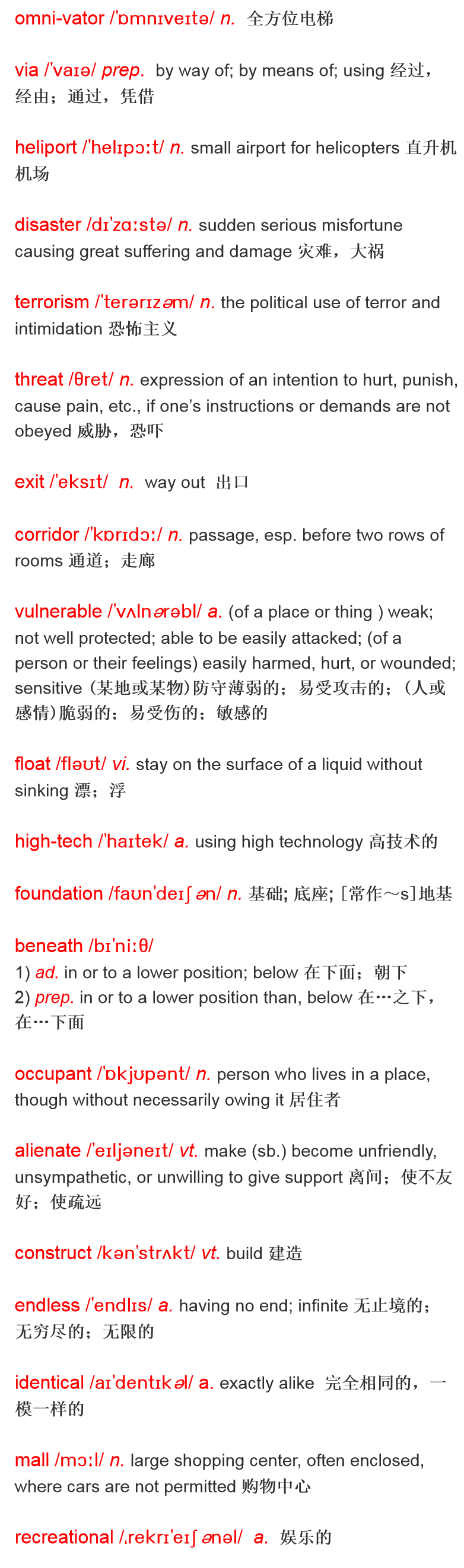
8 Speaking of elevators, a mile-high building would need dozens of elevators, working constantly, to move everyone where they want to go. Rising over half a mile high, the United Arab Emirates’ Dubai Tower uses the fastest elevators in the world, topping 40 miles per hour. Japanese designers have proposed an omni-vator — it would travel up and down or from side to side, connecting all parts of a building. Residents near the top of a mile-high building might even find it more convenient to leave via a rooftop heliport.
High Alert
9 Fires, natural disasters, and even acts of terrorism that are dangers of city life all become greater threats as buildings rise higher. In Tokyo, designers of the proposed 1,800-foot Shimizu Super High-Rise are experimenting with pumping high pressure air through the building to prevent smoke from filling emergency exit corridors in the event of a skyscraper fire. Since Japan is also vulnerable to earthquakes, the Super High-Rise has been designed to float on high-tech foundation posts, should the ground beneath it fail.
Alone Together
10 Social planners worry that very tall buildings may leave their occupants feeling alienated, cut off from the world and even each other. They warn that a mile-high skyscraper, if we can construct one, must not simply offer endless layers of identical housing. Planners stress the need to create community by including businesses, schools, shopping malls, even parks and recreational facilities at various levels of the structure.
(608 words)