
-
1 Objectives
-
2 I. Listening...
-
3 II. Listenin...

1. To become familiar with decimals presented as a listening focus;
2. To improve listening comprehension through specific exercises.

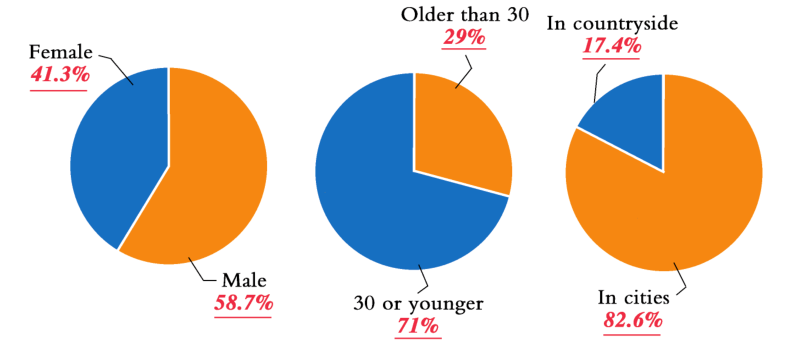
Sometimes it seems that you cannot prove something without drawing on speciic percentages as evidence. Often you can better convince your audience or readers of your point of view by adding the weight of such numerical information to your argument. This section focuses your attention on an aspect of authentic, day-to-day English: percentages. Listen to the following short speech, Who Is Using the Internet in China? While listening, ill in each of the blanks with the corresponding percentage.
Who Is Using the Internet in China?
* Script:
Who Is Using the Internet in China?
Despite its advantages, online data collection is open to demographic bias (人口统计的偏见) as Internet users tend to represent a certain profile (数据图表) .
First, let’s look at men and women. Men use the Internet at a rate of 58.7%, and women at a rate of 41.3%. Obviously, men outnumber (在数量上超过) women in their use of the Internet.
Now let’s find out the difference in percentages between youngsters and adults. 71% of Internet users are 30 or younger, and 29% of Internet users are older than 30. Of course, these results could be expected.
And finally, here’s the difference in percentages between those living in cities and those living in the countryside. The former accounts for 82.6% of Internet users while the latter only 17.4%. From this, we can see that the countryside in China possesses a great potential for increased Internet use in the future.


A. News Item One
● Listen to the following news item and then, for each question, select the best answer from among the four choices given.
paraplegic | a. 截瘫的 |
make it to | 到达 |
tip | n. 顶端 |
destination | n. 终点 |
epic | a. 史诗般的 |
physical challenge | 身体不便 |
disability | n. 残疾 |
discrimination | n. 歧视 |
on a shoestring budget | 预算不足 |
bulging | a. 肿胀的 |
biceps | n. 二头肌 |
shelter | n. 遮盖物 |
1)
a. A real story of green travel across China.
b. An economic way of travelling across China.
c. The best way of overcoming physical challenges.
d. A travel across China by a disabled man on wheelchair.
2)
a. The environment-friendly means of traveling.
b. The public awareness of physical challenges.
c. The new concept of wheelchair.
d. The justice of disabled people.
* Script:
A 29-year-old paraplegic man is traveling more than 3,500 miles (5,670 kilometers) across China — by wheelchair.
Quan Peng, from Gansu Province in western China, set off from Beijing in August 2014 and has visited 43 cities and towns in five provinces. In the next six months, he hopes to make it to China’s southern tip — his final destination.
The goal of his epic journey? He wants people with physical challenges like him to be treated like anybody else.
“I see it as a battle,” Quan told CNN. “I’m not only battling against my disability, but against discrimination.”
Quan has traveled on a shoestring budget. He’s wheeled himself all of the way so far — and has the bulging biceps to prove it.
He’s slept in a tent or in his chair with only the shelter of an umbrella, and camped out in hospitals, banks and public toilets.
Q1: What can we learn from the news report?
Q2: What did the 29-year-old paraplegic man fight for on his trip?
B. News Item Two
● Listen to the following news item and then, for each question, select the best answer from among the four choices given.
customary | a. 习惯的 |
routine | a. 惯例的 |
parking lot | 停车场 |
odd | a. 奇怪的 |
salvage | vt. 获得 |
garbage can | 垃圾桶 |
convict | n. 罪犯 |
dude | n. 〈美口〉 (男)人,家伙 |
capture | n. 抓获 |
chase | n. 追逐 |
the Orange County Board of Supervisors | (美国加州)橙县议会 |
3)
a. He is one of three escaped convicts.
b. He is a lucky customer.
c. He is a fast-food eater.
d. He is a homeless man.
4)
a. He saw a homeless man he had been looking for.
b. He recognized one of three escaped convicts.
c. He picked up a bundle of cash.
d. He found an abandoned van.
5)
a. A job at McDonald’s.
b. A reward of $100,000.
c. A cup of coffee for free.
d. A white van as a reward.
* Script:
It was customary for Matthew Hay-Chapman to go to McDonald’s each day. He lived in a San Francisco park near the fast-food restaurant and would go to get coffee in the morning.
In January while on his routine walk to get his cup of coffee, he saw a white van in the nearby parking lot. It was odd. People appeared to be sleeping inside.
One man got out of the van, and Hay-Chapman recognized him from the newspapers he salvaged from the garbage cans. It was one of the three escaped convicts from Santa Ana. The whole state was looking for them.
“That’s the dude. That’s got to be the guy,” Hay-Chapman recalled a week after the capture.
Police soon caught Hossein Nayeri after a chase and found Jonathan Tieu still inside the van.
Questions followed. Would Hay-Chapman, a homeless man, get reward money?
On Tuesday, the Orange County Board of Supervisors voted to give him $100,000.
Q3: What can we learn about Mathew Hay-Chapman from the news report?
Q4: What did Hay-Chapman happen to find on his way to MaDonald’s?
Q5: What did the information mean to the homeless man?

A. Conversation One
● Listen to the following long conversation and then, for each question, select the best answer from among the four choices given.
1)
a. The man.
b. The woman.
c. The man’s wife.
d. The woman’s husband.
2)
a. She is a housewife most of the time.
b. She works at home as a publisher.
c. She is a mother of ten children.
d. She writes on her computer.
3)
a. Nine.
b. Ten.
c. Eleven.
d. Twelve.
* Script:
W: Does your wife work?
M: Yes, she does. She works at home.
W: Oh, I understand. She cooks and cleans, takes care of the children. She does the housework. Is that right?
M: No, that’s not right. Most of the time I do those things. My wife is a writer. She writes on her computer. She has published ten novels already. Her next book will come out later this month. The name of the book is “The Death of a Housewife.”
W: Unbelievable. I’ve got to read her new book as soon as it comes out.
M: Really?
Q1: Who does most of the housework according to the conversation?
Q2: What does the man mean when he says that his wife works at home?
Q3: How many novels will the man’s wife have published by the end of this month?
B. Conversation Two
● Listen to the following long conversation and then, for each question, select the best answer from among the four choices given.
4)
a. The company’s reorganization.
b. A decrease in production.
c. A mistake he has made.
d. His loss of advantage.
5)
a. It began to lose money.
b. It increased its production.
c. It started to lay off its employees.
d. It hired more employees than necessary.
6)
a. He’s upset.
b. He’s crazy.
c. He’s penniless.
d. He’s out of job.
7)
a. On his savings.
b. With his new business.
c. By doing part-time jobs.
d. By borrowing money from the woman.
8)
a. He never lost money in business.
b. He stopped spending so much.
c. He made smart investments.
d. He made more than he spent.
* Script:
W: Michael, what’s wrong?
M: I got laid off from my job.
W: Oh no. Why?
M: The company has decided to decrease production. That means they need fewer workers for the time being.
W: I’m so sorry. You must feel awful. Maybe you’ll get your job back soon.
M: No, probably not. Actually, I’m not very surprised. I’ve known for some time that the company was in the red. It started losing money three years ago.
W: What will you do? How will you make ends meet? Would you like to borrow some money from me?
M: Thanks, but I’m not broke. I’ve been saving money for emergencies. I guess this is an emergency.
W: How did you manage to save money? Didn’t you say your job didn’t pay a lot?
M: Well, I just stopped spending so much money.
W: That was smart.
Q4: What has made the man get laid off from his job?
Q5: What does the man mean when he says that the company was in the red?
Q6: What can be said of the man now?
Q7: How will the man make ends meet now?
Q8: How did the man manage to save money?

A. Passage One
● Listen to the following passage and then, for each question, select the best answer from among the four choices given.
1)
a. He drove his Rolls-Royce (劳斯莱斯汽车) in the European countries.
b. He parked his Rolls-Royce in the bank’s underground.
c. He found a job in a downtown New York City bank.
d. He went to Europe for some important business.
2)
a. $15.40.
b. $5,000.
c. $51.40.
d. $40.15
3)
a. He was penny-wise, but pound-foolish.
b. He was not honest when he did business in the bank.
c. He paid for his parking fee when he paid the interest.
d. He fooled the loan officer into an immediate loan of $5,000.
* Script:
Before going to Europe on business, a man drives his Rolls-Royce to a downtown New York City bank and asks for an immediate loan (贷款) of $5,000. The loan officer, taken aback (惊讶) , requests collateral (抵押品) . “Well then, here are the keys to my Rolls-Royce,” the man says. The loan oficer promptly has the car driven into the bank’s underground parking for safe keeping and gives the man the $5,000.
Two weeks later, the man walks through the bank’s doors and asks to settle up his loan and get his car back. “That will be $5,000 in principal (本金) , and $15.40 in interest,” the loan oficer says. The man writes out a check and starts to walk away. “Wait, sir,” the loan oficer says. “You are a millionaire. Why in the world would you need to borrow $5,000?” The man smiles, “Where else could I ind a safer place to park my Rolls-Royce in Manhattan for two weeks and pay only $15.40?”
Q1: What did the man do before he received an immediate loan of $5,000?
Q2: How much did the man pay in interest?
Q3: What can we learn about the man in the story?
B. Passage Two
● Listen to the following passage and then, for each question, select the best answer from among the four choices given.
4)
a. Breastfeeding her baby.
b. Nodding through his words.
c. Driving her new SUV (多功能车) .
d. Walking around in the showroom.
5)
a. She does not know what she is doing.
b. She loves everything about Len.
c. She does not like the new SUV.
d. She will certainly buy the car.
6)
a. The same behavior means different things to them.
b. They like to drive the cars of their own styles.
c. It is polite for one to nod while listening.
d. Understanding doesn’t mean agreeing.
7)
a. To learn a language is to learn its culture.
b. Listening and nodding go hand in hand.
c. Misunderstanding is part of life.
d. Nodding doesn’t mean yes.
* Script:
“This car will suit all your driving needs,” Len tells Chris, the young mother of two as she stands on the showroom floor, her baby perched on her hip.
She listens to him intently, nodding with his words.
This encourages Len to believe he’s making headway (有进展) . “Wow!” He thinks, “She’s hooked! I've got this sale in the bag (稳操胜券) !”
When he’s done, Chris responds, “Thanks for telling me about your new SUV, but I’m not interested. I don’t think it will work for my family. I need something smaller and more fuel efficient (省油) .”
Len is stunned (惊讶) and stymied (受挫) ! Didn’t she want the car?
Was Chris intentionally trying to mislead Len into believing he’d made a sale? No, not at all. Nodding is an excellent example of the same behavior meaning different things to each gender. For women, nodding while listening conveys understanding and consideration. Chris was nodding as a feminine courtesy (女性礼貌) . To her, the nod didn’t mean she was buying Len’s product, only that she was paying attention and that she understood him. But confusion arises because for men nodding means not just understanding but also agreeing. If a woman nods, a man thinks, “Oh good, she’s buying everything I’m saying.” But at the end of the conversation, she may say, “No, I don’t think that’s a good idea.”
Q4: What is Chris doing while listening to the car dealer?
Q5: What does the customer’s nodding mean to Len?
Q6: What is the speaker trying to tell us from women to men?
Q7: What can we learn from the story?

