

高职英语

黄媛媛

目录

  • 1 Unit 1 Idols and Heroes
    • 1.1 Part A: Lead-in
    • 1.2 Part A: Text A
    • 1.3 Part B: Lead-in
    • 1.4 Part B: Text B
    • 1.5 Part C: Grammar
    • 1.6 Part C: Functions and Notions
  • 2 Unit 2 Love
    • 2.1 Part A: Lead-in
    • 2.2 Part A: Text A
    • 2.3 Part B: Lead-in
    • 2.4 Part B: Text B
    • 2.5 Part C: Grammar
    • 2.6 Part C: Functions and Notions
  • 3 Unit 3 Beauty
    • 3.1 Part A: Lead-in
    • 3.2 Part A: Text A
    • 3.3 Part B: Lead-in
    • 3.4 Part B: Text B
    • 3.5 Part C: Grammar
    • 3.6 Part C: Functions and Notions
  • 4 Unit 4 Procrastination
    • 4.1 Part A: Lead-in
    • 4.2 Part A: Text A
    • 4.3 Part B: Lead-in
    • 4.4 Part B: Text B
    • 4.5 Part C: Grammar
    • 4.6 Part C: Functions and Notions
  • 5 Unit 5 Social Media
    • 5.1 Part A: Lead-in
    • 5.2 Part A: Text A
    • 5.3 Part B: Lead-in
    • 5.4 Part B: Text B
    • 5.5 Part C: Grammar
    • 5.6 Part C: Functionss and Notions
  • 6 Unit 6 Environment
    • 6.1 Part A: Lead-in
    • 6.2 Part A: Text A
    • 6.3 Part B: Lead-in
    • 6.4 Part B: Text B
    • 6.5 Part C: Grammar
    • 6.6 Part C: Funtions and Notions
  • 7 全国大学英语四级课程(Cet-4)
    • 7.1 考试介绍
      • 7.1.1 技能要求
      • 7.1.2 考试题型
      • 7.1.3 评分标准
      • 7.1.4 成绩证书
      • 7.1.5 词汇量要求
    • 7.2 核心单词儿背起来
      • 7.2.1 付妈喊你背单词(视频+文字讲解)
    • 7.3 四六级16个救命答疑
      • 7.3.1 马上跟课学习、消除疑问
    • 7.4 阅读考点及解题技巧
      • 7.4.1 15选10抢分技巧
      • 7.4.2 真题带练
      • 7.4.3 长篇阅读抢分技巧
      • 7.4.4 真题带练
      • 7.4.5 仔细阅读抢分技巧
      • 7.4.6 细节题专攻
      • 7.4.7 推断题专攻
      • 7.4.8 真题带练
    • 7.5 听力考点及解题技巧
      • 7.5.1 备考困惑
      • 7.5.2 必懂信号词
      • 7.5.3 问题考点
      • 7.5.4 如何读选项?
    • 7.6 翻译考点及解题技巧
      • 7.6.1 七大翻译必备技巧
      • 7.6.2 主题带练
      • 7.6.3 考前点睛
    • 7.7 写作考点及解题技巧
      • 7.7.1 四大写作抢分模板
      • 7.7.2 如何旁征博引?
      • 7.7.3 主题带练
    • 7.8 四六级重点考点精准讲解
      • 7.8.1 马上跟课学习
    • 7.9 模考
      • 7.9.1 真题模考一(易)
      • 7.9.2 真题模考二(中)
      • 7.9.3 真题模考三(难)
Part B: Text B


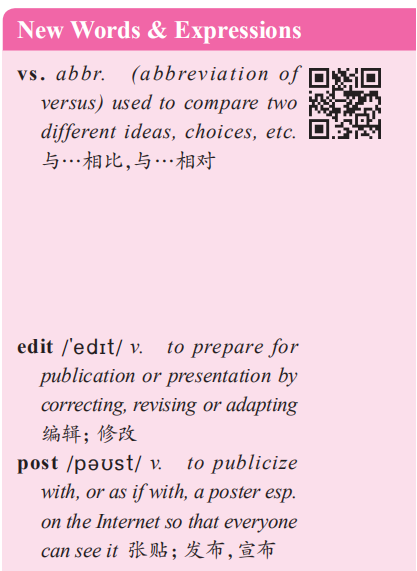
Social Media Vs. "Real Life"

Overuse of social media is a real problem people face, and it can distract you from some important "real life" responsibilities some times. So here are a few things to remember.

Don't compare your life to what you see on social media

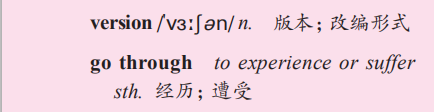
On social media, you can edit what people see. You're able to take 100 pictures and post the one you think is best. Not that there is anything wrong with that, but it's important to know that when you're looking at people's lives online, you're looking at an edited version. You don't see what they're actually going through. 

Don't get caught up in other people's opinions

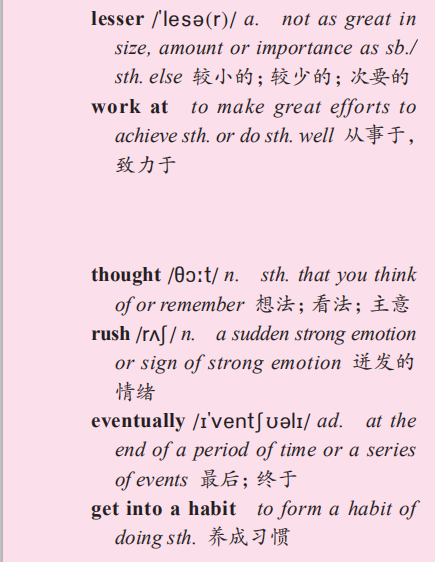
Do you ever find yourself getting caught up in what other people might think about you, or whether they like you? Well, this happens to so many young people. You're probably still trying to understand yourself and figure out who you really are, but what you shouldn't do is to think that other people's opinions of you are the truth. Not everyone is going to like you, just the same way that you're not going to like every person you meet, but that doesn't mean you are lesser than anyone else. You have to work at building a healthy self-esteem to really become confident in who you are — it's a hard, but a very necessary process.

Don't forget to experience life

When we do something interesting, sometimes our first thought is to let everybody else know about it. We feel that first rush of excitement, and immediately want everybody else to see it. Eventually, this can get you into a habit of not being present in the moment — whether you're by yourself or with others. You don't always have to share every single thing that's happening in your life with the world.


Notes on the Text

1. real life: 现实生活,是与以网络为媒介的虚拟生活相对而言的生活状态。网络为人类提供了一个能够隐匿和篡改身份的虚拟空间,催生了一种与现实生活异质的虚拟生活。

2. Don't forget to experience life: 不要忘了体验生活。在我们的生活中,有两种误区:一是活给别人看;二是看别人活。实际上,我们大多数人都生活在这两种误区中,都不可取。这样不但会让人们失去自我,也会失去生活的乐趣与追求。