目录

  • 1 建筑业 The Construction Industry
    • 1.1 本章纲要 Chapter Outline
    • 1.2 建筑业本质与特征 Industry essence and characteristics
    • 1.3 建筑业的分类 Industry sectors
    • 1.4 建筑业发展趋势 Trends in the industry
    • 1.5 建筑业道德规范 Construction ethics
  • 2 工程项目参与人 Project participants
    • 2.1 本章纲要 Chapter Outline
    • 2.2 业主方 Owners
    • 2.3 设计方 Design professionals
    • 2.4 建造方 Construction professionals
    • 2.5 其他参与方 Other participants
    • 2.6 参与方协同工具  BIM
    • 2.7 各方冲突管理 Conflict management
  • 3 项目的组织领导 Organizing and Leading project
    • 3.1 本章纲要 Chapter outline
    • 3.2 项目以及项目管理定义 Definition of project & PM
    • 3.3 项目管理相关术语 Basic PM terms
    • 3.4 项目领导艺术 Leadership
    • 3.5 项目沟通 Communication
    • 3.6 项目团队组建 Team assembling and building
    • 3.7 项目组织结构 Organizational structure
    • 3.8 合法的所有制形式 Legal forms of business ownership
  • 4 工程项目交付方式 Project Delivery Method
    • 4.1 本章纲要 Chapter Outline
    • 4.2 项目交付导言 Introduction
    • 4.3 项目交付方式类型 Project delivery method
    • 4.4 项目中的合同 Contract
    • 4.5 项目风险 Project risks
  • 5 项目生命周期 Project Chronology
    • 5.1 本章纲要 Chapter Outline
    • 5.2 项目发起、可行性、融资分析Initiation;Feasibility analysis;Financing
    • 5.3 项目设计、采购、建造Design, Procurment, Construction
    • 5.4 项目交付、运营、报废Turnover,Operation,Disposal
    • 5.5 项目管理生命周期 PM life cycle
  • 6 设计中建造相关服务 Construction Services during Design
    • 6.1 本章纲要 Chapter Outline
    • 6.2 建造相关服务引入背景Introduction
    • 6.3 服务之“可行性与可建造性分析”Feasibility ,Constructability analysis
    • 6.4 服务之“价值工程” Value engieering
    • 6.5 服务之“”建造干扰缓解” Construction mitigations
  • 7 项目投标与招标 Bidding and procurement
    • 7.1 本章纲要 Chapter Outline
    • 7.2 投标 Bidding
    • 7.3 工作分包 Work packages
    • 7.4 招标采购 Procurement
    • 7.5 招投标以及合同文档 Construction documents
  • 8 工程建造与收尾 Construction and Closeout
    • 8.1 本章纲要 Chapter Outline
    • 8.2 建造内容 Construction Activities
    • 8.3 建造效率 Construction productivity
    • 8.4 工程收尾 Construction Closeout
  • 9 项目成本估算 Estimating Project Costs
    • 9.1 本章纲要 Chapter Outline
    • 9.2 成本估算导言 Introduction
    • 9.3 成本估算类型 Types of estimates
    • 9.4 成本估算因素与常见问题 Estimate considerations and common problems
  • 10 项目进度计划 Project Scheduling
    • 10.1 本章纲要 Chapter outline
    • 10.2 进度计划的内涵  Essence of schedule
    • 10.3 进度计划编制流程  Scheduling Process
    • 10.4 进度计划编制方法 Scheduling Methods
  • 11 项目CTQ控制 Controlling Project Cost,Time and Quality
    • 11.1 本章纲要 Chapter Outline
    • 11.2 控制系统介绍 Project control system
    • 11.3 质量控制 Quality control
    • 11.4 成本、进度基线计划 Cost time Baselines
    • 11.5 成本、进度绩效模型 Cost and schedule performance models
    • 11.6 成本、进度联合的挣值分析 Earned Value Analysis
  • 12 现场以及远程管理 Job site and remote adminstrative management
    • 12.1 本章纲要 Chapter Outline
    • 12.2 现场管理Job site administrative management
    • 12.3 远程电子化管理 Remote electronic management
  • 13 工程安全与健康管理 Construction Safety and Health
    • 13.1 本章纲要 Chapter Outline
    • 13.2 工程安全与健康管理 Construction Safety and Health
    • 13.3 事故预防与处理 Accident Prevention and Programs
项目管理生命周期 PM life cycle

Project management  life cycle  

项目管理生命周期


Initionation(发起阶段): :Define scope; Assess Scope; Determine resourses needed; Identify stakehoders; ask for approval界定范围;评估范围;确定所需资源;识别干系人;项目审批)   


Plannning(计划阶段) :   Planning is considered to be the most important phase of project management, therefore one of the most important responsibilities of the project manager. A project plan provides the basis for its implementation, control & termination. The plan is a point of reference for specific project objectives, performance specifications, duration & milestones, organizational structure, resource requirements & budget. It is a vehicle for assigning team members’ role & duty.It helps individual know when his/her tasks is done.Planning forces one to think through the entire project, enables more efficient use of resources.Plans are more effective when they are developed by or at least with the help of doers.计划被认为是项目管理中最重要的阶段,因此也是项目经理最重要的职责之一。项目计划为其实施、控制和终止提供依据。计划是特定项目目标、绩效规范、工期和里程碑、组织结构、资源需求和预算的参考点。它是进行团队成员角色定位和职责分配的工具。它有助于个人了解他/她的任务何时完成。计划迫使一个人对整个项目进行思考,能使资源得到更有效的利用。当计划由实干家制定或至少在实干家的帮助下制定时才会更加有效。)
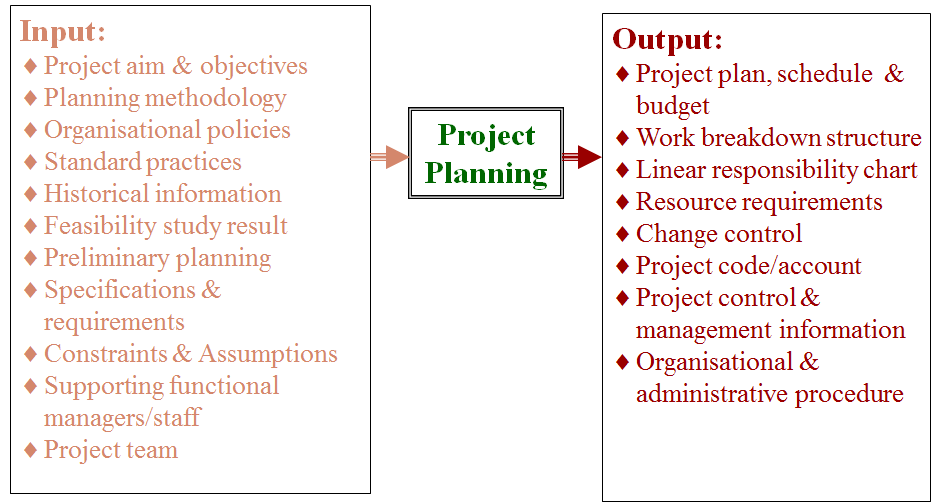

☛A project planner should be CRAP:

 Creative – imaginative in the adoption of ideas & techniques and developing tools to match project needs. (创造性——富有想象力地使用想法、技术以及开发工具来满足项目需求。)

Responsive – ever conscious of time constraint; quick to identify & solve problems with the participation & support of others(反应迅速——时刻意识时间限制;在他人参与和支持下快速发现并解决问题)    

Analytic – able to grasp uncertainty & risks, and identify contributory factors and variables    

(分析型——能够把握不确定性和风险,并识别促成因素和变量 )

Persuasive – effective in communication: initiate, coordinate & integrate

 (说服力——有效沟通:发起、协调、整合)


 Executing and Controlling执行和控制阶段 : A major portion of the project work takes place during this stage. Time, cost and specification measures are used for control. Is the project on schedule, on budget, and meeting specifications? What are the forecasts of each of these measures ? What revisions /changes are necessary?  Controlling goes through the entireprocess it includes  checking the progress , comparing to what was planned and  taking necessary action. 项目的大部分工作在这一阶段完成。时间、成本和规范方面的措施被用来进行控制。项目是否按计划、按预算进行、是否符合规格?对这些指标的预测是什么?需要进行哪些修订或者更改?控制贯穿整个过程,它包括检查绩效、与计划进行比较以及采取必要的措施。)


Closing收尾阶段It includes the two activities: delivering the project product to the customer and redeploying project resources. Delivery of the project might include customer  training and transfering documents.Redeployment usually involves releasing project equipment/materials to other projects and finding new assignments for team members.它包括两项活动,向客户交付项目产品和重新部署项目资源。项目交付可能包括客户培训和转交档案资料。重新部署通常涉及将项目设备和材料分配到其他项目,并为团队成员找到新的任务)