
★About Construction Safety and Health
Workers expect safety in the workplace.----a comfortable, safe place to perform their work. In some industries, the work itself makes it difficult to meet these basic standards. Construction is a prime(首要的) example of this type of industry. Construction is a hazardous(有危险的) profession. Managing safety on construction sites is a challenging endeavor(活动), and each project has its own particular set of hazards.
Construction work is dangerous, but these dangers can be controlled and sometimes completely eliminated (消除)if safety is treated as an integral(不可或缺的) part of the overall production schedule.
Constructors are considered primarily responsible for providing a safe environment for their workers and protection for the general public during the construction process. However, everyone associated with the project can assist. To meet basic health and safety needs on a construction site, all participants must cooperate.
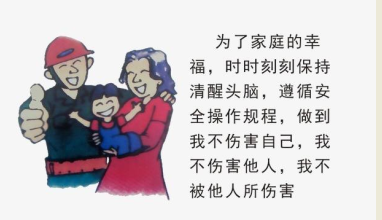
The consequences of accidents are many, but the primary(主要的,基本的)one is that someone often gets hurt. Besides the person who suffers the injury, others are affected as well.Worker morale(士气)suffers when a coworker is injured. Worry over the person’s welfare(福利),fear of being injured themselves, guilt over not preventing the accident all come into focus. Families of the person injured also suffer.
Safety is an attitude. It starts with top management and is reflected on the job site in many ways.How safety is attended(出席,关注)to on construction sites depends on individual attitudes toward it.No matter what the attitude, safety is required by law.There are also humanitarian(人道主义的)and economic reasons for attending to safety.There are many ways to prevent accidents.Even with the best of intentions, accidents can happen.
★Types of Accidents
The leading types of fatal construction accidents are falls(高空坠落), being struck by something(物体打击), being struck by electricity(触电),mechanical injury (机械伤害), These “Fatal Four” account for 90 percent of deaths. With the height of building and the depth of basement rise, the earth collapse accidents are increasing.Therefore, the collapse accidents(坍塌) become the fifith major injury.
常见安全事故警示
★The Cause of Accidents
The following two factors are at the heart of safety.
* Unsafe Conditions(不安全的环境)
Unsafe conditions are hazards(危险) that can cause injuries. these hazards can be physical,such as defective tools, unprotected openings(未受保护的洞口), and improper storage of equipment or materials. They also can be environmental, such as contaminants(污染物) brought onto the site without proper containment(抑制、控制). Controlling these unsafe conditions is challenging because they are forever changing as the job progresses. A safe area of construction on a given day can contain many hazards on the following day.

* Unsafe acts(不安全的行为)
Unsafe acts are hazards caused by the actions of people on the job. These actions can be categorized in three ways: things a person should have done (such as informing others about unsafe conditions), should have done differently, or should not have done at all. If a person neglects(忽略) to inform others about unsafe conditions, he or she is neglecting to act. If the person uses tools or equipment inappropriately or works at heights without proper protection, he or she is acting incorrectly. If the person proceeds into a hazardous area despite(不顾) warning signs, the person is acting when he or she should not.
With all the awareness(意识) of safety in the workplace today, it might seem simple to have total cooperation from everyone about accident prevention.Sometimes, however, pressures run counter to a safe work environment(压力和安全工作环境背道而驰), especially in construction. During schedule pressures, there is a tendency(倾向) to increase the speed of individual tasks, which can lead to carelessness. Construction attracts men and women who often have good physical skills, which can sometimes lead to a sense of invulnerability(坚不可摧,无敌) and a willingness(意愿) to take risks.Because the typical construction workforce mixes different cultures and races, there are likely to be varying styles of behavior and work practices, which can lead to conflicts among workers. If not handled correctly, conflicts can lead to angry confrontations(对抗), which in turn can jeopardize(危害) safety.
★The Cost of Accidents
The cost of accidents is high. Companies carry insurance(保险) to cover some of these costs, but the real costs are more indirect, difficult to predict, and not covered by insurance.
The cost of accidents is high. Companies carry insurance to cover some of these costs, such as medical expenses and workers’ compensation, but the real costs are more indirect, difficult to predict, and not covered by insurance. Loss of productivity and personnel time; damaged property, material, and equipment; cleanup and repair; liability claims(责任索赔); and the cost of retraining replacement workers are all burdens placed on the company that will not be covered by any insurance. These costs eat into the profits on a job. Following are some common indirect costs:
Worker’s compensation insurance premiums(工伤保险费用的增加)Insurance companies use a measurement tool called an experience modification rate (EMR) to calculate how to charge individual companies. The purpose of an EMR is to collect higher premiums from companies with above-average accident rates and to reduce the costs for companies with below-average rates.
Liability (法律责任)If an injury involves a tool or a piece of equipment, the worker can sue the manufacturer, who in turn can sue the company. These are called third-party lawsuits. If another contractor on the site is injured due to a company’s negligence, he or she can sue the company directly. The general public also can file a lawsuit against the company directly if a person is injured due to construction activity.
Penalties(惩罚) Companies can be faced with penalties beyond the liability and increased premiums.
Public relations(公共关系)Serious accidents on construction sites are often shown on the evening news and recounted in newspaper stories. Interviews with families and coworkers reinforce emotional responses to the accident. A company’s reputation can be seriously damaged by this sort of coverage.Understandably, owners are reluctant to hire a company with a poor accident record because it puts them in a vulnerable position if there is an accident on their job.

事故的代价

