
★Cost and schedule performance models(成本和进度绩效模型)
Cash, like people and equipment, is a resource that must be tightly controlled on project. It is rare that owner begins a project with cash equivalent(相等的) to the project budget sitting in the bank. The owner needs to know, with accuracy, how much cash must be available each month of the project to pay the contractor's invoices(发票).
Like the owner, the contractors must be able to predict his or her cash needs for a project. Contractors receive income from the owner in the form of paid invoices. That cash is then paid out to in-house labor, subcontractors, and material and equipment supplier. To stay in business, the contractor must diligently(勤奋的) manage these cashflows.
Managing cash flow is made difficult by the fact that payments are made in different increments(增额) depending on the type of activity. (for example,subcontractors are generally paid at the end of each month for the work completed; the labor is usually paid at the end of each week; materials are generally provided to the contractor on credit(赊账). To properly project cash flow, each activity must be tracked in the manner in which the payment will be made.
▶Income projection (收入推测)—— (cash income curve)(现金收入曲线)
The projected payment period totals are commonly negotiated between the contractor and the owner. It is in the contractor's best interest to shift as much value as possible to the front of the job, overvaluing(高估) early activities while undervaluing(低估) later items. This ploy(策略) is commonly called “front-end loading”.Within reason, this is a always reasonable and accepted practice since in the early part of a project , contractors often are faced with hidden costs not easily attached to specific work activities.
▶Payment projection(支出预测) ——(cash requirements curve)(现金需求曲线)
Before construction the contractor should prepare a payment projection( also called a cash requirements curve). This curve is prepared similarly to the income curve expect that now the contractor is forecasting the cash that is leaving the company to pay for labor, materials, subcontractors, and other commitments. Another difference is that the costs assigned to each activity are direct costs and do not include general contractor profit, which are not directly paid out. At the end of the project, the final point on the cash requirements curve indicates the total amount of money that the contractor has spend for labor, materials, equipment, and subcontractors, just as the income curve reflects the total amount of money paid to the contractor by the owner.
(The reason why the costs have been categorized as labor, material, or subcontractors is that the terms for payment of each is different: In-house labor is paid weekly; materials are paid at the end of month; and sometimes subcontractors are paid after the general contractor receives payment from the owner.)
▶The joint analysis of both cash income curve and requirements curve(现金收入支出联合分析)
The cash requirements curve is the contractor's attempt to model as precisely as possible his or her cash needs for a project. When this curve is compared to the cash income curve, we can visualize the contractor's cash flow .
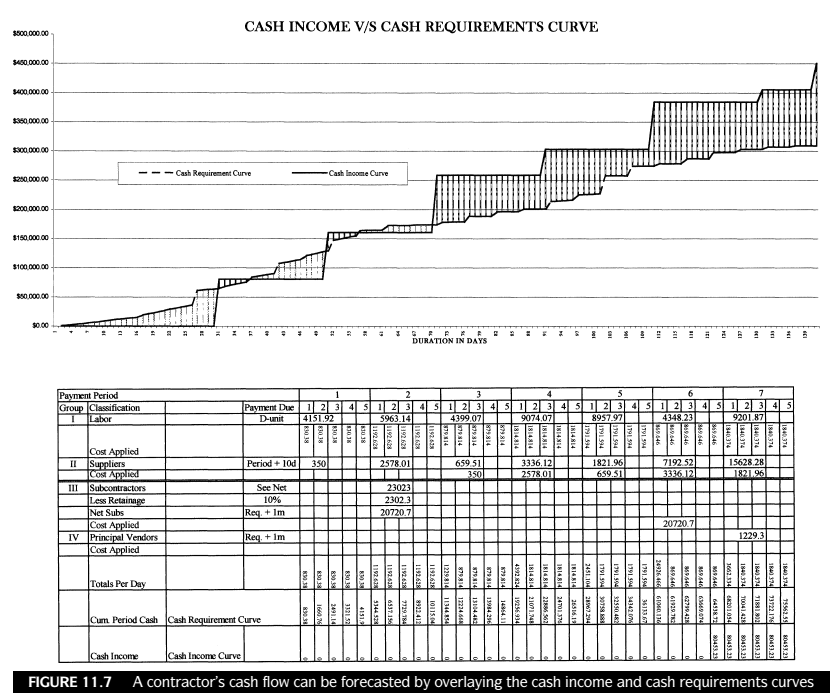
As the upper figure shows, this project will need a source of additional financing for the beginning of the project; but as the project nears completion, it will begin to produce the positive cash flow needed to cover the contractor's general requirements and provide profit.
Early negative cash flowis typical for most projects and must be planned for . Owner retainage(保留金) and the lag(滞后) between the receipt and payment often worsen the situation.
☛How to deal with early negative cash flow?
Contractors can minimize this negative cash flow by front-loading the job, of course,this method must get the agreement from the owner;
(承包商可以通过提前加载工作来最小化负的现金流,当然,这种方法必须得到业主的同意)
Using more subcontractors early in the job, since contractors usually do not pay their subcontractors until after they receive owner payment;
(在工作初期使用更多分包商,因为总包通常是在收到业主付款后才向分包商付款);
Negotiating a lower rate of owner retainage, freeing up retainage earlier;
(协商降低保留金率,提前解冻保留金);
Arranging additional credit from material suppliers;
(从材料供应商处取得更多的赊购);
Arranging a credit line from a bank.
(从银行获得更多的信贷额度)。
Conclusion
A project begins with a work plan that includes a budget, a schedule, and an engineered approach designed to completethe project most effectively, but the reality of construction is that events occur that force the plan to be altered. (Such as an owner adds or deletes work, forcing a change in the project's scope; or productivity in the field is less than planned). To manage these events, the project team must establish a system to capture the actual events of the project, analyze them, and make appropriate adjustment so that the project's budget, schedule, and quality can maintained.(项目起始于一个工作计划,该计划包括一个预算、一个进度表,以及一个旨在最有效完成该项目的工程方案,但现实是,迫使计划改变的事情经常发生。(比如,业主增减工作内容,迫使项目范围发生变化;或者现场生产效率低于计划)。为了管理这些事件,项目团队必须建立一个系统,以捕获项目进行中实际发生的事件,并对它们进行分析,进行适当的调整,以便维持项目的预算、进度和质量。)
Project control is a continuous cycle in which project managers identify a goal, measure results, analyze, make a adjustments, and report results.
As the project proceeds, the actual results are compared to the target dates and costs established by the estimate and schedule. Significant deviations from the plan should be analyzed so that corrections can be made either in the ongoing project or in the company's database so that future estimates and schedules will not repeat mistakes. Project control should be viewed as a learning process in which team members exchange information, make adjustments, and record results.(随着项目的推进,实际结果将与估算和进度计划确定的目标日期和成本进行比较。与计划不同的重大偏差都应该认真分析,以便在当前正在进行的项目或公司的数据库中进行调整,避免未来的估算和计划重蹈覆辙。项目控制应该被视为一个学习的过程,在这个过程中,团队成员相互交换信息,做出调整,并记录结果。)
Estimates and schedules are usually prepared independently; but as the final preparation are made for the project, every effort should be made to integrate the two. When projects are shortened, indirect costs are saved while direct costs go up. The optimum duration is the duration at which the project can be constructed for the least cost. This is found by analyzing the project's critical path and crashing activities as long as the direct cost of shortening the project is less than the indirect cost of the project.(预算和工期计划表通常是独立编制的;但随着项目准备工作最终完成,我们应努力将两者结合起来。当项目工期压缩时,间接成本会节省,而直接成本会上升。最佳工期是以最低成本建造该项目的工期。只要缩短工期带来的直接成本增加小于项目的间接成本,最佳工期就可以通过分析项目的关键路径以及赶工来实现。)
Reviewing questions(复习思考):
How to deal with eraly negative cash flow from the general construction contractor perspective?(从总承包商的视角谈谈,如何解决早期负现金流的问题)

