目录

  • 1 建筑业 The Construction Industry
    • 1.1 本章纲要 Chapter Outline
    • 1.2 建筑业本质与特征 Industry essence and characteristics
    • 1.3 建筑业的分类 Industry sectors
    • 1.4 建筑业发展趋势 Trends in the industry
    • 1.5 建筑业道德规范 Construction ethics
  • 2 工程项目参与人 Project participants
    • 2.1 本章纲要 Chapter Outline
    • 2.2 业主方 Owners
    • 2.3 设计方 Design professionals
    • 2.4 建造方 Construction professionals
    • 2.5 其他参与方 Other participants
    • 2.6 参与方协同工具  BIM
    • 2.7 各方冲突管理 Conflict management
  • 3 项目的组织领导 Organizing and Leading project
    • 3.1 本章纲要 Chapter outline
    • 3.2 项目以及项目管理定义 Definition of project & PM
    • 3.3 项目管理相关术语 Basic PM terms
    • 3.4 项目领导艺术 Leadership
    • 3.5 项目沟通 Communication
    • 3.6 项目团队组建 Team assembling and building
    • 3.7 项目组织结构 Organizational structure
    • 3.8 合法的所有制形式 Legal forms of business ownership
  • 4 工程项目交付方式 Project Delivery Method
    • 4.1 本章纲要 Chapter Outline
    • 4.2 项目交付导言 Introduction
    • 4.3 项目交付方式类型 Project delivery method
    • 4.4 项目中的合同 Contract
    • 4.5 项目风险 Project risks
  • 5 项目生命周期 Project Chronology
    • 5.1 本章纲要 Chapter Outline
    • 5.2 项目发起、可行性、融资分析Initiation;Feasibility analysis;Financing
    • 5.3 项目设计、采购、建造Design, Procurment, Construction
    • 5.4 项目交付、运营、报废Turnover,Operation,Disposal
    • 5.5 项目管理生命周期 PM life cycle
  • 6 设计中建造相关服务 Construction Services during Design
    • 6.1 本章纲要 Chapter Outline
    • 6.2 建造相关服务引入背景Introduction
    • 6.3 服务之“可行性与可建造性分析”Feasibility ,Constructability analysis
    • 6.4 服务之“价值工程” Value engieering
    • 6.5 服务之“”建造干扰缓解” Construction mitigations
  • 7 项目投标与招标 Bidding and procurement
    • 7.1 本章纲要 Chapter Outline
    • 7.2 投标 Bidding
    • 7.3 工作分包 Work packages
    • 7.4 招标采购 Procurement
    • 7.5 招投标以及合同文档 Construction documents
  • 8 工程建造与收尾 Construction and Closeout
    • 8.1 本章纲要 Chapter Outline
    • 8.2 建造内容 Construction Activities
    • 8.3 建造效率 Construction productivity
    • 8.4 工程收尾 Construction Closeout
  • 9 项目成本估算 Estimating Project Costs
    • 9.1 本章纲要 Chapter Outline
    • 9.2 成本估算导言 Introduction
    • 9.3 成本估算类型 Types of estimates
    • 9.4 成本估算因素与常见问题 Estimate considerations and common problems
  • 10 项目进度计划 Project Scheduling
    • 10.1 本章纲要 Chapter outline
    • 10.2 进度计划的内涵  Essence of schedule
    • 10.3 进度计划编制流程  Scheduling Process
    • 10.4 进度计划编制方法 Scheduling Methods
  • 11 项目CTQ控制 Controlling Project Cost,Time and Quality
    • 11.1 本章纲要 Chapter Outline
    • 11.2 控制系统介绍 Project control system
    • 11.3 质量控制 Quality control
    • 11.4 成本、进度基线计划 Cost time Baselines
    • 11.5 成本、进度绩效模型 Cost and schedule performance models
    • 11.6 成本、进度联合的挣值分析 Earned Value Analysis
  • 12 现场以及远程管理 Job site and remote adminstrative management
    • 12.1 本章纲要 Chapter Outline
    • 12.2 现场管理Job site administrative management
    • 12.3 远程电子化管理 Remote electronic management
  • 13 工程安全与健康管理 Construction Safety and Health
    • 13.1 本章纲要 Chapter Outline
    • 13.2 工程安全与健康管理 Construction Safety and Health
    • 13.3 事故预防与处理 Accident Prevention and Programs
质量控制 Quality control

About quality and QM

Quality is a much more complicated term than it appears.  Dictionary definitions are usually inadequate(不充分) in helping a quality professional(质量专业人员) understand the concept.  It seems that every quality expert(专家) defines quality in a somewhat different way.  There are a variety of perspectives(视角) that can be taken in defining quality (e.g. customer's perspective, specification-based perspective基于规范的视角).  A modern definition of quality derives from(起源于) Juran's "fitness for intended use."  This definition basically says that quality is "meeting or exceeding customer expectations."  Deming states that the customer's definition of quality is the only one that matters. 

ISO(International Standard Organization):质量是“反应实体满足客户明确和隐含需求的能力的特性总和”。实体的内涵丰富,可以是具体的实物,也可以指对应的活动、过程或组织等。明确需求是指在标准、规范、图样、技术要求、合同和其他文件中用户明确提出的要求与需要。隐含需求是指用户对实体的期望以及公认的、不必明确的需求。特性是指实体所特有的性质,反映了实体满足需要的能力。

what is quality?


why is quality  important?


★Quality management

Quality management is the totality(整体,全部) of functions involved in the determination and achievement of quality (includes quality assurance and quality control).

Modern quality management believes that quality  should be planned, designed, and biult-into——not  inspected into the project's deliverables(可交付物)

Modern quality management approaches recognize the  importance of:

  1. Customer satisfaction  (顾客满意度)

  2. Continuous improvement(持续改进)

  3. Prevention over inspection(预防胜于检查)

  4. Management responsibility(管理责任)


▶Quality control tools

收集质量数据,分析和确定质量问题,控制和改进质量水平的常用7种工具:
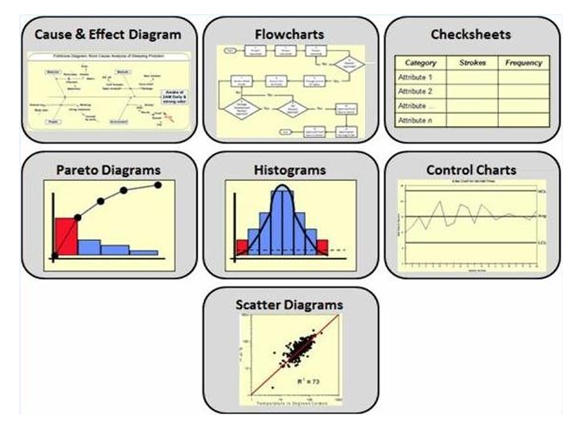
(因果图;流程图;核检表

帕累托图;直方图;控制图

散点图)


▶Total Quality management(TQM) (全面质量管理)

TQM is a new concept in the construction industry, but it has made a significant impact during the past two decades. Although dozens of books and hundreds of articles have been published about the TQM philosophy, its essence can be summed up in just two guiding concepts: customer satisfaction and continuous improvement.

The concept of customer satisfaction goes far beyond the traditional idea of providing an acceptable product to the owner for whom we are working. The customers are considered to be everyone involved in the building process from designers to subcontractors and employees. TQM encourages innovation and cooperation. Ideas flow more freely, and decisions are made with more input from all of the parties involved.

Continuous improvement means making every job better than the last one. Ask“is there a better way to perform this task?  If so learn from the experience and share it with other members of the project team. This attitude can be seen at every level in the TQM Company.

    TQM is a philosophy, not a business plan. TQM is everyone's responsibility and everyone's reward.
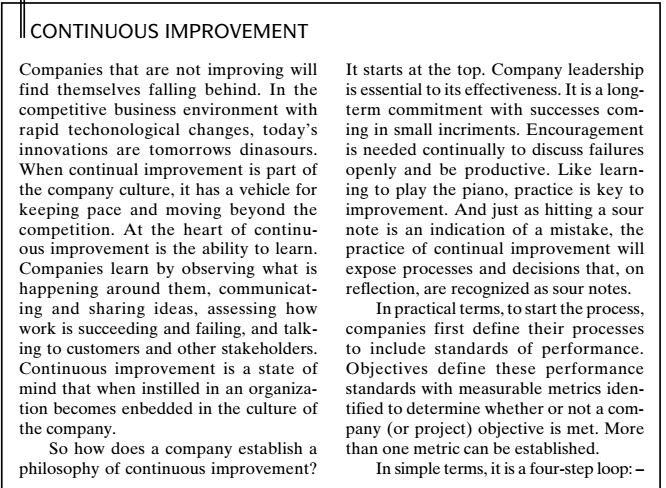

PDCA - A useful manangement tool


 Reviewing questions(复习思考):

1、Write out your understanding of TQM

2、what's PDCA?