
Introduction
Project control begins with the identification of the owner's objectives and ends with those objectives have been met. The owner, the designer, and the construction professional together design, estimate, and schedule the project to meet those objectives. This is the basis of the control system.
The purpose of project control is to guarantee that the project's design, budget, and schedule are met by the project team. If any objective begins to slip(滑行,偏离), the control system will identify this deviation(背离) early so that the appropriate correction(纠偏) can be made.
Project control begins with a plan that identifies the objectives of the project and specific checkpoints throughout the project cycle. The plan is a roadmap(路线图) that allows the project team to constantly monitor and make corrections as necessary.
★ Components of project control system
▷Standards(标准)
A system of control is essential for the successful delivery of any construction project. To begin the process, managers first establish the standards that define success for the construction project. Cost, schedule, and quality are the basis of these standards and are configured(使成形) so that they are measurable and provide direction to check progress and provide direction. The project team will continually use these standards to check progress and provide direction.
The standards used for control vary depending on the level and type of control necessary. Drawings, specifications, estimate and schedule are all providing project standards.
Measurement standards serve as the goals for the project participants. With the standards, each project participants can be given a task with the corresponding budget and time frame in which to accomplish the job (For example, a carpenter can be given the task of laying one hundred square meters of interior floor, a budget of $1500 for materials and duration of two days.)
▷Actuals(实际绩效)
The second component of the project control system is measurement of actual progress. This includes accurate cost, schedule, and quality information about the project. Actual performance compared to planned performance provides the management team with feedback about how well the project is proceeding. Also, actual cost and schedule performance information can be stored for reference(参考) when estimating and scheduling future projects.
Measuring actual performance is a complicated progress since the necessary information resides in(存在于) many different places (E.G. An review of daily reports, a walk through by trained schedulers, submitted quality reports, or video reports can provide information about the percent of the project completion; purchase orders, delivery tickets, and receipts(发票,收据) provide actual costs for material, equipment, and so on)
Such information provides the raw material for the project control reports necessary to monitor progress. These reports will then be properly processed, sorted, filtered(过滤), and delivered to the appropriate managers in a timely manner.
The feedback from the data can only be useful if put together in a combined form so that the correlation among cost, schedule, anticipated events, and unanticipated ones can be examined. (for example the hours expanded are greater than the hours budgeted for the work. if the estimate, site conditions, and weather all appear to be normal , then worker performance should be examined.)
The inconsistency(不一致性) can be explained through an analysis of several possible options:Poor worker performance; Incorrect reporting; Different site conditions; Wrong equipment assigned; Bad weather; An error in estimate
▷Correction and adjustments(纠偏和调整)
Once the project management team has this information, it then determines which reasons explain the variance(变动) noted in the report.
Key to the reporting process is that any inconsistency be identified quickly and the proper adjustment made in a timely manner. Good reports are accurate, show variances (differences) between budgeted amounts and actual amounts, forecast goals for future work periods, and suggest corrective actions. Timeliness(及时性) is also important: if all the appropriate tasks have been accomplished but too late for any corrective action, the control effort has been wasted.
★ Basic control theory
The process of project control can best be illustrated(阐释) as a control loop(环) that repeats itself in a similar pattern.
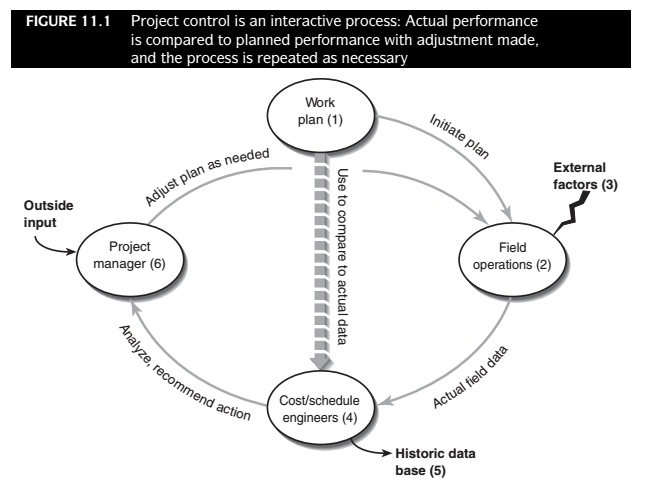
The control process begins with the initial project plan (1), which includes budget, schedule, and quality along with other planning information such as staffing and administrative procedures(人员配备和行政程序).
The project plan is used to initiate(开始,发起) the field operations (2). The order in which the work is completed and the type and level of staffing are determined by the project plan. The initial plan identifies resources such as equipment, people, and materials that are needed at the job site.
The lightning bolt(闪电箭头) (3)represents the impact of external factors such as labor strikes(罢工), bad weather, or unanticipated events that affect the field operations. The arrow between field operations and the cost/schedule block(块) represents the processing of actual information from the field. Since the process involves many people in the organization, it needs close coordination.
The cost/schedule engineers block (4) represents the processing of data from the field and the comparison with the initial plan. Any differences between the actual and planned performance should be noted at this point. Then timely and accurate recommendations should be made to the project manager.
Historical data (5) represents the permanent storage(永久储存) of information for use by the company in future job planning. All actual field information should be used to update the company data base. This is how a data base is built and maintained(维护).
The arrow between cost/schedule engineers(step 4) and project management (step 6 ) represents the dissemination of status reports(状态报告的传递) to the project team. For the reporting process to be useful, it must deliver accurate information to the right people on time. The reports should be sorted so that managers only get information that is key to their job. The reports should also be prioritized(优先) to focus on the most important activities with key variances noted.
The arrow from project management (6) to the filed operations represents the completion of the project control system. Management made a decision, and final instructions are now being given to the field. Adjustments may be made in the project plan, or the instructions may be to continue as originally scheduled. For these instructions to be effective, they must be delivered soon enough to be smoothly implemented(顺利执行).
This loop allows learning to occur and adjustments to be made. Without a project control cycle, project people might continue to make the same mistakes and have little opportunity to measure the effect of specific decisions.
The project control cycle can be repeated as often as necessary to control a particular project monthly, weekly, daily,or even hourly. However, the more frequent the reporting process, the more cost is incurred(引致) by the company because of the additional time necessary to collect, process, and interpret(阐释) results.

