
Construction Activities
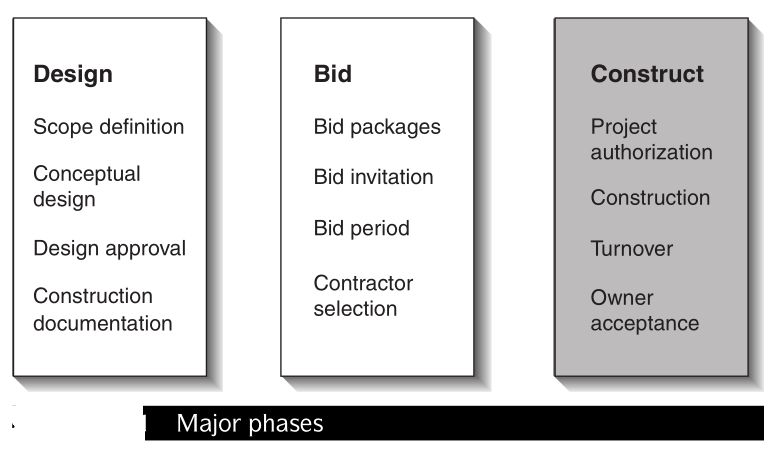
Once a project enters the construction phase, the builder's work is pretty the same no matter what contract form or delivery method was choosen. The same activities include:
negotiate the subcontracts
staff the project (staffing)
develop the work schedules
Job start
Job site arrangement
Every day the conditions at the site change, so the construction manager must remain constantly aware of these shifting circumstances. Stay ahead of the day, the week, and the month; meet problems and solve them before they affect the pace of the work. A manager's real skill is to solve problem before it is a problem. This can only be done through anticipation(预期) and contingency(意外)planning and by putting together a well-organized team of people.
★Negotiate subcontracts(与分包商协商)
To simply our discussion in this chapter, we assume that the builder is the construction manager at risk, this means that the subcontractors work directly for the builder( or general contractor 总承包商) with no direct contractual relationship with the owner.
Subcontractors signed by the contractor can be either a trade(劳务) contractor or a supplier. The difference is that a trade contractor has specific construction skills such as carpentry or plumbing whereas a supplier furnishes(提供) a product to the job such as a refrigeration(冷藏)unit or an electrical generator. Either a trade contractor or a supplier can sometimes be contracted to another subcontractor, making him or her a second-tier subcontractor. For example ,a mechanical subcontractor can hire a sheetmetal(钣金) subcontractor to fabricate(制作) and install the ductwork(排污管道).
Although there is no direct contract between the owner and the subcontractor, there are provisions(规定) in the owner-contractor general conditions that pass on the same owner obligations to the subcontractor and subcontractor obligations to the owner as exist between the owner and the prime contractor. If the prime contractor defaults(违约,缺席), provisions in the general conditions assign the subcontractor to the owner, as long as the owner is willing to accept it. This provision attempts to offset the disruption caused by the default of the prime contractor.
Subcontractors do a large percentage of the work on most projects, and they are at considerable risk, thus they must carefully consider the terms and conditions of the contract to minimizing the potential risks.
How to negotiate a higher salary
商业谈判
★Staffing(人员配备,员工入场)
Generally speaking, there are two groups of staffing--- the home office and the field office. Some parts of the project always get managed from the home office; on the other hand, some tasks can only be performed in the field, such as supervision of subcontractors and management of the safety program. Some functions may take place at the home office and then shift to the field during construction. Such as scheduling, procurement, and accounting.
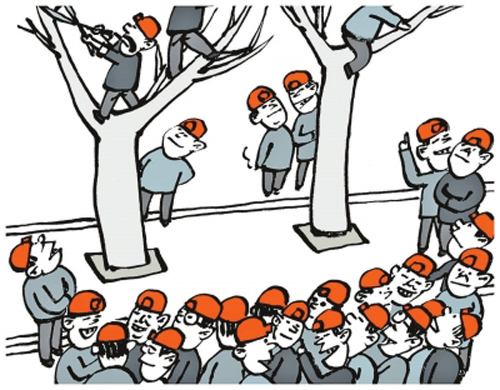
A project manager must be careful about when he or she staffs a project. If there is insufficient work, the money lost to the project can never be recovered, if the project is under staffed, the time wasted on the project can never be recovered.
Slowing down or stoping work means finding other places for the workers. Once they are gone from the site, it is difficult to get them back. Thus, a slowdown must be carefully discussed with the owner so that team members understand and make provisions for the consequences(结果).
★Job start(开工)
Before actual construction starts, the owner, the architect, and the contractor usually hold a preconstruction meeting, which is often called and chaired(主持) by the owner. Here the focus shifts to the logistics(后勤) of getting the project built. Agreement about communication protocol(议定书) is established, site rules are reviewed, and certificates of insurance are submitted.
One important issue is communication protocol. Discussions clarify the specific roles of each project participant; establish lines of communication; and set procedures for submittals, questions and answers about design, emergencies, community relations, and dispute resolution. Often a project runs into trouble when communication protocols are either poorly worked out or ignored by project participants.
★Job site arrangement(现场布置)
Organizing a construction project is primarily a material handling challenge: understanding what material is needed , when it needs to arrive, and how it will be manipulated(操作,操纵) once it arrives. Some materials are used temporarily- for example, scaffolding(脚手架) and forms for concrete pours(模板). Others are permanent parts of the project- steel,concrete, and masonry(石块).
Planning for materials requires a good strategy for the job site itself. Many sites are limited in size, especially in an urban environment or a renovation(修理). Good understanding of how material will arrive and be handled once inside the site helps create as much efficiency as possible.
Before the contractor sets up the job site(施工现场), he or she should plan it on paper. A version of the site, with dimensions, access road, utility locations, elevations, and existing structures, should be noted. The layout should be drawn with an eye to how material will arrive and be processed and how people will move into and around the site. For instance, the main office trailer(活动板房) should be located close to the site entrance. ——why ? Visitors can be easily disoriented(迷失方向), which may contribute to safety problems. By locating the office near the entrance with clear signage(标示), visitors can sign in and be escorted (护送)to wherever they need to go. This location will also provide a security point for unauthorized visits(不速之客. )
(Case: 施工现场平面布置图)
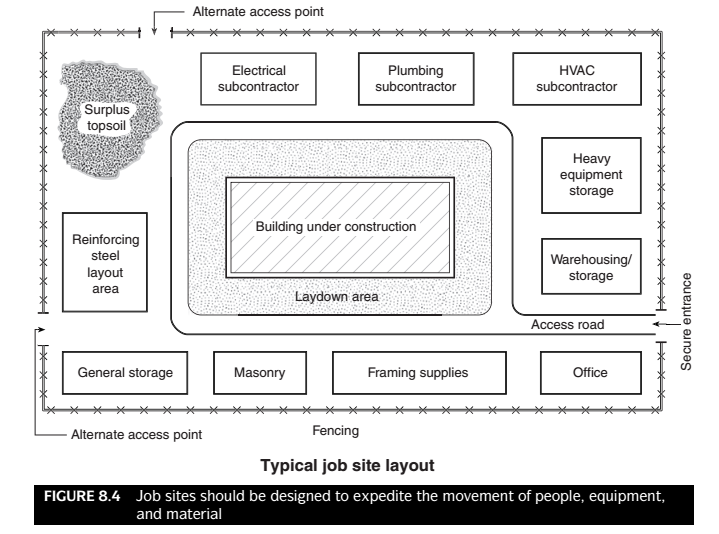
施工现场平面如何布置
水下结构是如何修建的?
Reviewingquestions(复习思考):
How construction sites(工地) are staffed(人员配备) and the relationship between the field and the home offices(总部)

