目录

  • 1 建筑业 The Construction Industry
    • 1.1 本章纲要 Chapter Outline
    • 1.2 建筑业本质与特征 Industry essence and characteristics
    • 1.3 建筑业的分类 Industry sectors
    • 1.4 建筑业发展趋势 Trends in the industry
    • 1.5 建筑业道德规范 Construction ethics
  • 2 工程项目参与人 Project participants
    • 2.1 本章纲要 Chapter Outline
    • 2.2 业主方 Owners
    • 2.3 设计方 Design professionals
    • 2.4 建造方 Construction professionals
    • 2.5 其他参与方 Other participants
    • 2.6 参与方协同工具  BIM
    • 2.7 各方冲突管理 Conflict management
  • 3 项目的组织领导 Organizing and Leading project
    • 3.1 本章纲要 Chapter outline
    • 3.2 项目以及项目管理定义 Definition of project & PM
    • 3.3 项目管理相关术语 Basic PM terms
    • 3.4 项目领导艺术 Leadership
    • 3.5 项目沟通 Communication
    • 3.6 项目团队组建 Team assembling and building
    • 3.7 项目组织结构 Organizational structure
    • 3.8 合法的所有制形式 Legal forms of business ownership
  • 4 工程项目交付方式 Project Delivery Method
    • 4.1 本章纲要 Chapter Outline
    • 4.2 项目交付导言 Introduction
    • 4.3 项目交付方式类型 Project delivery method
    • 4.4 项目中的合同 Contract
    • 4.5 项目风险 Project risks
  • 5 项目生命周期 Project Chronology
    • 5.1 本章纲要 Chapter Outline
    • 5.2 项目发起、可行性、融资分析Initiation;Feasibility analysis;Financing
    • 5.3 项目设计、采购、建造Design, Procurment, Construction
    • 5.4 项目交付、运营、报废Turnover,Operation,Disposal
    • 5.5 项目管理生命周期 PM life cycle
  • 6 设计中建造相关服务 Construction Services during Design
    • 6.1 本章纲要 Chapter Outline
    • 6.2 建造相关服务引入背景Introduction
    • 6.3 服务之“可行性与可建造性分析”Feasibility ,Constructability analysis
    • 6.4 服务之“价值工程” Value engieering
    • 6.5 服务之“”建造干扰缓解” Construction mitigations
  • 7 项目投标与招标 Bidding and procurement
    • 7.1 本章纲要 Chapter Outline
    • 7.2 投标 Bidding
    • 7.3 工作分包 Work packages
    • 7.4 招标采购 Procurement
    • 7.5 招投标以及合同文档 Construction documents
  • 8 工程建造与收尾 Construction and Closeout
    • 8.1 本章纲要 Chapter Outline
    • 8.2 建造内容 Construction Activities
    • 8.3 建造效率 Construction productivity
    • 8.4 工程收尾 Construction Closeout
  • 9 项目成本估算 Estimating Project Costs
    • 9.1 本章纲要 Chapter Outline
    • 9.2 成本估算导言 Introduction
    • 9.3 成本估算类型 Types of estimates
    • 9.4 成本估算因素与常见问题 Estimate considerations and common problems
  • 10 项目进度计划 Project Scheduling
    • 10.1 本章纲要 Chapter outline
    • 10.2 进度计划的内涵  Essence of schedule
    • 10.3 进度计划编制流程  Scheduling Process
    • 10.4 进度计划编制方法 Scheduling Methods
  • 11 项目CTQ控制 Controlling Project Cost,Time and Quality
    • 11.1 本章纲要 Chapter Outline
    • 11.2 控制系统介绍 Project control system
    • 11.3 质量控制 Quality control
    • 11.4 成本、进度基线计划 Cost time Baselines
    • 11.5 成本、进度绩效模型 Cost and schedule performance models
    • 11.6 成本、进度联合的挣值分析 Earned Value Analysis
  • 12 现场以及远程管理 Job site and remote adminstrative management
    • 12.1 本章纲要 Chapter Outline
    • 12.2 现场管理Job site administrative management
    • 12.3 远程电子化管理 Remote electronic management
  • 13 工程安全与健康管理 Construction Safety and Health
    • 13.1 本章纲要 Chapter Outline
    • 13.2 工程安全与健康管理 Construction Safety and Health
    • 13.3 事故预防与处理 Accident Prevention and Programs
工作分包 Work packages

Work packages(工作分包)

Packaging the work has many advantages , but there are also disadvantages in splitting the work into separate packages.

Advantages: 

☝It  allows for fast tracking the work so that parts of the project (the foundations, for instance) can be bid and started before the entire design package is assembled. This practice can save time on the project, but it also has potential risk as other related parts of the design change. But if the schedule is paramount, fast tracking can be of great benefits.

First it allows for the incorporation of local practices. For instance, if the local market has small, reputable mill houses but not one large entity, the construction manager can break the work down so that the local firms can share the work. This saves the price of having to get material and labor from distant places. 

Second, packing the work reduces overhead(加价): the more packages, the fewer markups (加在商品成本上以决定售价的金额)(Subcontractors typically mark up their work 20 percent. A general contractor typically marks up the subcontractors' work 10 percent. The same is true if subcontractors have to hire others to do part of their work. 
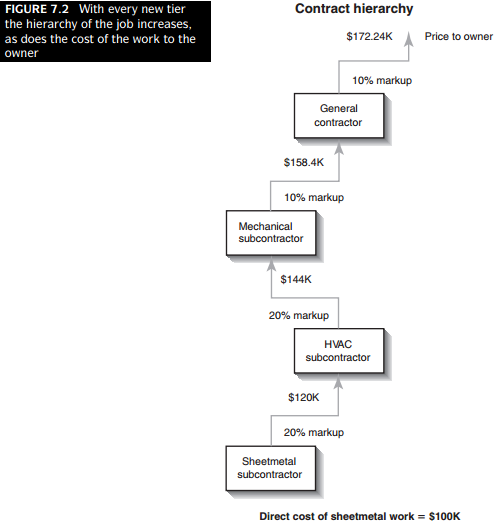
(  Case 例子    sheetmatal :钣金件; HVAC: Heating,Ventilation & Air-conditioning 制热、通风空调系统;   mechanical:机械)  

When deciding the contract hierarchy, the owner and the designer must take their managing and coordinating ability into account.

Disadvantages:

☟High demand on coordination.  Construction manager must coordinate different subcontractors and trades. There is high risk of disputes and more time has to be spent sorting out who is doing what and when.

☟Improper packaging of the work can cause omission of responsibilities or redundancy of work. For example, if the mechanical contractor has the control wiring in his or her scope and electrical contractor also has this scope, the overlap(重叠) can lead to disputes, create confusion.

Breaking work into individual bid packages is best done using the services of a construction manager. With proper construction knowledge, the manager can minimize the risk associated with packaging while maximizing the savings in cost and perhaps time.

易混淆的两个概念——分包与转包