
Project Risks(项目风险)
★What's risk?
Project risk is simply defined as any possible event that can negatively affect the viability of a project or an estimate of the probability of loss from a large population of unwanted circumstances.
Risk = Probability of event x Consequences of event
风险值=风险发生概率×风险发生后的后果(损失)
什么是风险?
★Project risk types?
1.General risks(常规风险)
Financial: the project will cost more than the allocated money, or it will cost more than the product itself is worth.(Estimates are only estimates. They are not purchasing prices. As time goes by, the condition will change, many factors will affect the prices of materials and labor, for example, the bankruptcy of a giant steel mill will change the steel price.)
Time: the project will not be completed within the planned time. (Strikes(罢工), poor working relationships, extreme weather conditions, site accidents are all risks that are difficult to predict and control. All can cause serious overruns in money and time during construction.)
Design: the project will not perform the function it was designed for or more commonly will perform the function in a degraded manner(质量打折扣).
Quality: the project will have poor quality materials or workmanship.
2.Project-specific risks (项目特有风险)
In addition to general industry risks, there are specific risks that all owners and designers and constructors must take into account during their work.
▶Separated function(功能不匹配):A design change after construction is disastrous, which can cause considerable increase in cost and time. Conversely,if a contractor makes a filed change that is not included in the design, the building may not function as well as intended. So the two primary professionals (designer and constructor) communication is the key to project success.
▶Scope change(范围变化):The scope of work on a project can be defined as the quantity and the character of the work. For instance, imagine that 1000 square meter of 1 inch gypsum wallboard(石膏板) defines the work of a drywall subcontractor(干墙分包商). If the quantity increases to 1100 square meter or the thickness to 1.5 inch, then the scope of work increases. Scope of work is the primary determinant of costs on a project.Any changes of the work scope can lead to the change of costs. If scope increases, cost also increases.
▶Poor stakeholder management (项目干系人管理不善)(expecially the external stakeholder) Every project has neighbors who may or may not be pleased with the idea of a new facility in their community, then this will lead to site-risks. Environmental, political, and social groups that can have a positive or negative effect on the project’s development and launch.
★What's risk management?
Risk management is defined as the art and science of identifying, analyzing, and responding to risk factors throughout the life of a project and in the best interests of its objectives
Risk management consists of anticipating, at the beginning of the project, unexpected situations that may arise that are beyond the PM’s control. Risk management questions:
▶What is likely to happen (the probability and impact)?
▶What can be done to minimize the probability or impact of these events?
▶What cues will signal the need for such action?
▶What are the likely outcomes of these problems and my anticipated reactions?
★Risk Management process: a Four-Stage Process
Risk identification – the process of determining the specific risk factors that can reasonably be expected to affect your project(Methods of risk identification:Brainstorming,Expert opinion,Past history,Multiple (or team-based) assessments
Analysis of probability and consequences – the potential impact of these risk factors, determined by how likely they are to occur and the effect they would have on the project if they did occur
Risk mitigation strategies – steps taken to minimize the potential impact of those risk factors deemed sufficiently threatening to the project (Four possible alternatives to address risks:Accept risk: a project team must always consider is whether the risk is sufficiently strong that any action is warranted; Minimize risk;Share risk: risk may be allocated proportionately among multiple members of the project;Transfer risk: shift risks bound up in a project to other parties if they can not be eliminated)
Control and documentation – creating a knowledge base for future projects based on lessons learned
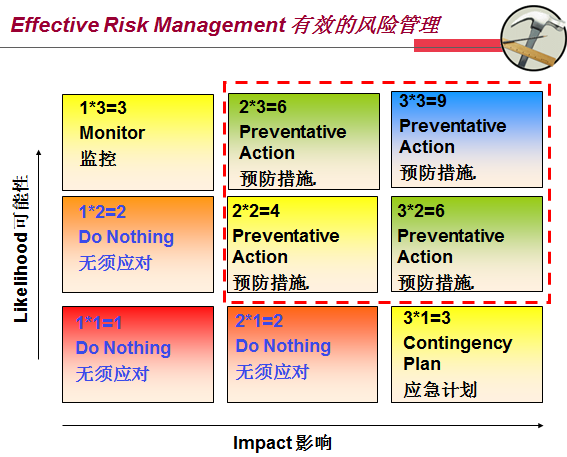
what's risk management about?(6 questions to explain)
★How to minimize risks in constrcution project
▶Choose the right delivery method.
▶Choose a proper contract type (Fixed-price contracts for budget overrun risks;Liquidated damages(违约金) for ensuring project functionality risks. The dilemma(进退两难) for the owner in choosing delivery methods is one of price versus performance.)
▶Monitor the entire process. (It can effectively prevent the tricks played by the contractor or the constructor, for example the risk of quality).
▶improve stakeholder management
Conclusion
Because no two projects are exactly alike, each project is facing different risks, so an owner has to choose the right delivery method and contract type to match the project. Each method has advantages and disadvantages. It is the owner's task to maximize each method and type's advantages and minimize the disadvantages. The best way to do this work is examine the project risks.
Reviewing questions(复习思考):
What is risk and how to assess and minimize the risks?

