目录

  • 1 建筑业 The Construction Industry
    • 1.1 本章纲要 Chapter Outline
    • 1.2 建筑业本质与特征 Industry essence and characteristics
    • 1.3 建筑业的分类 Industry sectors
    • 1.4 建筑业发展趋势 Trends in the industry
    • 1.5 建筑业道德规范 Construction ethics
  • 2 工程项目参与人 Project participants
    • 2.1 本章纲要 Chapter Outline
    • 2.2 业主方 Owners
    • 2.3 设计方 Design professionals
    • 2.4 建造方 Construction professionals
    • 2.5 其他参与方 Other participants
    • 2.6 参与方协同工具  BIM
    • 2.7 各方冲突管理 Conflict management
  • 3 项目的组织领导 Organizing and Leading project
    • 3.1 本章纲要 Chapter outline
    • 3.2 项目以及项目管理定义 Definition of project & PM
    • 3.3 项目管理相关术语 Basic PM terms
    • 3.4 项目领导艺术 Leadership
    • 3.5 项目沟通 Communication
    • 3.6 项目团队组建 Team assembling and building
    • 3.7 项目组织结构 Organizational structure
    • 3.8 合法的所有制形式 Legal forms of business ownership
  • 4 工程项目交付方式 Project Delivery Method
    • 4.1 本章纲要 Chapter Outline
    • 4.2 项目交付导言 Introduction
    • 4.3 项目交付方式类型 Project delivery method
    • 4.4 项目中的合同 Contract
    • 4.5 项目风险 Project risks
  • 5 项目生命周期 Project Chronology
    • 5.1 本章纲要 Chapter Outline
    • 5.2 项目发起、可行性、融资分析Initiation;Feasibility analysis;Financing
    • 5.3 项目设计、采购、建造Design, Procurment, Construction
    • 5.4 项目交付、运营、报废Turnover,Operation,Disposal
    • 5.5 项目管理生命周期 PM life cycle
  • 6 设计中建造相关服务 Construction Services during Design
    • 6.1 本章纲要 Chapter Outline
    • 6.2 建造相关服务引入背景Introduction
    • 6.3 服务之“可行性与可建造性分析”Feasibility ,Constructability analysis
    • 6.4 服务之“价值工程” Value engieering
    • 6.5 服务之“”建造干扰缓解” Construction mitigations
  • 7 项目投标与招标 Bidding and procurement
    • 7.1 本章纲要 Chapter Outline
    • 7.2 投标 Bidding
    • 7.3 工作分包 Work packages
    • 7.4 招标采购 Procurement
    • 7.5 招投标以及合同文档 Construction documents
  • 8 工程建造与收尾 Construction and Closeout
    • 8.1 本章纲要 Chapter Outline
    • 8.2 建造内容 Construction Activities
    • 8.3 建造效率 Construction productivity
    • 8.4 工程收尾 Construction Closeout
  • 9 项目成本估算 Estimating Project Costs
    • 9.1 本章纲要 Chapter Outline
    • 9.2 成本估算导言 Introduction
    • 9.3 成本估算类型 Types of estimates
    • 9.4 成本估算因素与常见问题 Estimate considerations and common problems
  • 10 项目进度计划 Project Scheduling
    • 10.1 本章纲要 Chapter outline
    • 10.2 进度计划的内涵  Essence of schedule
    • 10.3 进度计划编制流程  Scheduling Process
    • 10.4 进度计划编制方法 Scheduling Methods
  • 11 项目CTQ控制 Controlling Project Cost,Time and Quality
    • 11.1 本章纲要 Chapter Outline
    • 11.2 控制系统介绍 Project control system
    • 11.3 质量控制 Quality control
    • 11.4 成本、进度基线计划 Cost time Baselines
    • 11.5 成本、进度绩效模型 Cost and schedule performance models
    • 11.6 成本、进度联合的挣值分析 Earned Value Analysis
  • 12 现场以及远程管理 Job site and remote adminstrative management
    • 12.1 本章纲要 Chapter Outline
    • 12.2 现场管理Job site administrative management
    • 12.3 远程电子化管理 Remote electronic management
  • 13 工程安全与健康管理 Construction Safety and Health
    • 13.1 本章纲要 Chapter Outline
    • 13.2 工程安全与健康管理 Construction Safety and Health
    • 13.3 事故预防与处理 Accident Prevention and Programs
项目沟通 Communication

★Communication(沟通)

A discussion on the leadership would be incomplete without addressing the topic of communication—good, clear, honest communication. Leadership communication is distinct—it is up close and personal. Whether the message is inspirational, criticizing, or crisis driven, the form and the timing of the message are important. In fact, timing is everything. For real communication to occur, the message must be delivered and received. The receiver has to be in a frame of mind(一定的精神状态) to hear the message. Therefore, leaders must be very careful about when they transmit their message, particularly when it comes to communicating criticism. They must also be explicit(简洁) in the scope of their words. Not everyone needs to know the big picture, only what is pertinent(恰当的,相宜的) to do the job. Too much information can hide or distract the intended message. Timely and precise communication can correct a problem before it becomes serious.

Project managers spend 75%-90% of working time on communication. 

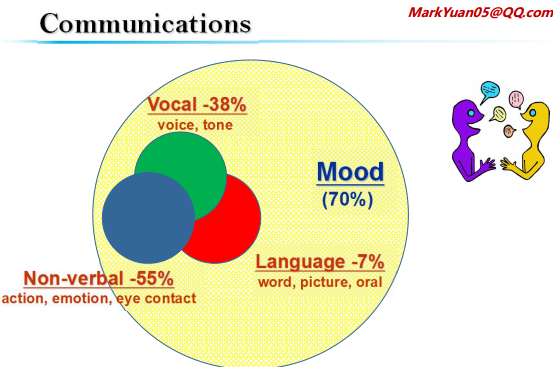
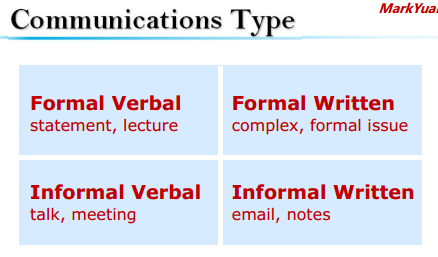
▷Communication forms(沟通形式)

Many forms of communication occur on project and within an organization.(verbal:口头的,语言的    written :书面的,文字的     vocal:音调的,发音的)
☛How to carry out effective written and oral communication.(如何开展有效的书面和口头交流)

1.written communication---being heard and understood


2.Oral communication ---being understood(被理解)

3.Oral communication ---be bold(大胆说出来)

▷Communication Loop(沟通环理论)

Whether the message is inspirational,  criticizing, the form(形式) and the timing(及时性)of the message are important. Generally speaking, communication contains three components: a source, symbols (to impart a message(承载信息) and receiver. The source could be the project leader; the symbols could be a written memo or a verbal announcement(书面备忘录或口头通知), and the receiver a subordinate(部属、下级).  
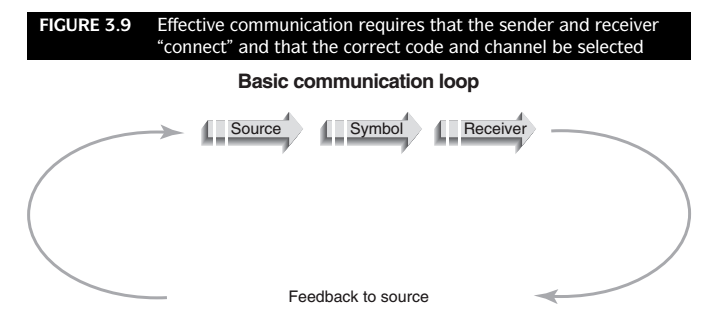
▶Source be explicit(明确)in the cope of their words. Be timely and precise to correct a problem before it becomes serious.

Symbol must consider the receivers background, experience and education. A written message sent to an audience that cannot read would be an ineffective method of communication. On the other hand, a message meant for one person that is announced in a group could do a lot of damage.

Receiver's obligation is to empathize(共情,同情), work with the sender, and try to connect and understand the message. Receivers need to indicate to the source that they understand the message. This will satisfactorily complete the transaction(交易).

工作环境中的交流


10个有效沟通的障碍因素


沟通的意义、原理以及方法

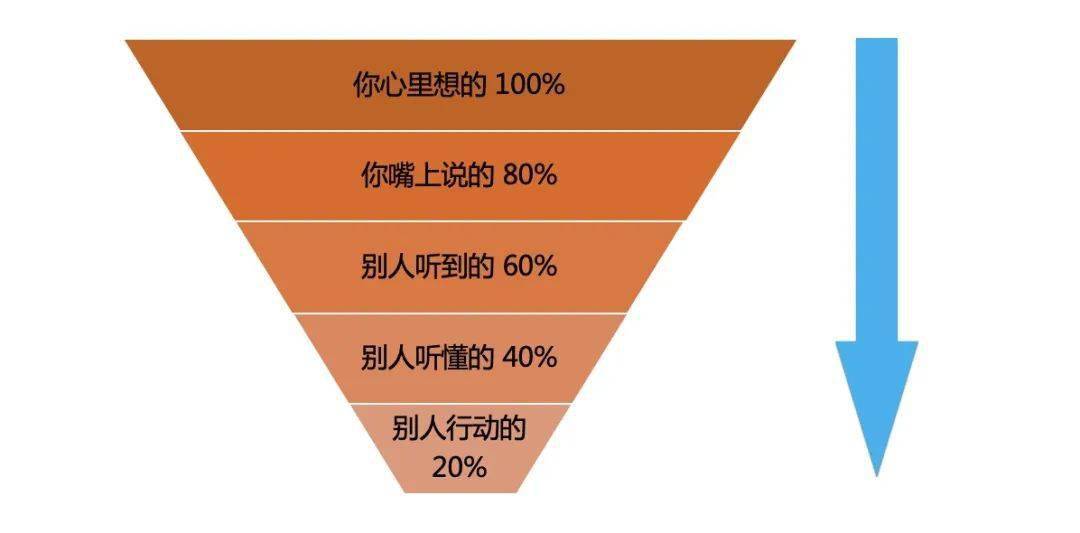
A interesting phenomeno  assocaited with communication  (一个有趣的沟通现象——漏斗效应)
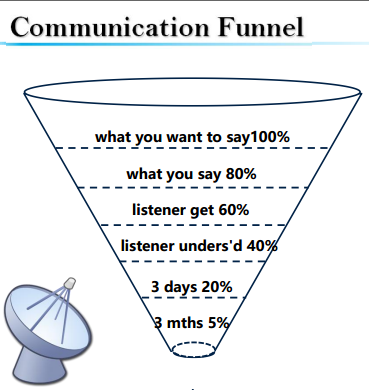
A joke: 一个黑人走进沙漠旅行,因为迷路而又累又渴,这时他发现了一盏阿拉丁神灯,擦了擦,一个精灵便出现了,精灵说:它在神灯里已被关了几千年了,今天黑人救了它,它要报答他,它可以满足黑人的一个要求,而且这个要求可以同时满足三个条件。 

    黑人想了想,便说:第一,因为肤黑老受歧视,他要变成白色的;第二,在沙漠太干渴了,他要有一辈子都喝不完的水;第三,他要每天能看见女人的臀部。

   精灵想都没想,把黑人变成了一个白色的抽水马桶。

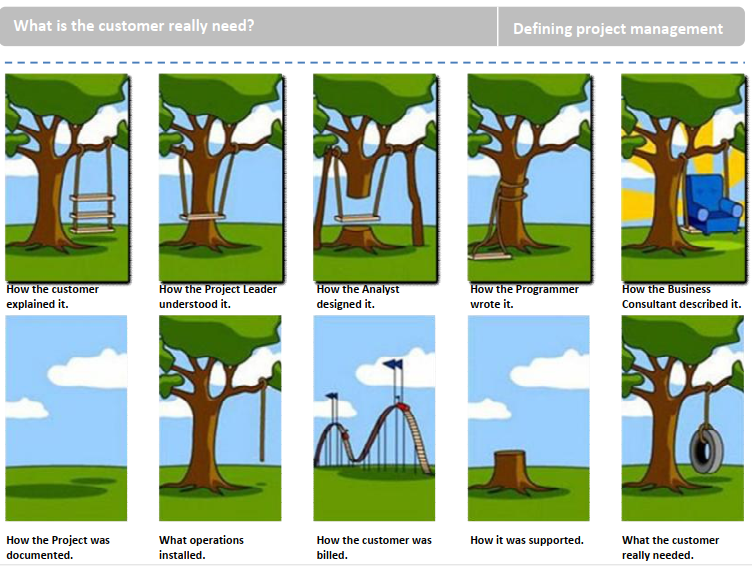
An example: