
Conflict management
★What's conflict?(什么是冲突)
——Conflict is a difference of ideas or opinions.
——An active disagreement between people(or groups) with opposing opinions or principles:
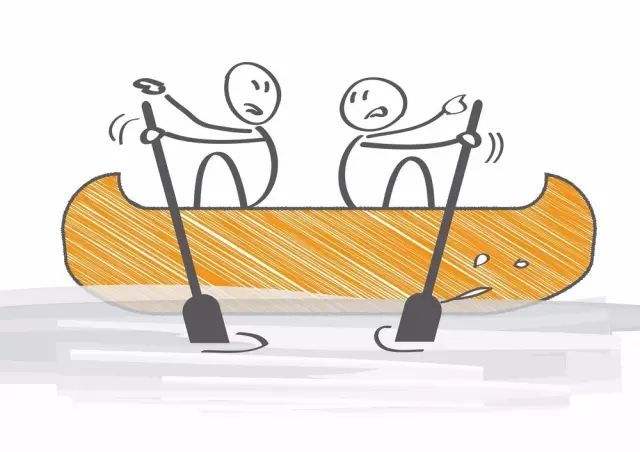
Conflict is a process that begins when you perceive(感知、认为) that someone has frustrated(挫败,使沮丧) or is about to frustrate a major concern of yours.In a team consisting of people from different backgrounds and with different skills and experience, it is likely that you will experience some form of conflict. Conflict can be either a positive or negative process for a team.With regard to conflict, we must keep two points in mind:
☀Conflict is a process, which is dynamic and evolving(冲突是一个动态演变的过程)
☀Conflict is everywhere(冲突无处不在)
★Three categories of conflict(冲突的三种类型)
▶Goal-oriented conflict is associated with disagreements regarding end results, project scope outcomes, performance specifications and criteria, project priorities and objectives; it often result from multiple perceptions of the project and are fueled by vague or incomplete goals that allow project team members to make their own interpretations(目标导向型冲突与最终结果、项目范围结果、绩效规范和标准、项目优先级和目标的分歧有关;它通常源于对项目的多种看法,并由模糊或不完整的目标推动,这些目标允许项目团队成员做出自己的解释)
▶Administrative conflict arises through management hierarchy, organizational structure, or company philosophy; these conflicts are often centered on disagreements about reporting relationships, who has authority and administrative control for functions, project tasks, and decisions(行政管理型冲突产生于管理层级、组织结构或公司理念;这些冲突通常集中在报告关系的分歧上,即谁对职能、项目任务和决策拥有权力和行政控制权)
▶Interpersonal conflict occurs with personality differences between project team members and important project stakeholders; its sources include different work ethics, behavioral styles, egos, and personalities of project team members(人际关系型冲突起源于项目团队成员与重要项目利益相关者之间的性格差异;其来源包括不同的工作道德、行为风格、自我和项目团队成员的个性)
★Three views of conflict(冲突的三种观点)
▶Traditionalists see conflicts as having negative effect on organizations; the conflict should be avoided and resolved as quickly and painlessly as possible when it does occur.They encourage conflict suppression and elimination(传统主义者 认为冲突对组织会产生负面影响;应尽可能避免冲突,当冲突确实发生了,则应尽可能迅速、无痛地避免和解决冲突。他们鼓励制止和消除冲突)
▶Behavioral theorists view conflict as a natural and inevitable part of organization life; their solution to conflict is to manage conflict effectively rather than attempt to eliminate or suppress it (行为理论学者将冲突视为组织生活自然和不可避免的一部分;解决冲突的办法是有效地管理冲突,而不是试图消除或压制冲突 )
▶Interactionists encourage conflict to develop; conflict actually introduces an element of tension that produces innovation, creativity, and higher productivity; there is an optimal level of conflict that improves the organization, too little leads to inertia and too much leads to chaos,we need to find the optimal level of conflict(互动主义者鼓励冲突发展;冲突实际上引入了一种紧张因素,这种因素能带来创新、创造力和更高的生产力;有一个可以改善组织的最佳冲突水平。太少会导致惰性,太多会导致混乱,我们要找到那个最佳的水平点)
★Sources of Conflict(冲突的来源)
1. Organizational causes of conflict (冲突的组织性原因)
The most common causes of organizational conflict are reward systems, scarce sources, uncertainty, and differentiation (组织冲突最常见的原因是奖励制度、资源稀缺、不确定性和差异性)
▷Reward systems are competitive processes some organizations have set up that pit one group or functional department against another(奖励系统是一些组织设置的竞争过程,它让一个团队或职能部门与另一个团队或职能部门开展竞争)
▷Scare resources are a natural cause of conflict as individuals and departments compete for the resources they believe are necessary to do their jobs well(资源稀缺是冲突的自然原因,因为个人和部门都会争夺他们认为做好工作所必需的资源)
▷Uncertainty over lines of authority essentially asks the tongue-in-cheek question, “who’s in charge around here?”(权力的不确定性本质上是在问一个开玩笑的问题:“这里谁负责?” )
▷Differentiation reflects the fact that different functional departments develop their own mind sets, attitudes, time frames, and value systems, which can conflict with those of other departments (差异化反映了一个事实,即不同的职能部门会发展出自己的思维方式、态度、时间框架以及价值体系,这可能与其他部门的思维方式、态度、时间框架和价值体系相冲突)
2. Interpersonal causes of conflict (冲突的人际关系原因)
People look at the world and make decisions about things in very different ways.
▷Faulty attributions refer to our misconceptions of the reasons behind another’s behavior(错误的归因指的是我们误解他人行为背后的原因)
▷Faulty communication is a second and very common interpersonal cause of conflict; it implies the potential for two mistakes: communicating in ways that are ambiguous and lead to different interpretations and unintentionally communicating in ways that annoy other parties(错误的沟通是第二个也是非常常见的人际冲突原因;沟通错误包含两层意思:一种是以模棱两可的方式沟通从而导致不同解释,第二种是无意中以恼人的方式进行沟通,从而激怒其他方)
▷Personal grudges and prejudices are another main cause of interpersonal conflict; each of us brings attitudes into any work situation(个人恩怨和偏见是人际冲突的另一个主要原因;我们每个人都会将态度带入任何的工作环境中)

冲突的冰山现象:冲突表象及其根源就像一座漂浮在水面上的巨大冰山,能够被外界看到的行为表现或应对方式,只是露在水面上很小的一部分,大约只有八分之一露出水面,另外的八分之七藏在水底。而暗涌在水面之下更大的山体,则是长期压抑并被我们忽略的“内在”。揭开冰山的秘密,我们会看到生命中的渴望、期待、观点和感受,看到真正的自我。
★ts that occur continually within a project
——from conflicting parties perspective(从冲突当事人的视角)
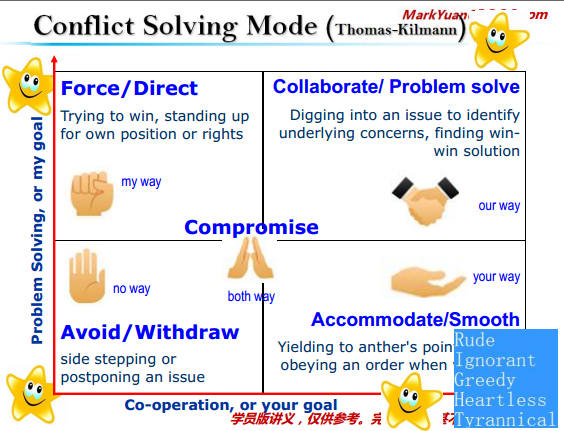
冲突管理的“托马斯—基尔曼”模型:
对于当事人而言,如何处理冲突,通常有五种选择,竞争(Force-my way)、退让()、回避(Aviod-no way)、妥协(Compromise-both way)和合作(Collaborate-our way)。
用一个橘子故事来简单解释一下这5种解决冲突的区别。比如现在有一个橘子,你想要,我也想要。如果我不管不顾,抢先把橘子抢到,这是“竞争”方式;如果我考虑到你更需要这个橘子,故而把橘子让给你,这是“退让”;我们都不想争,大家都不要这个橘子,这是“回避”;如果我们把橘子掰开,一人一半,这是“妥协”;如果我们能坐下来共同探讨为什么想要这个橘子,原来我要吃橘子肉,你要的是橘子皮做糕点,这样我们两个人的需求都得到满足,这种方式就是“合作”。
冲突管理中退让(Accommodate-your way)策略背后的法则:
1.垃圾车法则:
美国心理学家大卫·波莱:“许多人就像垃圾车,他们装满了垃圾四处奔走,充满懊恼、愤怒、失望的情绪,随着垃圾越堆越高,他们就需要找地儿倾倒,如果你给他们机会,他们就会把垃圾一股脑儿倾倒在你身上。 所以,有人想要这么做的时候,千万不要收下。只要微笑,挥挥手,祝他们好,然后继续走你的路”。你的时间和精力都是成本,聪明人不会为了不值得的烂人烂事而消耗自己。轻则容易被影响了好几天的心情,重则被严重影响了学习和工作,甚至自己也被同化,掉进戾气的深渊无法自拔。
2.费斯汀格法则:
美国社会心理学家费斯汀格(Festinger):生活中的10%是由发生在你身上的事情组成,而另外的90%则是由你对所发生的事情如何反应所决定。换言之,生活中有10%的事情是我们无法掌控的,而另外的90%却是我们能掌控的。为了更好的理解该法则,可以看看这样一个故事。
一只骆驼在沙漠里艰难跋涉着,突然,脚掌被一块玻璃碎片划了一下。骆驼顿时气不打一处来,一脚就把玻璃碎片踢得老远。却不小心把自己的脚掌又划了道深深的口子,鲜血一下子染红了沙粒。骆驼忍着剧痛继续行走,没想到脚掌上的血腥味引来了几只秃鹫,跟着骆驼在上空盘旋。骆驼非常生气,拼命奔跑起来,试图甩开那群秃鹫,没想到越跑伤口流的血越多。浓浓的血腥味,又招来了正在附近觅食的两头狼。骆驼更仓惶地奔跑,甩开了狼,没想到又招来了食人蚁。黑压压一片的食人蚁把骆驼包围得严严实实,精疲力尽的骆驼再也跑不动了。临死前,它特别懊恼,为什么自己会因为一块小小的玻璃碎片,而搭上了性命。很多时候,我们不也和这头骆驼一样,满心满眼都是和一些琐碎的烂人烂事较劲,不会理性地控制自己的情绪。然而,你越是纠缠,事情就会越来越糟,甚至会引发一系列更糟糕的事。事实上,我们的时间太少,好玩的事儿又太多,从尊重生命的角度,不必去生气纠缠。远离剪不断理还乱的烂人烂事,不是怯懦,而是一种大智慧,是为真正有意义的事情腾出时间和空间。
管理冲突的四点建议
★Conflict between construction project participants
While designers focus on functionality(功能性), aesthetics and innovative use of materials, owners are additionally concerned about the durability of the design, storage and availability of materials, simplicity of operation(易操作性), and ease of maintenance. While constructors are concerned with maintaining the schedule and budget through efficient methods of assembling and improved management techniques, owners are additionally concerned about a turnover process and a smooth startup transition. So sometimes the differences of their concern and their narrowness(狭隘性) can put them at odds(意见相左,不和), the only solution is good communication and incorporation(结合) of different interests.
These conflicts are often at the heart of construction disputes. Most disputes arise when the owner delegates(授权) its responsibility for management and/or coordination to the designer, construction manager or contractor. This can be a big mistake if problems arise that present a conflict of interest. That is why owners need to retain control of the process.
In “conventional”(常规的,传统的) construction, the owner hires a designer to design the facility and represent their interests through the construction process. This presents a potential conflict of interest, because the designer’s plans are not perfect. Problems arise and decisions must be made regarding financial responsibility for these problems. The designer must determine responsibility for the problem, as well as defend its design, which presents a conflict of interest.
Conclusion
Many kinds of professionals get involved in construction.Each of them is equipped with certain skills and experience. From apprentice carpenters(学徒木匠) to company executives(公司总裁), the one thing they share is their passion for construction.The building industry is a harsh(残酷的)one: risks are high, working conditions are often tough, conflicts arise from time to time, so the interaction among the people on the job can determine whether the project succeeds or fails.
Reviewing questions(复习思考):
1. Read the following story,and talk about: Who participated in the shaping of the building, What kind of construction goal is worth pursuing(追求)? what conflicts existed in the design process and how to resolve them?
2. Just tell a story about how you solve a conflict between your classmates.

