A general guide on how to conduct and write a literature review.
What is a literature review?
A literature review is a piece of academic writing demonstrating knowledge and understanding of the academic literature on a specific topic placed in context. A literature review also includes a critical evaluation of the material; this is why it is called a literature review rather than a literature report. It is a process of reviewing the literature, as well as a form of writing.
To illustrate the difference between reporting and reviewing, think about television or film review articles. These articles include content such as a brief synopsis or the key points of the film or programme plus the critic’s own evaluation. Similarly the two main objectives of a literature review are firstly the content covering existing research, theories and evidence, and secondly your own critical evaluation and discussion of this content.
Usually a literature review forms a section or part of a dissertation, research project or long essay. However, it can also be set and assessed as a standalone piece of work.
What is the purpose of a literature review?
…your task is to build an argument, not a library.
In a larger piece of written work, such as a dissertation or project, a literature review is usually one of the first tasks carried out after deciding on a topic. Reading combined with critical analysis can help to refine a topic and frame research questions. Conducting a literature review establishes your familiarity with and understanding of current research in a particular field before carrying out a new investigation. After doing a literature review, you should know what research has already been done and be able to identify what is unknown within your topic.
When doing and writing a literature review, it is good practice to:
summarise and analyse previous research and theories;
identify areas of controversy and contested claims;
highlight any gaps that may exist in research to date.
Conducting a literature review
Focusing on different aspects of your literature review can be useful to help plan, develop, refine and write it. You can use and adapt the prompt questions in our worksheet below at different points in the process of researching and writing your review. These are suggestions to get you thinking and writing.
How to Write a Literature Review | Guide, Examples, & Templates
Published on February 22, 2019 by Shona McCombes. Revised on September 14, 2022.
What is a literature review? A literature review is a survey of scholarly sources on a specific topic. It provides an overview of current knowledge, allowing you to identify relevant theories, methods, and gaps in the existing research.
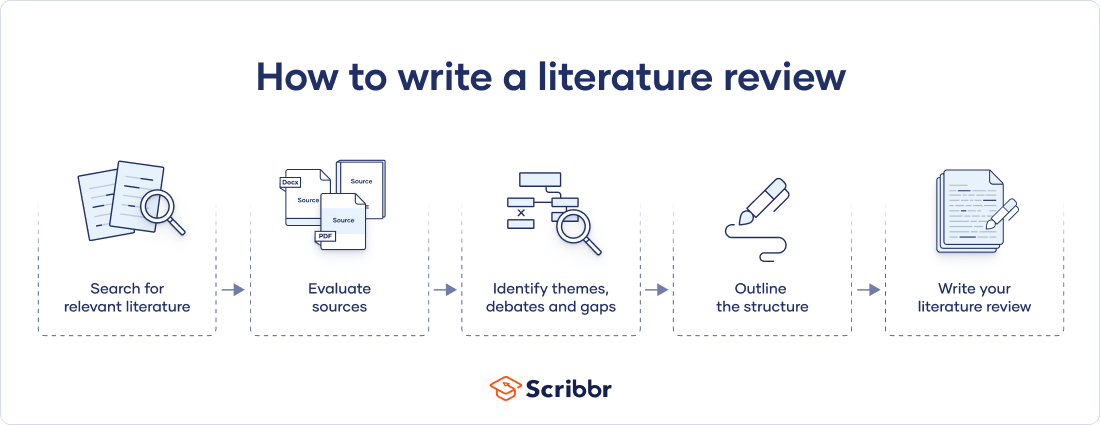
There are five key steps to writing a literature review:
A good literature review doesn’t just summarize sources—it analyzes, synthesizes, and critically evaluates to give a clear picture of the state of knowledge on the subject.
When you write a thesis, dissertation, or research paper, you will likely have to conduct a literature review to situate your research within existing knowledge. The literature review gives you a chance to:
Demonstrate your familiarity with the topic and its scholarly context
Position your work in relation to other researchers and theorists
Show how your research addresses a gap or contributes to a debate
Evaluate the current state of research and demonstrate your knowledge of the scholarly debates around your topic.
Writing literature reviews is a particularly important skill if you want to apply for graduate school or pursue a career in research. We’ve written a step-by-step guide that you can follow below.
Examples of literature reviews
Writing literature reviews can be quite challenging! A good starting point could be to look at some examples, depending on what kind of literature review you’d like to write.
You can also check out our templates with literature review examples and sample outlines at the links below.
Step 1 – Search for relevant literature
Before you begin searching for literature, you need a clearly defined topic.
If you are writing the literature review section of a dissertation or research paper, you will search for literature related to your research problem and questions.
Literature review research question exampleWhat is the impact of social media on body image among Generation Z?
Make a list of keywords
Start by creating a list of keywords related to your research question. Include each of the key concepts or variables you’re interested in, and list any synonyms and related terms. You can add to this list as you discover new keywords in the process of your literature search.
Keywords example
Social media, Facebook, Instagram, Twitter, Snapchat, TikTok
Body image, self-perception, self-esteem, mental health
Generation Z, teenagers, adolescents, youth
Search for relevant sources
Use your keywords to begin searching for sources. Some useful databases to search for journals and articles include:
Make sure to read the abstract to find out whether an article is relevant to your question. When you find a useful book or article, you can check the bibliography to find other relevant sources.
Step 2 – Evaluate and select sources
You likely won’t be able to read absolutely everything that has been written on your topic, so it will be necessary to evaluate which sources are most relevant to your research question.
For each publication, ask yourself:
What question or problem is the author addressing?
What are the key concepts and how are they defined?
What are the key theories, models, and methods?
Does the research use established frameworks or take an innovative approach?
What are the results and conclusions of the study?
How does the publication relate to other literature in the field? Does it confirm, add to, or challenge established knowledge?
What are the strengths and weaknesses of the research?
Make sure the sources you use are credible, and make sure you read any landmark studies and major theories in your field of research.
You can use our template to summarize and evaluate sources you’re thinking about using. Click on either button below to download.
As you read, you should also begin the writing process. Take notes that you can later incorporate into the text of your literature review.
It is important to keep track of your sources with citations to avoid plagiarism. It can be helpful to make an annotated bibliography, where you compile full citation information and write a paragraph of summary and analysis for each source. This helps you remember what you read and saves time later in the process.
To begin organizing your literature review’s argument and structure, be sure you understand the connections and relationships between the sources you’ve read. Based on your reading and notes, you can look for:
Trends and patterns (in theory, method or results): do certain approaches become more or less popular over time?
Themes: what questions or concepts recur across the literature?
Debates, conflicts and contradictions: where do sources disagree?
Pivotal publications: are there any influential theories or studies that changed the direction of the field?
Gaps: what is missing from the literature? Are there weaknesses that need to be addressed?
This step will help you work out the structure of your literature review and (if applicable) show how your own research will contribute to existing knowledge.
Example of trends and gapsIn reviewing the literature on social media and body image, you note that:
Most research has focused on young women.
There is an increasing interest in the visual aspects of social media.
But there is still a lack of robust research on highly visual platforms like Instagram and Snapchat—this is a gap that you could address in your own research.
Step 4 – Outline your literature review’s structure
There are various approaches to organizing the body of a literature review. Depending on the length of your literature review, you can combine several of these strategies (for example, your overall structure might be thematic, but each theme is discussed chronologically).
Chronological
The simplest approach is to trace the development of the topic over time. However, if you choose this strategy, be careful to avoid simply listing and summarizing sources in order.
Try to analyze patterns, turning points and key debates that have shaped the direction of the field. Give your interpretation of how and why certain developments occurred.
Thematic
If you have found some recurring central themes, you can organize your literature review into subsections that address different aspects of the topic.
For example, if you are reviewing literature about inequalities in migrant health outcomes, key themes might include healthcare policy, language barriers, cultural attitudes, legal status, and economic access.
Methodological
If you draw your sources from different disciplines or fields that use a variety of research methods, you might want to compare the results and conclusions that emerge from different approaches. For example:
Discuss how the topic has been approached by empirical versus theoretical scholarship
Divide the literature into sociological, historical, and cultural sources
Theoretical
A literature review is often the foundation for a theoretical framework. You can use it to discuss various theories, models, and definitions of key concepts.
You might argue for the relevance of a specific theoretical approach, or combine various theoretical concepts to create a framework for your research.
Like any other academic text, your literature review should have an introduction, a main body, and a conclusion. What you include in each depends on the objective of your literature review.
Introduction
The introduction should clearly establish the focus and purpose of the literature review.
TipIf you are writing the literature review as part of your dissertation or thesis, reiterate your central problem or research question and give a brief summary of the scholarly context. You can emphasize the timeliness of the topic (“many recent studies have focused on the problem of x”) or highlight a gap in the literature (“while there has been much research on x, few researchers have taken y into consideration”).
Body
Depending on the length of your literature review, you might want to divide the body into subsections. You can use a subheading for each theme, time period, or methodological approach.
As you write, you can follow these tips:
Summarize and synthesize: give an overview of the main points of each source and combine them into a coherent whole
Analyze and interpret: don’t just paraphrase other researchers—add your own interpretations where possible, discussing the significance of findings in relation to the literature as a whole
Critically evaluate: mention the strengths and weaknesses of your sources
Write in well-structured paragraphs: use transition words and topic sentences to draw connections, comparisons and contrasts
Conclusion
In the conclusion, you should summarize the key findings you have taken from the literature and emphasize their significance.
TipBe sure to show how your research addresses gaps and contributes new knowledge, or discuss how you have drawn on existing theories and methods to build a framework for your research.