-
1 Reading
-
2 Translation
The Web is being expanded all the time and is able to supply an almost limitless amount of information on most subjects. Apart from offering a great deal of information, the Web is also fast and convenient to use. Today we have many different devices which are capable of connecting to the Internet and displaying information, even when you are on the move. The Web, then, can provide a convenient means of accessing information and has become greatly valued by students. If a student has Internet access, then there is no need for him/her to go to a library to search for information. This not only saves a great deal of time but also eliminates transportation costs. It is probably true to say that students have more time than many working people to browse the Web, and they have the added motivation that information found on it may be able to help them complete assignments.
Background Information:
The Text: Checking Is Believing
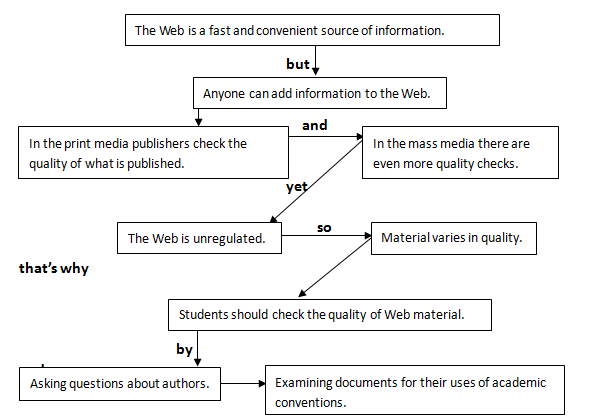
The text basically advises students to check the information they find on the Web for its quality, otherwise they may be misled into using wrong or inadequate information. The argument of the text may be easier to see as a flow chart. The following chart shows the structure of the “final” text after students have completed the Developing Your Skills section. As a key visual, this can be used to illustrate the overall argument of the text. It can also be used for a revision activity by getting students to verbalize the main ideas (using the key visual only and not looking at the text).
This freedom is, of course, in sharp contrast to traditional media. Publishing companies, for example, can be very selective about their authors. Such companies have high standards and will only publish a book if the author is well qualified and experienced in the subject area. Publishers get other experts to review a book before it is printed and further improvements to the book are made by editors and book designers employed by the publishing companies. Editors frequently make suggestions to make the book longer or shorter and to improve the author’s use of language to make the writing clearer and more easily comprehensible to readers. Designers handle the layout of a book, including the cover, photographs and other graphics and even the font type and style of the text.
Key Words:
review: the process of studying or examining a situation, policy or idea again in order to decide whether it is satisfactory or suitable
comprehensible: able to be understood
Few such restrictions apply to the Web. It is an unregulated medium at every level. There are no bosses deciding who will get published, no reviewers to check the reliability of information, no editors or designers to improve the way it is written or presented and few enforceable laws or government regulations to check the acceptability of the information or to make authors accountable for their material. The Web therefore lacks the quality assurance controls which operate in most media and which help the public to trust what they view, read and hear. The results of this lack of quality control are easy to see. The Web is littered with sites which would be illegal if presented by the more traditional media. The Web allows people to publish their opinions, even if these are unfounded and use discrimination.
Key Word:
discrimination: unfair treatment of someone because of their religion, race, or other personal features
TV, video and radio companies work under even stricter regulations than publishing companies. The law controls the content of their programmes in order to limit the amount of bias (sexual, racial and political) listeners and viewers are exposed to. Strict legal limitations are also placed on the amount of sex and violence in programmes. The language used in such programmes is also carefully controlled so that the audience is not offended by excessive bad language. Where doubt exists about a programme, the company responsible for broadcasting the programme will get lawyers to check that the content and language used in the film do not break any laws.
Key Words:
strict: having definite rules that people are expected to obey completely
bias: an attitude that you have that makes you treat someone in a way that is unfair or different from the way you treat other people
It is clear, then, that students who wish to use the Web as a source of information to help them complete assignments will need to be cautious about using material found on it. It is important to check whether a site has been created and registered by a recognized body such as a university or a publisher or whether it has been created by an individual, i.e. a private Net account holder. Look for the organization’s logo or a structure chart showing its various departments and offices, its mission statement, and also for some information on its history and its plans for the future. In other words, check for the features that you would expect to find on an official and professionally produced website.
This is not to say that sites produced by individuals are all unreliable — far from it — some are excellent. Some very highly respected professors and authors of academic textbooks have their own websites and these are valuable and trustworthy sources of information. But if an author of a website fails to provide a means for browsers to make contact or has forgotten to put up his/her affiliations and some biodata giving their qualifications and experience, then he or she is just asking to be treated with suspicion.
Biodata, information on the qualifications and experience of an author, is very helpful for students checking the reliability of a site. Look at the author’s affiliations and career record. Look carefully, too, at his/her qualifications, research record and publications. Then ask yourself questions: which university does he or she currently work in and for how long? Is the university recognized and respected? Does the author have a substantial number of years of experience in the subject area? Does the author have a PhD (some excellent researchers don’t, but nevertheless possession of a doctorate is an encouraging sign when we’re checking a person’s credibility)? Has the author been involved in research projects and has he/she published articles in journals and academic books with reputable publishers? Be critical and ask questions.
Students may find that no email address is given on a site. If this is the case, carry out name searches via online catalogues of publications to try to find out whether the author is recognized or published in the subject area you are interested in. If an email address is provided, look at it carefully. Does it appear to be a personal rather than organizational address? If you are still in doubt, you could email the author of the pages directly and ask them about their work. But do this politely so that he or she provides evidence of possessing appropriate qualifications and experience to write with authority on the topic in question. Show interest in the topic — this may even help you to start a very useful correspondence with the author. You can then start building up a list of contacts and start your career in what’s known as electronic networking!
Another way you can check Web information is to examine carefully the document itself. Carry out the examination very carefully and look for the conventions academic authors follow when they write. Conventions include the use of up-to-date references to other authors and bibliographies for the convenience of interested readers. Academic writers also use footnotes or endnotes to add detail to what they have written. The tone of their writing is likely to be objective and impersonal and the style is likely to be quite formal. Finally, respectable Web contributors will show that they know a great deal of background information on a topic and will also show familiarity with modern research methods in their fields of study.
The Web has provided all of us with limitless, convenient and cheap access to vast amounts of information but the quality and reliability of the information must be checked and this means that the student needs to be his or her own quality control mechanism.