目录

  • 1 introduction
    • 1.1 course introduction
  • 2 freight forwarding industry
    • 2.1 highlight and Outline
    • 2.2 Text
    • 2.3 part A:Relevant Organizations
      • 2.3.1 FIATA
      • 2.3.2 CIFA and IATA
      • 2.3.3 IMO WTO & ICC
      • 2.3.4 Others
    • 2.4 part B: Services Scope
      • 2.4.1 on hehalf of the consignor(exporter)
      • 2.4.2 on behalf of the consignee(importer)
      • 2.4.3 other services
    • 2.5 talking about forwarding business
  • 3 international Trade
    • 3.1 highlight and outline
    • 3.2 Part A: Introduction to international trade
      • 3.2.1 part one
      • 3.2.2 part two
    • 3.3 Part B: INCOTERMS@2010
      • 3.3.1 Introduction
      • 3.3.2 term for any mode or modes of transport
      • 3.3.3 terms for sea and inland waterway transport
    • 3.4 Part C Letter of Credit
      • 3.4.1 letter of credit-definition
      • 3.4.2 procedure of L/C operation
      • 3.4.3 UCP600
  • 4 Formalities for import and export cargo
    • 4.1 highlight and outline
    • 4.2 Part A Customs Clearance
    • 4.3 Part B Inspection and Quarntine
    • 4.4 Talking about Customs Clearance
  • 5 Marine Cargo Insurance
    • 5.1 hignlight and outline
    • 5.2 Part A Principles of Marine Cargo Insurance
    • 5.3 Part B Ocean Marine Cargo Clauses
    • 5.4 Talking about Marine Cargo Insurance
  • 6 Marine Cargo Transportation
    • 6.1 highlight and outline
    • 6.2 Container Liner Shipping
    • 6.3 Marine Bills of Lading
    • 6.4 Part B Chartering
    • 6.5 Talking about Marine Cargo Transportation
  • 7 Air Cargo Transport
    • 7.1 highlight and outline
    • 7.2 Part A Air Cargo Charges
    • 7.3 Part A Rates and Waybill
    • 7.4 Part B C onsolidation
  • 8 Land Freight Transport
    • 8.1 highlight and outline
    • 8.2 Part A Rail Freight Transport
    • 8.3 Part B Road Transport of Goods
    • 8.4 Talking about Land Freight Transport
  • 9 Multimodal Transport
    • 9.1 highlight and outline
    • 9.2 Part A International Multimodal Transport
    • 9.3 Part B Container Transport
  • 10 Supply Chain Management and Logistics
    • 10.1 highlight and outline
    • 10.2 Part A Supply Chain Mangement
    • 10.3 Part B Logistics
    • 10.4 how to write a business letter
Talking about Marine Cargo Transportation
  • 1 课堂对话
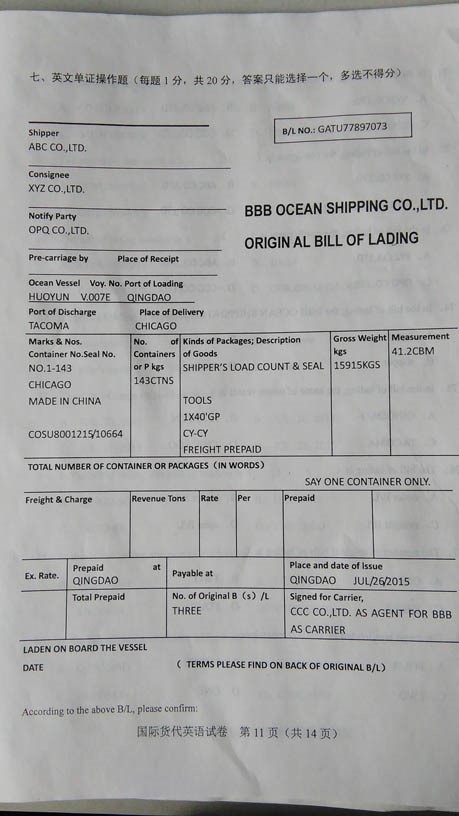
  • 2 认识单证
  • 3 拓展学习

Dialogue: Talking about Marine CargoTransportation


Situation:The shipper(the exporter) has oneconsignment of cargo (1×40’GP, one box/unit of 40’GP)to be transported from Qingdao to Rotterdam.He is consulting with the freight forwarder about marine cargo transportation.

A-The shipper(the exporter)   B-The freight forwarder

A: HELLO, Mr. B, I have something to consultwith you about marine cargo transportation.

B: HELLO, this is B speaking. We can arrange shipments to any port ofthe world. Please.

A: The cargo is toys loaded in one 40’GP, which mode oftransportation of this cargo is the best?

B: OK. How do you usually move your cargo?

A: Usually, it is cheaper to have thecargo sent by sea than by railway.

B: Yes, we propose to have the 40’GPcontainer dispatched by sea. The containerbooking space must be reserved, please send us thebooking notes.

A: OK, I will fax you. Please quote me yourbest offer(报价) for 1×40’GP ex(经,由) Qingdao to Rotterdam. Cargo will be ready, commodity is toys andcargo weight is 18200KGS. Please also advise thecarrier, ETD(EstimatedTime of Departure预计离港时间)Qingdao and Transit time(航行时间).

ETD= Estimated Time of Departure,预计离港时间,通常接起运港

ETA= Estimated Time of Arrival, 预计到港时间,通常接卸货港(目的港)


B: I have three choices for you: ABC shipping company, USD2300 ETD Qingdao Friday, 31 days. /BCD shipping company, USD2250 ETD Qingdao Tuesday, 31days. /CDE shipping company, USD2350 ETD Qingdao Thursday, 29 days.

A: Thanks, we accept the BCD shipping company.

B: That’s all right.