
目录

  • 1 第一课时
    • 1.1 Course Objectives
    • 1.2 Reading Research Articles
      • 1.2.1 Reading titles for prediction
    • 1.3 Writing Research Articles
      • 1.3.1 Writing a working title
        • 1.3.1.1 Understanding the characteristics of a research article
        • 1.3.1.2 Components of a title
        • 1.3.1.3 Titles in 4 grammatical constructions
        • 1.3.1.4 Writing techniques
    • 1.4 Literature Retrieval (文献检索)
    • 1.5 Keywords
  • 2 Abstract
    • 2.1 Reading the abstract
      • 2.1.1 Lingusitics features of Abstract
        • 2.1.1.1 Tense
        • 2.1.1.2 Formality
    • 2.2 Writing an abstract (P217)
  • 3 Introduction
    • 3.1 Reading the introduction
    • 3.2 Writing the introduction
      • 3.2.1 Writing the initial sentences in the introduction
      • 3.2.2 Expressing the objective or purpose
      • 3.2.3 Turning the research question into the objective
      • 3.2.4 Indicating the gap to be filled
      • 3.2.5 Postulating the hypothesis
    • 3.3 Bridging Course (衔接课程为自主学习部分)
      • 3.3.1 Vocabulary
      • 3.3.2 Paraphrase
      • 3.3.3 Listening comprehension
  • 4 Literature review
    • 4.1 Literature review
    • 4.2 Listening strategy
      • 4.2.1 Identify different structures of the body part in the lecture
      • 4.2.2 Identify the conclusion of the lecture
    • 4.3 Bridging courses
      • 4.3.1 Grammar
    • 4.4 Compilation of literature (如何整理文献)
  • 5 Methods section
    • 5.1 Writing methods section
  • 6 Results section
    • 6.1 Writing results section
  • 7 Discussion and conclusion
    • 7.1 Writing discussion section
  • 8 Lingusitic features of academic articles
    • 8.1 Nominalization
    • 8.2 The use of single , formal verbs (P188)
    • 8.3 Impersonal structure (passive strucuture) (P187)
    • 8.4 Premodification (前置限定语)
    • 8.5 Hedging expressions.(definition 定义))
      • 8.5.1 Types of hedging expressions (类别)
    • 8.6 Impersonal structure
  • 9 Academic skills
    • 9.1 Paraphrase (转述)
      • 9.1.1 Strategy (转述方法)
    • 9.2 Definition
      • 9.2.1 Definition :  Flipped classroom model  (翻转课堂模式)
    • 9.3 Summary
      • 9.3.1 Identifying the main ideas  and topic sentences
      • 9.3.2 Writing a summary
        • 9.3.2.1 Writing Strategy
    • 9.4 Synthesizing(P138)
      • 9.4.1 Summary and Synthesis
        • 9.4.1.1 Refutation of an argument  (批驳类作文写法)
    • 9.5 Citation
      • 9.5.1 Citation
        • 9.5.1.1 Citation types
        • 9.5.1.2 Citation methods
          • 9.5.1.2.1 Quotations
          • 9.5.1.2.2 Summarizing
          • 9.5.1.2.3 Paraphrasing
        • 9.5.1.3 Citation function
        • 9.5.1.4 Verbs used to report past studies
  • 10 Academic integrity
    • 10.1 How to avoid plagiarism
  • 11 Academic Listening
    • 11.1 Listening strategy1
      • 11.1.1 Identifying the topic of a lecture
        • 11.1.1.1 Watch the video clip and do the following comprehensive exercise
      • 11.1.2 Listening strategy2
        • 11.1.2.1 Identify the signal language (textbook p80))
        • 11.1.2.2 Identifying the type of introduction.
        • 11.1.2.3 Understanding definition
  • 12 Academic lecture
    • 12.1 Oral presentation
      • 12.1.1 Paying attention to the introduction.
        • 12.1.1.1 How to open a presentation(textbook p76)这不是任务点不用做,对演讲展示感兴趣的同学可以看,不感兴趣可以不用看
  • 13 Review
    • 13.1 Review
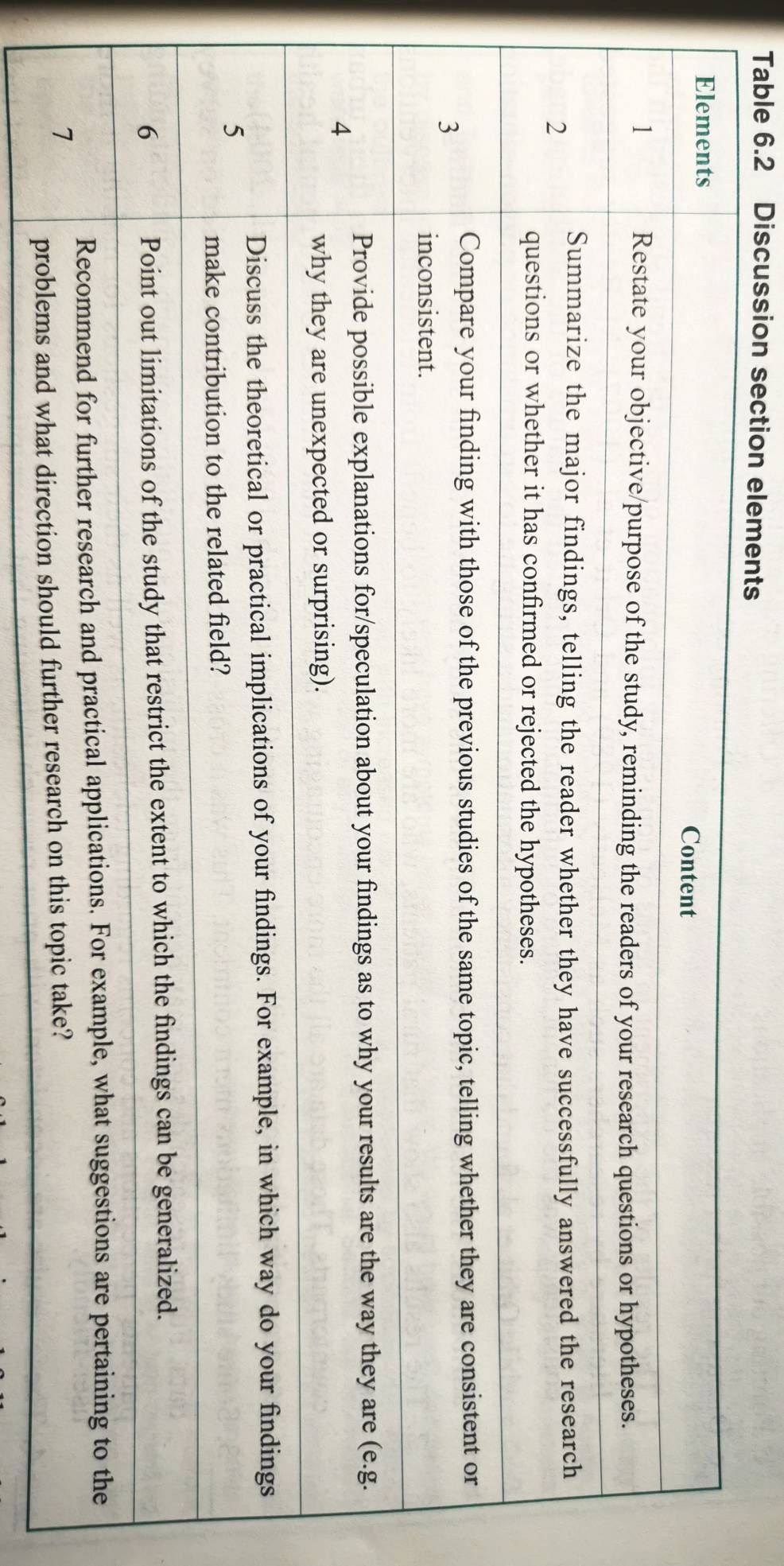
Writing discussion section


Example : 

①I hypothesized that the participants would be most likely to cheat in the 20 dollar reward group.②However, I did not find a significant difference between the different reward levels, which could either mean that the type of reward did not affect the likelihood of cheating or that the sample size was not large enough to yield significant results. 

③The pattern that emerged between participants' self-reports of cheating behaviors and their dishonesty ratings revealed that participants were willing to say that behaviors in which they had not engaged were "extremely wrong, 'but behaviors in which they had engaged were rated as “not wrong" or "somewhat wrong."④ It could be that the participants were trying to justify their behaviors by saying that they only engaged in the more acceptable types of cheating and never took part in anything that was really dishonest.

  ⑤ Participants who cheated on the puzzle task also had higher self-efficacy scores, which means that they feel like they have more control over their success.⑥ Perhaps participants who have higher levels of self-efficacy are more confident that they will succeed. (7)The puzzle task in this experiment, however, was designed so that the participants could not successfully solve all of the puzzles without cheating.⑧ Refusing to fail such a simple task, they decided cheating was an acceptable tactic for success.

⑨ This study contained only 34 participants, hence it is important to note that all of these findings should be approached with caution.⑩ Further investigation is necessary in order to strengthen the significance of the findings.⑪ However, the findings of this study could be the first steps to uncovering the motivations behind academic dishonesty.⑫ A suggestion for future research is closer examination of the differences in academic motivations of people who cheat and those who do not.