
-
1 Objectives
-
2 I. Listening...
-
3 II. Listenin...

1. Understanding how to express dates, time and temperature;
2. Understanding two news items and doing all the exercises;
3. Understanding two conversations and doing all the exercises;
4. Understanding two passages and doing all the exercises.


A. Listen to the following statements and write down the date for each holiday.
Christmas Day
____________
Halloween
___________
New Year’s Day
——————
Thanksgiving Day
The Fourth Thursday in __________
Valentine’s Day
——————
Spring Festival
__________Lunar Calendar(农历)
Lantern Festival
__________ Lunar Calendar
Mid-Autumn Festival
__________ Lunar Calendar
* Script:
Christmas is the 25th of December. On that day parents dress up as Santa Claus to surprise their little children.
It’s the 31st of October, Halloween — that’s a special holiday for children in the United States. It is a time when they visit neighborhood homes in their costumes, knock on doors, and say, “Trick or treat!”
Happy New Year! January 1 is the beginning of the New Year.
Thanksgiving Day is not fixed. It is always the fourth Thursday of every November.
Young people like Valentine’s Day — the 14th of February. They are busy buying chocolates and/or special cards for their lovers.
Spring Festival is Chinese New Year — the first day of the lunar calendar. The most popular greetings are “Gonghexinxi,” “Gongxifacai.”
Lantern Festival is the 15th of January according to the lunar calendar. On that day, lanterns can be found everywhere in China.
The 15th of August is Mid’Autumn Festival, according to lunar calendar. On that day people eat moon cakes.
B. Listen to the following passage and write down the accurate time in each blank.
David Hunter wakes up at 6:00 every morning. He gets up, takes a shower, gets dressed, and eats breakfast. After breakfast he reads the newspaper until 7:15, and then he leaves for work. He gets on the 7:45 bus at the bus stop, rides it to University Avenue, gets off, and walks to his office by 8:45. He works until 5:00. He usually goes to play basketball with friends after work. Then he goes home and has dinner at 7:30. He leads a very boring life.

A. Listen to the following short passage and fill in the accurate temperatures.
1) ___℃ is freezing for Brazilians.
2)____℃ is normal in Switzerland.
3) ____℃ is common in Spain in summer.
* Script:
People around the world have different ideas about temperature:
5℃ (five degrees centigrade) is freezing for many Brazilians but warm enough for most Russians. -10℃ (ten degrees below zero) is very cold, but quite normal in the mountains of Switzerland during the winter when it usually snows a lot. 30-35℃ (thirty to thirty-five degrees centigrade) is extremely hot and very unusual for England, but very common in parts of Spain during the summer.
B. Listen to the following statements and blacken the thermometer in each case to show the accurate temperature.
A
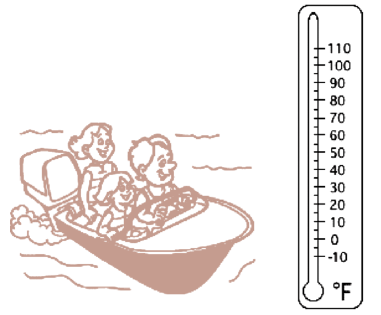
B
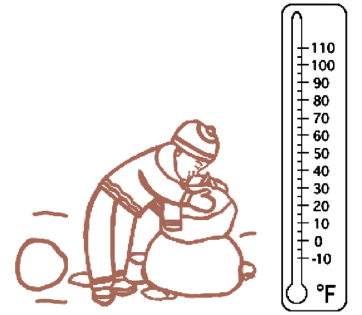
C
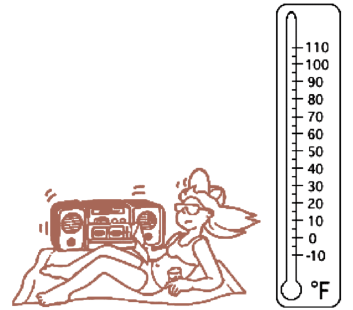
D
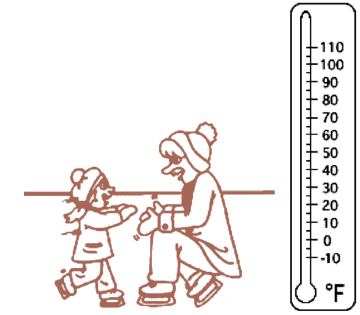
* Script:
Picture A: It’s 85 degrees Fahrenheit. The Smiths are driving a motorboat.
Picture B: It’s 25 degrees Fahrenheit. Joe is making a snowman.
Picture C: It’s 90 degrees Fahrenheit. Susan is lying on the beach and listening to music.
Picture D: It’s 5 degrees Fahrenheit. Tom and his mom are skating.


A. News Item One
● Listen to the following news item and then, for each question, select the best answer from among the four choices given.
remove | v. 迁移 |
suffer from | 遭受 |
treatment | n. 对待 |
unusual | a. 不寻常的 |
remaining | a. 剩余的,剩下的 |
CNN (Cable News Network) | (美国)有线新闻电视网 |
1) What can we infer from the news report?
a. Travelers are overcharged to walk among tigers and take photos.
b. Officials in Thailand are removing tourists from a Buddhist temple.
c. Many tigers are being removed from a Buddhist temple in Thailand.
d. The Thailand temple’s collection of tigers is very unusual.
2) What is the total number of tigers, removed and unremoved, according to the news?
a. 40.
b. 57.
c. 97.
d. 137.
* Script:
Officials in Thailand are removing tigers from a Buddhist temple. The tigers were popular with travelers, who could pay to walk among them and take photos. But wildlife groups said many tigers were kept in small spaces and suffered from poor treatment.
The Thailand temple’s collection of tigers is not unusual. Thai officials said they received reports about visitors to the temple being attacked by tigers.
It is reported that 40 tigers had been taken from the temple. Efforts to remove the remaining 97 tigers would continue in coming days. CNN reported that temple officials tried to slow the process by setting some tigers free.
B. News Item Two
● Listen to the following news item and then, for each question, select the best answer from among the four choices given.
The World Health Organization | 世界卫生组织(简称WHO) |
urban | a. 城市的 |
guideline | n. 指导,参考 |
disease | n. 疾病 |
3) What is the news report mainly about?
a. 80% of urban residents breathe unsafe air.
b. The World Health Organization launched a campaign.
c. Cities with populations over 100,000 have less air pollution.
d. Air quality doesn’t have connection with many diseases.
4) What do we know about urban air pollution over the past two years?
a. It increases the number of deaths.
b. It has almost doubled in 3,000 cities.
c. It has affected people’s lives in 130 countries.
d. It did not meet WHO guidelines.
5) Who are affected most by dirty air in cities according to the report?
a. People live in the developed countries.
b. People live in the developing countries.
c. Both the richest and poorest people.
d. The youngest, oldest and poorest people.
* Script:
A new study finds that more than 80 percent of people living in cities are breathing unsafe air.
The World Health Organization says those most affected live in the world’s poorest cities. Urban air pollution has nearly doubled in 3,000 cities over the past two years. The cities are in 103 countries.
The study also shows that almost all cities with populations over 100,000 and in developing countries have air pollution levels that do not meet WHO guidelines.
The WHO warns that as air quality gets worse the risk increases for many diseases. Dirty air in cities most affects the youngest, oldest, and poorest people.

A. Conversation One
● Listen to the following long conversation and then, for each question, select the best answer from among the four choices given.
1) What can we learn from the conversation?
a. The man is not familiar with the area.
b. The woman is good at drawing maps.
c. The man and the woman are friends.
d. The man needn’t go to the Citibank to use his credit card.
2) Where is the Citibank?
a. It is quite far away from where the two speakers are.
b. It is next to the traffic lights.
c. It is near the department store.
d. It’s on the left-hand side of the footpath.
* Script:
M: Excuse me, can you tell me how to reach the bank, please?
W: Which bank? There are three banks in the area.
M: You see, I have a credit card and I want to get money from the bank.
W: You’ll go to the Citibank, which is the nearest one. You can use the ATM there.
M: How can I get there? I have no knowledge of this area.
W: Cross the road and turn right at the other side, walk along the footpath until you reach the traffic lights, and you will see the department store on your left-hand side. The bank is just next to the department store. You can’t miss it.
M: It sounds a little complicated. How far is it from here?
W: It is just ten minutes’ walk from here. I can draw a map for you if you wish.
M: Oh, it’s very kind of you!
W: My pleasure. Here you are.
B. Conversation Two
● Listen to the following long conversation and then, for each question, select the best answer from among the four choices given.
1) What is the man’s most likely profession?
a. Painter.
b. Teacher.
c. Architect.
d. Gardener.
2) Why can’t Harry come to the phone?
a. He is sick.
b. He left for a short time.
c. He asked not to be disturbed.
d. He doesn’t work there anymore.
3) When will the woman probably give Harry the message?
a. After lunch.
b. In two hours.
c. After 6 p.m.
d. Tomorrow.
* Script:
W: Hank Kern’s office, Sally speaking.
M: Hi, this is Jack Mason calling. Could I speak to Harry, please?
W: Can you hold on one moment, please? I’ll see if he’s here.
M: Sure.
W: Mr. Mason, Harry walked over to the diner for lunch. He should be back soon. Would you like to leave a message for him?
M: Yes, could you ask him to call me at 708-429-1850? I need to talk to him about the blueprints I drew up for the Peterson building.
W: I’m sorry; could you repeat your number please?
M: Yes, it’s 708-429-1850, and my name is Jack Mason. I’ll be here at my office until 6:30 tonight.
W: Thanks.

A. Passage One
● Listen to the following passage and then, for each question, select the best answer from among the four choices given.
1) Where did Holmes and his friend spend for the night?
a. In a tent.
b. In a room.
c. At a hotel.
d. On a plane.
2) What was the weather like that night?
a. Clear with few stars in the sky.
b. Cloudy but extremely hot.
c. Clear with lots of stars in the sky.
d. Cloudy but with plenty of stars in the sky.
3) Why did Holmes wake up Dr. Watson?
a. Because he couldn’t sleep at all.
b. Because their tent had been stolen.
c. Because he wanted to know something about the stars.
d. Because he saw that the next day would be quite sunny.
* Script:
After a rather difficult case, Sherlock Holmes and his good friend Dr. Watson decided to take a camping trip. Once finishing a fine meal and a bottle of wine they decided to go to sleep. A few hours before daybreak, Holmes woke up his friend and said, “Watson, look up and tell me what you see.”
Watson did so and said, “Why, I see millions of stars.” Holmes said, “What does this suggest to you, good friend?” The doctor thought for a moment and said, “I can think of many things, Holmes... from a scientific standpoint, the millions of stars visible suggest there are millions of planets moving around those stars.” “Go on,” said Holmes. Watson thought for a moment more and continued, “From a religious standpoint, I can see that God’s works are wonderful and we are but a small part of his plan. From a weather-reporter’s standpoint, from a clear sky, I think that tomorrow will be quite sunny. So tell me, Holmes, what do you think about this wonderful sight?”
Holmes replied, “Watson, how foolish you are! Someone has stolen our tent!”
B. Passage Two
● Listen to the following passage and then, for each question, select the best answer from among the four choices given.
1) Why can’t airplanes fly without air?
a. Because the pilots can’t breathe without air.
b. Because they need air to lift their wings.
c. Because they need air to see things far ahead.
d. Because airplanes are driven by air.
2) What will happen to us if we go far enough from the earth?
a. There will be a lot of air around us.
b. There will be no air.
c. We’ll become light enough to fly.
d. We’ll see airplanes flying in the sky.
* Script:
What is the sky? Where is it? How high is it? What lies above the sky? I am sure that you have asked these questions. They are very difficult to answer, aren’t they?
If someone asked you, “What color is the sky?” I expect that you would answer, “Blue.” I am afraid that you would be wrong. The sky has no color. When we see blue, we are looking at the blue sunlight. The sunlight is shining on little bits of dust in the air.
Is the sky full of air? I am sure you have asked this question, too. We know that there is air all around the world. We could not breathe without air. Airplanes could not fly without air. They need air to lift their wings. Airplanes cannot fly very high because as they go higher, the air gets thinner. If we go far enough away from the earth, we find there is no air.
Perhaps we can answer some of our questions now. What is the sky? Nothing. Where is it? It is all round the world. The sky is space. In this space there is nothing except the sun, the moon and all the stars.

