1. Understanding the two video episodes by watching and listening;
2. Observing the behavior of the people in the video when watching each for the first time;
3. Listening for specific information to do the exercises for the two episodes;
4. Creating role-plays using the situations presented in the mini-dialogues.



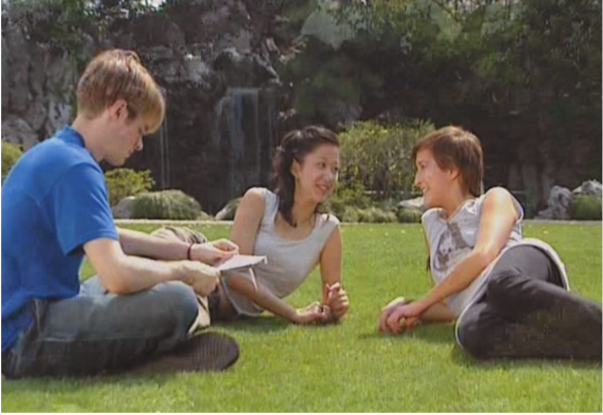
● Look at the following picture and choose the correct answers.
1) Shelley’s wearing (a T-shirt, a dress).
2) Michael is sitting with his legs (stretched, crossed).
3) Lizzie’s looking at (Shelley, Michael).

What’s the weather like…? | ……天气如何? |
It’s going to be… | 天气是…… |
The high will be… the low will be… | 最高温度是……最低温度是…… |
● Match the words and expressions in Column A with their definitions in Column B.
A | B |
1) shopping list | a. list of things that need to be bought when going shopping |
2) picnic | b. two pieces of bread with a selection of cheese, meat, vegetables, or hard-boiled egg, mayonnaise (蛋黄酱) and/or mustard (芥末) , etc. between them |
3) degree | c. taking a packed-up meal and eating it outdoors |
4) sandwich | d. a unit for measuring temperature |


A. Watch the video again and then decide whether each of the following statements is true (T ) or false (F ).
1) Lizzie and Shelley are lying on the grass.
2) There is a rockery in the distance.
3) Michael comes and sits down near Lizzie and Shelley.
4) Michael gives the newspaper to Lizzie.
5) Michael, Lizzie and Shelley get up and go to the classroom.
6) Shelley takes some paper out of her bag to write a shopping list.
B. Watch the video again and choose the correct word to complete each of the following sentences.
1) (Shelley, Michael) is reading a newspaper.
2) The weather is (beautiful, terrible).
3) The three students are having (a chat, a formal discussion).
4) Hearing about the fine weather, Shelley (stands up, sits up) and suggests that they go for a picnic.
5) Going out for a picnic seems to be a (good, bad) idea.
6) The three students are (excited, not excited) about going for a picnic.
A. Watch the video and complete the weather forecast provided in the newspaper.
Today’s Weather
Date | 8 September (Saturday) |
Weather | |
Temperature (high) | ℃ |
Temperature (low) | ℃ |
B. Watch the video again and check (√) the items on the shopping list that are mentioned.
Apple pies
Sandwiches
Biscuits
Orange juice
Chocolate
Salad
Ham
Ice cream
* Script:
Shelley: Do you have any plans for Saturday, Lizzie?
Lizzie: Not yet. What’s the weather going to be like on Saturday?
Michael: It says it’s going to be sunny the whole weekend.
Lizzie: Really? It’s beautiful weather. The high will be 25 degrees and the low will be 15 degrees.
Shelley: How about a picnic at Rock Park?
Lizzie: Good idea.
Michael: Sounds great. We can bring some sandwiches, salad and…
Lizzie: Chocolate, ice cream, orange juice…
Shelley: Hey, let’s get some paper and a pen. I think we need to make a shopping list.

1) Watch the video again, with a female student doing Shelley’s voice.

2) Watch the video another time, with a male student doing Michael’s voice.
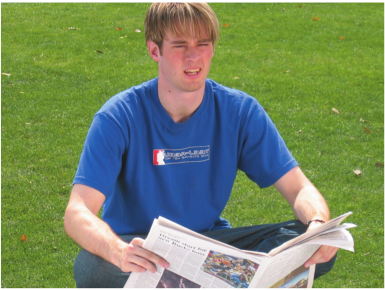
3) Watch the video once more, with a female student doing Lizzie’s voice.
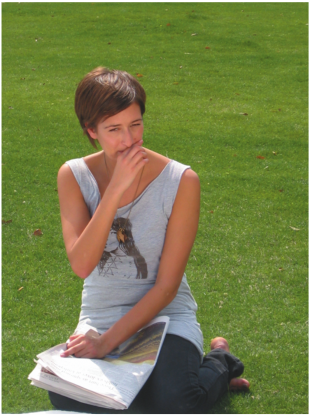
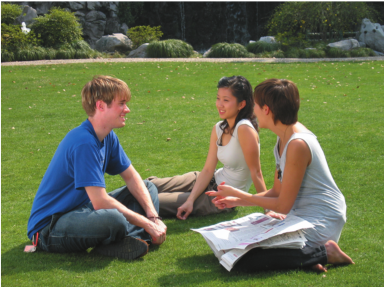
4) Watch the video one last time, with a male student and two female students doing all of the voices for the whole conversation.

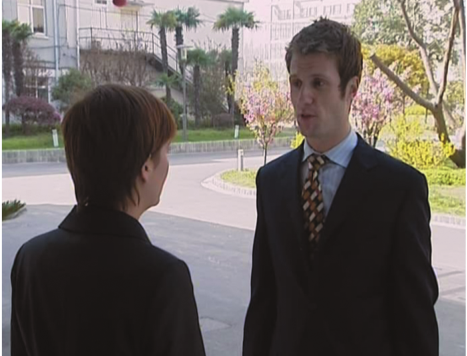
● Look at the following picture and choose the correct statements.
1) It’s (windy, fine) on the day in the photo.
2) Mary and Simon are standing (in the shade, under the sunshine).
3) Simon’s wearing a (checked, spotted) tie.
thunderstorm | n. 雷雨 |
lobby | n. 大堂 |
breeze | n. 微风 |
extremely | ad. 极度地 |
humid | a. 潮湿的 |
schedule | v. 安排时间 |
thoughtful | a. 考虑周到的 |

There are two temperature scales — Fahrenheit and Celsius. The Fahrenheit scale was introduced by a German-born physicist Gabriel Fahrenheit. On this scale, the freezing point of water is 32 degrees and the boiling point is 212 degrees. Anders Celsius, a Swedish astronomer, introduced his scale. For it, he used the freezing point of water as zero and the boiling point as 100. For a long time, the Celsius scale was called “centigrade.”
温度的刻度表达有两种:华氏与摄氏。华氏温标是由一位德国出生的物理学家加布里埃尔 · 华伦海特发明的。该温标的冰点是32度,沸点为212度。瑞典的天文学家安德斯 · 摄尔修斯推行他发明的温标。该温标的冰点为0度,沸点为100度。很久以来,摄氏温标被称为百分温标。
A. Watch the video again and then decide whether each of the following statements is true (T ) or false (F ).
1) Simon takes a taxi to the hotel.
2) Simon sits at the back of the taxi.
3) Simon has two large suitcases with him.
4) Mary offers her hand to shake hands with Simon.
5) Mary is waiting for Simon in front of the hotel.
6) Mary and Simon go into the hotel through a revolving door ( 旋转门 ) .
7) The doorman opens the hotel door for Mary and Simon.
8) Mary helps Simon with his check-in.
9) Mary gives Simon a folder with his itinerary (行程) .
10) Simon is happy to know that he can have a rest first.
● Match the words below with the seasons described in the video.
cold with wind and rain, cool, warm & breezy, hot & humid
* Shanghai’s Climate
Spring: __________________
Autumn: _________________
Summer: _________________
Winter:___________________
* Script:
Mary: You must be Mr. Milton. I’m Mary. Nice to meet you.
Simon: Call me Simon. Nice to meet you, too.
Mary: How was your flight?
Simon: There is a thunderstorm in Hong Kong, so the flight was delayed for half an hour.
Mary: But the weather here in Shanghai is fine.
Simon: Exactly. It has been raining in Hong Kong the whole week. I really miss the sunshine.
Mary: Let’s go to the lobby. I’ve booked a single room for you.
Simon: What’s the climate usually like in Shanghai?
Mary: Spring is warm and breezy, summer can be extremely hot and humid, autumn is cool, and winter is cold with wind and rain.
Simon: Lucky me! I’ve come in the right season ― spring.
Mary: The meeting is scheduled for 2 p.m. this afternoon. So you may rest first.
Simon: Thank you for the thoughtful arrangement.
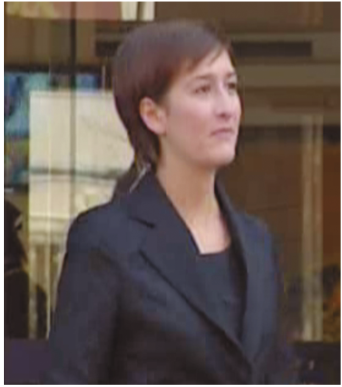
1) Watch the video again, with a female student doing Mary’s voice.
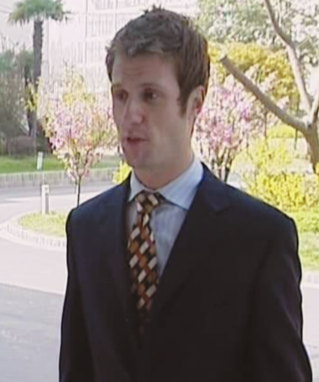
2) Watch the video once more, with a male student doing Simon’s voice.
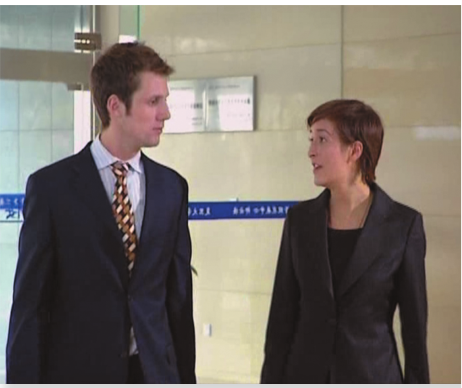
3) Watch the video one last time, with a male student and another female student doing both voices for the whole conversation.

● Useful Expressions
A lovely day, isn’t it?
Beautiful/nice/lovely/wonderful/awful weather, isn’t it?
How’s the weather today?
I think it’s starting to snow.
What’s the weather like today?
How was the weather during your vacation?
It looks like spring is coming soon.
What’s the weather like in your hometown/country?
It’s quite nice/warm/mild, etc.
It’s very cold/hot/dry/damp/muggy/windy/foggy, etc.
It isn’t too hot in summer, but it’s rather cold in winter.
Sometimes the temperature drops to 20 degrees below zero.
What’s the weather forecast for today?
It’s 15 (degrees) Centigrade.
It’s 35 (degrees) Fahrenheit.
It’s 3 (degrees) below zero.

● Practice the following situations, using the expressions provided above.
Situation 1
Students A and B are planning to play basketball on the playground. Just as they arrive at the playground to join the others, it begins to rain. Student A complains about the bad weather and Student B cheers him up.
Situation 2
Student A circles a job from the box below that sounds interesting.
Jobs to Choose From
Policeman | Officer | Farmer | Writer | Teacher |
Driver | Businessman | Doctor | Postman | Firefighter |
Student B asks Student A the following questions.
1) What is the weather like today? Is it suitable for your job?
2) What special clothes are you wearing today?
3) Do people care much about the weather in your profession?
4) Does the weather help you do your job well or does it make it harder?
5) What’s the best kind of weather for your job?

● Discuss the following talking points in groups.
1) What’s your favorite season and why?
2) Do you think bad weather affects people’s daily life? If so, how?
3) Have you ever been caught in bad weather? If so, what did you do?