
Xi's 'Community of shared future' has global implications
www.chinadaily.com.cn 2018-03-21 10:49
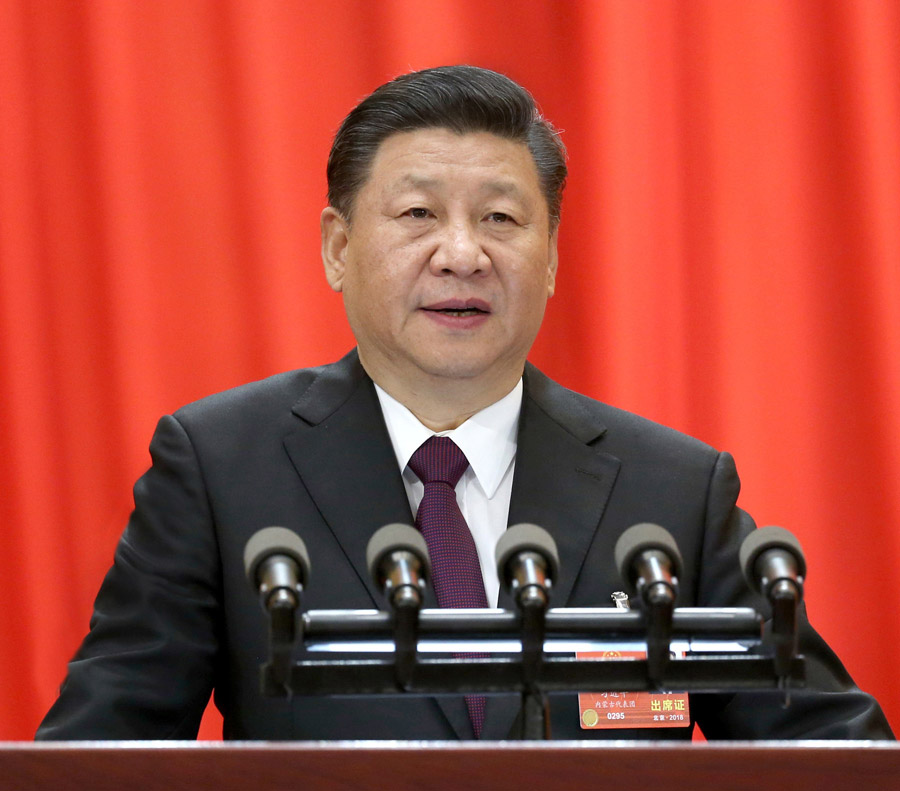
In his speech at the closing session of this year's National People's Congress, Chinese President Xi Jinping reiterated the two centenary goals and emphasized a vision of a "Community of Shared Future for Mankind". The aspects of this vision have global meaning, and observers have taken great interest in this philosophy within the context of China's internal and external circumstances.
With confidence and a pragmatic vision for the nation, Xi called on all efforts to tackle challenges and realize the Chinese Dream of national rejuvenation. He took the historic example of four great Chinese inventions — paper, printing, the compass and gunpowder — and encourage all NPC members to work hard for new achievements in a new era to build a strong, modern, socialist nation and also contribute to the peace, stability and development of the world. In the presence of more than 2,900 lawmakers, Xi asserted the Chinese people are striving for the goal of the building of a moderately prosperous society in all respects by 2020 and to tackle the unprecedented challenges ahead through a huge united effort, hard work and scientific vision.
In this speech Xi, also General Secretary of the CPC Central Committee, outlined his vision for the world community, too. He assured us there is no reason to see China as a threat, as proved by China's efforts since its reform and opening-up policy started in 1978. Some Western scholars still try to use the phrase "China threat" and give pressure to their leadership not to accept China's rise. But history has clearly shown today's global challenges were created by the domineering approach of the western countries. With China's development and relevant stake in the international arena, developing world-seeking contribution of China for more a equal and balanced international world order.
On the issue of building a favorable environment for world peace and development, Xi's speech has actually given a tangible overview for building a community of shared future for mankind. From Asia to Africa and Europe to Latin America, China's partnerships are increasing in new dimensions under Xi's guidance The last five years have shown China can maintain a harmonious relationship with the rest of the world based on mutual trust and win-win cooperation. China's contribution to the United Nations peacekeeping mission is highly admired by UN leadership and the world community.
China's assistance to underdeveloped and developing countries has started to have positive effects for the political stability and economic prosperity of the recipient nations. This is one reason why many countries are attracted to the China-led Belt and Road Initiative and the Asian Infrastructure and Investment Bank. To seek resolution to international conflicts and disputes, Xi has always focused on comprehensive dialogue and negotiations between conflicted parties. China's approach to settling conflicts has demonstrated China wants peaceful resolution of any international conflict and urges all parties to contribute to peace. In his speech, Xi said China will continue to participate in reform and development of world governance as well as contribute more "Chinese wisdom, Chinese solutions and Chinese strength" to promote lasting peace and stability in the world.
China's domestic development will have direct impact on the global sphere. A country with a history of more than 5,000 years has a lot to contribute to the rest of the world when it comes to peace and development. There is no doubt the targeted centenary goals of the Chinese leadership will be fulfilled. A strong and prosperous China will be supportive of world peace and development. Now the rest of the world is watching the newly elected Chinese leadership for more comprehensive efforts in building mutual trust and understanding to create a safe, clean and harmonious world.
Buddhi Prasad Sharma is a Ph.D candidate at the Communication University of China. He is the president of the Himalaya Dialogue and Leadership Foundation.
https://www.chinadaily.com.cn/a/201803/21/WS5ab1c83aa3106e7dcc1441b5.html
Reading 2

Tuesday, November 29, 2022
Belt and Road Initiative aims to build global community of shared future: report
Source: Xinhua| 2019-04-22 20:46:18|Editor: mingmei
BEIJING, April 22 (Xinhua) -- Belt and Road Initiative is becoming an important platform for building a global community of shared future, according to a report released Monday.
It said the Belt and Road Initiative upholds its noncompetitive and nonexclusive nature to the fullest extent, which reflects the international community's demand for a global governance system that is fair, egalitarian, open and inclusive.
The report also said the initiative offers a Chinese approach to reforming the current global governance system.
"It propels the interaction between global governance, security, and development -- an attempt to provide an alternative solution to these issues as they have not been addressed effectively in isolation over long periods of time," the report said.
China has no desire to export its ideology and no intention to impose its development model on other countries and is willing to share its experience with other countries and create a bright future together with relevant partners under the Belt and Road framework, it said.
The report called for more efforts on the convergence of China's development opportunities with those of Belt and Road partners and other countries in the wider world.
Entitled "The Belt and Road Initiative: Progress, Contributions and Prospects," the report was prepared by the Office of the Leading Group for Promoting the Belt and Road Initiative and was released ahead of the second Belt and Road Forum for International Cooperation to be held from April 25 to 27 in Beijing.
http://www.xinhuanet.com/english/2019-04/22/c_137998988.htm
Reading 3
China's 'community of shared future' is a call for global brotherhood
www.chinadaily.com.cn 2022-01-01 14:52

The first time I heard the idea to "promote a sense of community of shared future for mankind" proposed by President Xi Jinping at the 18th National Congress of the Communist Party of China (CPC) in November 2012 and in 2013 at the Moscow State Institute of International Relations, one word came to mind: brotherhood. This is the idea behind the concept that highlights China's hope in establishing a harmonious world where all could live peacefully in a spirit of brotherhood.
Judging from existing worldwide trends, the disturbing trend toward snowballing political divergence in the global community, and the socioeconomic disparities existing among developed and developing nations, the vision for a community of shared future is the culmination of China's notions to improve the existing international order. Therefore, China thinks working with the key players as well as other nations has become all the more important toward sustaining economic globalization, maintaining the system of global governance and ultimately promoting a community of shared future, based on equal opportunity and access to economic wealth, development and growth.
Based on this, the concept, which represents China's vision of a more just, secure and prosperous world order, has the potential and promise to contribute toward a more equal and economically equitable world. The community of a shared future offers the world Chinese wisdom and a new solution toward the advancement of human society. The idea is politically, socially and culturally inclusive of all societies with the end goal of building a world which is not only open and inclusive, but which enjoys lasting peace, universal security, and common prosperity. Since the community of a shared future is inclusive of all nations and regions, it is worth saying that the concept has direct applicability to the United Nations Sustainable Goals. As such, the Chinese leadership thinks cooperation toward attaining the goals of African Union's Agenda 2063 and the United Nations 2030 Agenda for Sustainable Development and building on the principle of "leaving no one behind", the novel agenda, which emphasizes a holistic approach to attaining sustainable development for all based on mutual respect, fairness, justice and win-win co-operation, should be a top priority for the international community.
In terms of multilateralism, this reaffirms why China multilateral diplomacy – the pillars underpinning the community of a shared future and the nation's long-standing Five Principles of Peaceful Coexistence: mutual respect for sovereignty and territorial integrity, mutual non-aggression, non-interference in each other's internal affairs, equality and mutual benefit, and peaceful coexistence, still apply to the nation's foreign policy and external engagements. Through the positions taken at multilateral platforms aimed at embracing and promoting global peace and stability, as well as through its development projects, such as the Belt and Road Initiative, China's leadership at the global level has further been accentuated by the contribution the nation has made in terms of supporting nations in fighting the COVID-19 pandemic.
This is because after the world was affected by the COVID-19 pandemic, China instantly attached significant importance to promoting global cooperation, which included the sharing of information on the COVID-19 pandemic with the global community, providing bilateral and multilateral assistance to affected nations, particularly in the continent of Africa, as well as other forms of multilateral assistance.
The above contributions that China makes to the international community and toward multilateralism stem from the remarkable headway that the Chinese government has made domestically, in terms of its internal reform process, its engagement with the outside world, and its integration in the global economy. These factors are some of the ingredients that have injected rich vitality into the China-Africa relations and promote sustainable development to build a community with a shared future.
As for China-Africa cooperation, and in terms of promoting development and growth on the African continent, China's vision for a shared future has turned out to be increasingly relevant as this implies striving toward a common and mutually beneficial future, wherein the continent of Africa can meaningfully benefit and take part in the vision. Since China has advocated for a policy of peaceful development and the promotion of stability through development and economic growth, China has proved to be an ideal partner for the African continent and is an integral move toward promoting growth and development in Africa. China's engagement with the continent is underpinned by the China-Africa Forum of Co-operation, including its bilateral relations with African countries at political, economic, social and cultural levels.
While FOCAC under the community of shared future continues to be a fruitful instrument for Africa and China policy, a successful international cooperation model setting the pace for sustained multilateralism; it is also a reminder of the United States diplomatic shortfalls in Africa. No wonder it is hard to remember the last time many African nations had their president photographed with a United States president let alone received an invitation to visit the White House. Even when Zambian President Hakainde Hichilema went to Washington this September, he met with Vice-President Kamala Harris but not Biden. And yet, a regular meeting with the president of China is something that every African leader can count on through FOCAC. This is a testament to the fact that the strength of FOCAC under the community of shared future lies in the principles of sincerity, pragmatism, affinity good faith, cemented by warm friendship, solidarity, trust, mutual respect, following the solidarity and cooperation in addressing the COVID-19 pandemic and, while supporting it with major economic and financial initiatives, for instance, the BRI and the Asian Infrastructure Investment Bank.
While the United States has simultaneously focused on keeping sanctions and security engagements on the high side with the United States President Joe Biden recently announcing that Ethiopia, Mali, and Guinea would be ineligible for duty-free trade access to the United States starting January 1, 2022, , China public diplomacy campaigns focus on relationship-building with African nations and broad media coverage of all forms of cooperation. As such, under FOCAC, China has focused on health, economic engagements and anything that can inject economic vitality into China-Africa cooperation over and above security and normative concerns, and on face time with African leaders and people-to-people exchanges.
Therefore, as the world strives for recovery, we might have turned a blind eye to the feats of a community of shared future, the truth is, for a changing world eyeing for closer cooperation and a stronger, more resilient post-pandemic global economy, the world coming together under the platform of the community of shared future would be a powerful tool for the post-COVID-19 global economy recovery.
The author is executive director, Center for Nigerian Studies, at the Institute of African Studies, Zhejiang Normal University.
The opinions expressed here are those of the writer and do not necessarily represent the views of China Daily and China Daily website.
If you have a specific expertise, or would like to share your thought about our stories, then send us your writings at opinion@chinadaily.com.cn, and comment@chinadaily.com.cn.
http://www.chinadaily.com.cn/a/202201/01/WS61cffaf7a310cdd39bc7ead7.html
Reading 4
"A community of shared future for all humankind" -- a Chinese concept winning U.N. recognition
Editor: Zhang Jianfeng 丨Xinhua
03-20-2017 11:26 BJT
BEIJING, March 20 (Xinhua) -- The Chinese concept of building "a community of shared future for all humankind" was on Friday incorporated into a U.N. Security Council resolution for the first time, reflecting the extraordinary charm and vitality of the notion.
It also embodies growing global recognition of China's great contribution to global governance.
The U.N.'s acceptance and incorporation of the Chinese concept into its resolution is of great significance and will have far-reaching influence.
Earlier this month, the call of Ma Zhaoxu -- the head of the Chinese mission to the United Nations in Geneva -- for protecting human rights and building a community of shared future for all humankind on behalf of 140 countries on the sidelines of the 34th session of the U.N. Human Rights Council also struck a chord in the minds of representatives of other countries.
The world is now at a critical juncture when it is faced with such increasing challenges as a rising trend of anti-globalization, terrorism and the refugee issue. As economic downturn still bites, instability and uncertainties have become a normal phenomenon. Therefore, how to lead a perplexed world to move forward is a key question on the table for politicians, strategists and scholars alike to ponder over.
Facing a world somewhat spiralling out of control, some Western countries' strategic have made choices that are virtually disappointing. Some of them choose to lock themselves in their small worlds, while others turn to protectionism and pursue narrow-minded "nation first." It's under such a circumstance that people turn their eyes to the East.
The report of the 18th National Congress of the Communist Party of China in November 2012 first proposed the concept of "a community of shared future for all humankind." Within the following four years, Chinese President Xi Jinping mentioned and illustrated the concept on various occasions.
In September 2015, Xi proposed the roadmap of building "a community of shared future for all humankind" at a United Nations (U.N.) summit. In January 2015, he further expounded his concept in a comprehensive, profound and systematic manner at the U.N. Office in Geneva.
By proposing the concept of "a community of shared future for all humankindy" and a roadmap thereof, China has offered the Chinese wisdom and Chinese plan for solving major problems concerning the future of mankind.
The concept has shown China's global view and responsibility as a big power, and is bound to leave its mark in international relations.
Philipp Charwath, chair of the 55th session of the U.N. Commission for Social Development, noted that the concept has offered inspiration to a world beset by rising challenges and risks.
"In the long run, it profits us all," Charwath said, "I think that's how I understand the concept, and that's how the U.N. work can profit from the concept."
The concept of "a community of shared future for all humankind" can be traced to the essential connotation of China's five thousand years of civilization. The concept, embodying the Chinese people's hope for a harmonious world, is a creative development of the traditional spirit in the new era of globalization, where all countries around the world share prosperity and losses, and are increasingly interconnected with one another.
Therefore, joint cooperation is an effective way of development promotion.
According to British scholar Martin Jacques, a professor at Cambridge University, China has provided a new possibility, that is, abandoning the law of the jungle, hegemonism and power politics and the zero-sum game and replacing them with win-win cooperation and co-construction and sharing. This is an unprecedented pioneering work and a great creation to change the world.
The concept of "a community of shared future for all humankind" is a fresh idea, featuring Chinese characteristics and the spirit of the time, initiated by China to reform and rebuild a world order, and a new top-level design to lead global governance.
The concept reflects Chinese style, power and responsibility that go beyond ideology and traditional geopolitics.
According to Ross Terrill, a research associate at Harvard University's Fairbank Center, China's global governance idea focusing on the goal of building "a community of shared future for all humankind" has shown the country's strategic thoughts on long-term development of bilateral ties between China and other countries, and has injected new impetus into the effort to establish a new world order.
The concept of "a community of shared future for all humankind" has proven practical when dealing with hot issues such as the Iran nuclear issue and the Korean peninsula issue, as it calls for consultation and coordination of international affairs among countries. It also involves the Belt and Road Initiative, generous emergency aid and other efforts.
China's Belt and Road Initiative -- the Silk Road Economic Belt and the 21st-Century Maritime Silk Road -- put forward by Chinese President Xi Jinping in 2013, aims to build a trade and infrastructure network connecting Asia with Europe and Africa along the ancient trade routes.
Building "a community of shared future for all humankind" is the essence of major country diplomacy with Chinese characteristics, and a torch of the time that leads the world in the 21st century.
http://english.cctv.com/2017/03/20/ARTIaT8SCQ5ibzwVTG6ZSOna170320.shtml
Reading 5
Two-year mark of global community towards a shared future
Xinhua | Updated: 2019-01-21 08:09

Two years ago, Chinese President Xi Jinping delivered a speech at the United Nations (UN) Office at Geneva, calling for joint efforts to build a community with a shared future for mankind.
Two years on, the appeal, which represents a vision of common development and progress, has gained wide support and helped form synergy among the international community in pursuing a better shared future.
IN HARMONY WITH ALL
"China has been a strong pillar of multilateralism," said UN Secretary-General Antonio Guterres, highlighting that the aim of multilateralism is to build a community with a shared future for mankind.
Over the past two years, the appeal by the Chinese leader has been incorporated into various documents, including UN Security Council resolutions, UN Human Rights Council resolutions, the Qingdao Declaration of the Council of Heads of Member States of the Shanghai Cooperation Organization, Forum on China-Africa Cooperation Beijing Action Plan (2019-2021).
The Chinese proposal, with its foresight and wisdom, has witnessed tremendous changes across the globe and resonated with people's longing for peace and development.
As China hosted a number of significant diplomatic events at home and Chinese leaders paid visits to other countries, the idea of building a community with a shared future has been increasingly accepted worldwide.
"It is a common ideal for mankind to build a world without conflicts, one with equal development opportunities and every people in it blessed with happiness," said Yasuo Fukuda, former Japanese prime minister.
ACTIONS
In 2018, China launched the China International Import Expo in Shanghai which attracted over 3,600 companies from around the world and more than 400,000 Chinese and foreign buyers. Deals for intended one-year purchases of goods and services worth a total of 57.83 billion U.S. dollars were reached at the six-day event.
The China-initiated Asian Infrastructure Investment Bank (AIIB) celebrated its third anniversary in December. Over the past three years, the investment bank has approved financing worth 7 billion U.S. dollars for development projects in Asia and Africa, with the aim to promote sustainable economic development through investment in infrastructure.
In July 2018, the China-Maldives Friendship Bridge, the first ever cross-sea bridge in Maldives, was completed. The bridge is deemed one of the landmark projects of the China-proposed Belt and Road Initiative (BRI).
In fact, nearly 170 countries and international organizations have signed BRI-related cooperation documents with China.
The BRI is a manifestation of China's vision of a community with a shared future for mankind, said John W. Allen, former vice chairman of the UN Business Council.
FUTURE OF HOPE
China's General Administration of Customs said recently the country's foreign trade rose 9.7 percent year on year to a record high of 30.51 trillion yuan (about 4.5 trillion U.S. dollars) in 2018.
Official data also show China's FDI hit a record 885.61 billion yuan (134.97 billion dollars) last year.
The numbers have demonstrated China's resilience after 40 years of reform and opening up, even at a time when unilateralism and protectionism are on the rise.
In April 2018, Xi announced a series of new measures for expanding China's reform and opening up, demonstrating China's willingness to work with the outside world.
The new initiatives include easing foreign shareholding restrictions in the industries of automobile, ship and aircraft, and implementing the management system based on pre-establishment national treatment and negative list.
Over the past two years, China has been promoting innovation and improving inclusive development amid external uncertainties. On such issues as the Korean Peninsula situation, the Syrian crisis and UN peacekeeping operations, China is committed to safeguarding peace and stability.
According to Gai Lin, secretary-general of the EU-China Friendship Group of the European Parliament, the future of mankind will surely involve bringing together nations for a world of cooperation. Building a community with a shared future is undoubtedly the best option for safeguarding world peace and promoting development.
http://www.chinadaily.com.cn/a/201901/21/WS5c450dc8a3106c65c34e5804.html
Reading 6
Commentary: "A community of shared future for mankind" in the making
Source: Xinhua| 2017-10-06 19:02:39|Editor: Xiang Bo

by Xinhua Writer Meng Na
BEIJING, Oct. 6 (Xinhua) -- With the 19th National Congress of the Communist Party of China (CPC) to convene in about two weeks, it is a good time to look back at how China interacted with the world over the past five years and predict what foreign policy the next five years may bring.
The phrase "building a community of shared future for humanity," was written into the report of the 18th CPC National Congress in 2012. Five years on, the term is a now concrete plan with a clear direction and widespread approval.
Multi-polarity, globalization, cultural diversity, interdependence, scientific and industrial revolution have emerged as the key descriptors of the world.
At the same time, the people of the world find themselves in an era of multifarious challenges: global growth is lethargic and listless, the impact of the last financial crisis lingers like a cloud on the horizon, climate is changing in unforeseeable ways, the development gap yawns. The Cold War mentality and power politics still exist. Terrorism and refugee crises are spreading.
Against such a backdrop, the open, inclusive, clean world of lasting peace, common security and prosperity that President Xi Jinping envisages is a beacon to all who believe that a shared future is the only future.
What has the politics of confrontation and petty alliances given the world? The time has come for countries to form partnerships based on understanding, dialogue and respect.
Until major powers respect each other's core interests and major concerns, until they learn to keep their differences under control, they will be unable to build a new model of relations featuring cooperation instead of confrontation, respect before rivalry and win-win above acquisitiveness.
None of this can come to pass, as Xi told the world in January from Geneva, until "big countries treat smaller ones as equals instead of acting as a hegemon imposing their will on others."
Common, comprehensive, cooperative, sustainable security have been Xi's mantra for five years now.
China upholds WTO rules. China supports an open, transparent, inclusive and nondiscriminatory trade. It is China who is now champion of the open world economy, because, as Xi has said on many occasions, protectionism and isolation will benefit no one.
The Paris Agreement is the strongest bastion against climate change. China understands its obligations and is committed to fighting to save the planet and, calls for other countries to join the cause with the same enthusiasm and actions.
In February, the community of shared future for mankind was incorporated into a UN resolution for the first time. To build such a future, economic globalization must be open, inclusive, balanced and benefit all. To this end, President Xi's declared aspiration is to "both make the cake bigger and share it fairly to ensure justice and equity."
The G20 Summit, held in Hangzhou last September, adopted the Blueprint on Innovative Growth, put development at the heart of global macro policy for the first time, and formulated an action plan.
To build a community of shared future for mankind, President Xi put forward the Belt and Road Initiative. Over 100 countries and international organizations support the plan and a large number of early harvest projects are already making a difference to the lives of ordinary people.
Inclusive growth and development demand better infrastructure for all. The Asian Infrastructure Investment Bank, for instance, already provides more public goods to the international community.
As the 19th CPC National Congress convenes and the world muses upon the possibilities for the next five years of China's foreign policy, one thing is certain.
Peace, development, partnership and multilateralism -- the community of shared future for humanity, tended and nourished by President Xi over the past five years -- will continue to be the guiding light.
http://www.chinadaily.com.cn/a/201901/21/WS5c450dc8a3106c65c34e5804.html
Reading 7
Cultivate the seeds for community of shared future
www.chinadaily.com.cn 2019-08-03 09:23
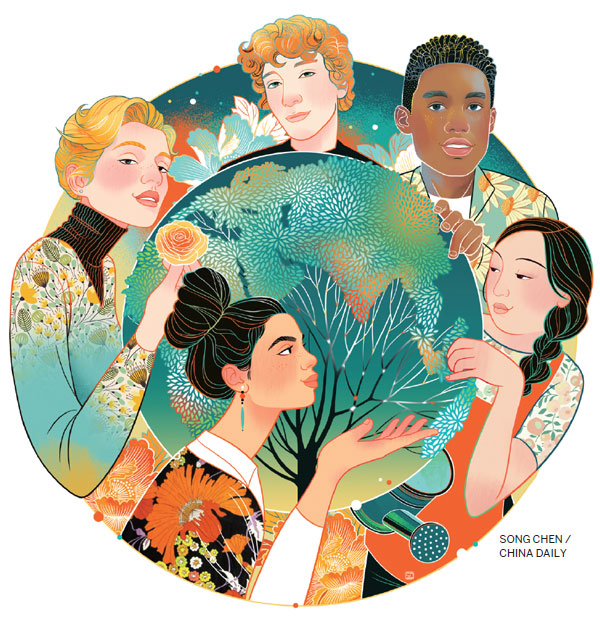
While addressing the 70th Session of the UN General Assembly on Sept 28, 2015, President Xi Jinping, in his statement titled "Working together to forge a new partnership of win-win cooperation and create a community of shared future for mankind", emphasized that, "In today's world, all countries are interdependent and share a common future."
Based on this judgment, he urged all countries to build a new type of international relations featuring win-win cooperation, and create a community with a shared future for mankind based on five principles: building partnerships in which countries treat each other as equals, engage in mutual consultation and show mutual understanding; creating a security architecture featuring fairness, justice, joint contribution and shared benefits; promoting open, innovative and inclusive development that benefits all; increasing inter-civilization exchanges to promote harmony, inclusiveness and respect for differences; and building an ecosystem that puts Mother Nature and green development first.
Given the nature of the current international community and the inertia of international politics, characterized by the law of the jungle and zero-sum games, there is reason enough to doubt the enforceability of Xi's beautiful ideas. It seems humankind is in a dilemma, the dilemma of choosing between a community with a shared future or a community with no future. But there is only one correct choice.
To transform the current international community into a community with a shared future for mankind, countries across the world have to take a variety of measures, including political, economic, security and environmental measures. For instance, Xi proposed the Belt and Road Initiative in 2013 with the aim of improving infrastructure connectivity between Asia and Europe and Africa, and thus help build a community with a shared future for mankind.
Equally important, intercultural communication can play an irreplaceable role in this historical undertaking. On the one hand, it can foster awareness of shared economic, security and environmental interests among citizens of different countries and, as a result, the growing awareness among people of shared interests will constantly expand the foundation of a community with a shared future for mankind. On the other hand, intercultural communication can accumulatively foster common core values such as peace, development, harmony in diversity, equity, justice, democracy and freedom, all of which are fundamental to the survival of a community of shared future.
Yet intercultural communication is impossible without intercultural education. As John Dewey put it," … education is a regulation of the process of coming to share in the social consciousness; and that the adjustment of individual activity on the basis of this social consciousness is the only sure method of social reconstruction."
Therefore, to prepare the young generation to act as competent global citizens of a community with a shared future for mankind, we have to sow in their hearts and minds the seeds of empathy, mutual respect and win-win cooperation, which will enable the community to constantly grow and flourish.
As I understand it, intercultural education is not one course, nor a-once-and-for-all effort. It should be integrated into day-by-day classroom teaching and extracurricular activities from the kindergarten through elementary and high school to the institutions of higher education, so it becomes a life-long pursuit of every global citizen.
So, as Mother Teresa put it, "Yesterday is gone, tomorrow has not yet come. We have only today, let us begin."
The author is vice-president of Beijing Foreign Studies University. The views don't necessarily reflect those of China Daily.
https://www.chinadaily.com.cn/a/201908/03/WS5d44e21ea310cf3e35563ae1.html

