
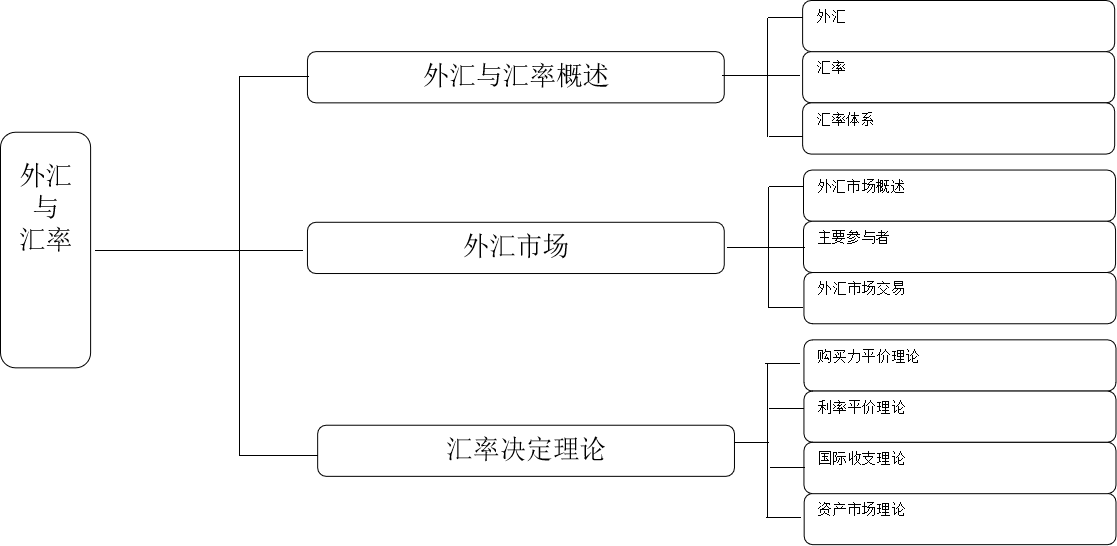
Chapter 4 Foreign Exchange and Foreign Exchange Rate 外汇与汇率
Learning Objectives:
1.To learn the definition and types of foreign exchange.
2.To notice the quotations of foreign exchange rates.
3.To understand foreign exchange rate system.
4.To know about foreign exchange markets.
5.To grasp foreign exchange transactions.
6.To understand theories of exchange rate determination.
4.1 Introduction to Foreign Exchange and Exchange Rates 外汇与汇率概述
教学视频:
课堂练习:
主题讨论:
1. Definition of foreign exchange 外汇的定义
Foreign exchange, or forex, is foreign money. All foreign currency, consisting of funds held with banks abroad, or bills or cheques, again in foreign currency and payable abroad, are termed foreign exchange.
外汇是外国货币。所有外币,包括在国外银行持有的资金,或以外币在国外支付的票据或支票,都称为外汇。
2. Types of foreign exchange 外汇的类型
1)According to the convertibility of currencies, foreign exchange can be divided into free exchange and account exchange.
2)According to the sources and uses of foreign exchange, foreign exchange can be divided into trade exchange and invisible trade exchange.
3) According to the delivery date in foreign exchange market, foreign exchange can be divided into spot and forward exchange.
Exchange Rate 汇率
The exchange rate between two currencies specifies how much one currency is worth in terms of the other.
两种货币之间的汇率规定了一种货币对另一种货币的价值。
An exchange rate quotation is given by stating the number of units of “term currency” or “price currency” that can be bought in terms of 1 unit currency (also called base currency).
汇率报价按1个单位货币(也被称为基准货币)可以买到的若干数量的计价货币或报价货币表示。
For example, in a quotation that says the EURUSD exchange rate is 1.4320 (1.4320 USD per EUR), the term currency is USD and the base currency is EUR.
Quotes using a country's home currency as the price currency (e.g., EUR 1.00 = $1.58 in the US) are known as direct quotation or price quotation (from that country's perspective) and are used by most countries.
Quotes using a country's home currency as the unit currency (e.g., $0.97 AUD = $1.00 US) are known as indirect quotation or quantity quotation and are used in British newspapers and are also common in Australia, New Zealand and the euro-zone.
Direct quotation: 1 foreign currency unit = x home currency units 直接标价
Indirect quotation: 1 home currency unit = x foreign currency units 间接标价
System of Foreign Exchange Rate 汇率体系
1. Fixed exchange rate system 固定汇率制度
A fixed exchange-rate system (also known as pegged exchange rate system) is a currency system in which governments try to keep the value of their currencies constant against one another.
固定汇率制(也称为钉住汇率制)是一种货币体系,在这种体系中,政府试图保持本国货币相对于其他货币的价值不变。
In a fixed exchange-rate system, a country’s government decides the worth of its currency in terms of either a fixed weight of gold, a fixed amount of another currency or a basket of other currencies.
The central bank of a country remains committed at all times to buy and sell its currency at a fixed price. The central bank provides foreign currency needed to finance payment imbalances.
2. Floating exchange rate system 浮动汇率制度
A floating exchange rate or a flexible exchange rate is a type of exchange rate regime wherein a currency's value is allowed to fluctuate according to the foreign exchange market.
A currency that uses a floating exchange rate is known as a floating currency.
Checkpoint:
Do you know the Majors in foreign exchange market?

