英语演讲

毕文丽

目录

  • 1 初识公众演讲
    • 1.1 课程概览Course overview
    • 1.2 公众演讲为何重要?Why public speaking matters?
    • 1.3 如何控制演讲焦虑?How to manage speaking anxiety?
    • 1.4 如何吸引观众?How to engage the audience?
    • 1.5 如何进行演讲评价?How to give effective speech evaluations
  • 2 【1stSpeech】自我介绍演讲Self-introduction Speech
    • 2.1 自我介绍演讲要求 Speech assignment1
    • 2.2 不一样的自我介绍 How to give an impressive self-introduction?
    • 2.3 如何进行演讲彩排? Practice makes perfect: How to rehearse your speech.
  • 3 【2ndSpeech】模仿演讲 Be then and there
    • 3.1 模仿演讲要求与评价Speech assignment2
    • 3.2 巧用声音 Vocal variety
    • 3.3 语言的使用 Using language
    • 3.4 跟林肯总统学演讲之道 Learn from Abraham Lincoln
  • 4 【3rd Speech】告知演讲 Speaking to Inform
    • 4.1 告知演讲要求Speech assignment 3
    • 4.2 演讲选题Strategies for Selecting a Topic
    • 4.3 搜集材料Gathering materials
    • 4.4 演讲支撑 Supporting materials
    • 4.5 演讲结构Organizing the speech
    • 4.6 演讲正文 The body of speech
    • 4.7 演讲如何开好头 How to start a speech?
    • 4.8 结尾和开头一样重要 How to end your speech?
    • 4.9 演讲提纲Outlining your speech
    • 4.10 视觉辅助Visual aids
    • 4.11 演讲呈现 Delivering an informative speech
  • 5 【4th Speech】说服演讲Speaking to Persuade
    • 5.1 说服演讲要求 Speech assignment3
    • 5.2 说服第一步:分析受众 How to analyze your audience before a presentation.
    • 5.3 说服演讲常见结构 How to organize a persuasive speech.
    • 5.4 门罗五步法 Monroe’s motivated sequence
    • 5.5 亚里士多德的修辞三要素 Ethos, pathos, logos: three pillars of public speaking
    • 5.6 如何赢得观众信任 How to establish your credibility as a speaker.
    • 5.7 如何有效使用论据 How to support my idea with evidence.
    • 5.8 晓之以理: 归纳与演绎 Inductive and deductive reasoning
    • 5.9 晓之以理: 因果与类比 Causal and analogical reasoning
    • 5.10 逻辑谬误:爱情是谬误 Logical fallacies
    • 5.11 动之以情:演讲中的情感共鸣。 Aim for the heartstring: How to use emotional appeals in public speaking.
    • 5.12 演讲支撑之引用有方 How to use quotes in your speech.
    • 5.13 演讲支撑之转述有法 How to paraphrase effectively in a speech.
    • 5.14 演讲中如何进行口头引用 How to cite sources in a speech(with examples)
  • 6 【5th Speech】校园篇Speaking on Different Occasions
    • 6.1 实用演讲要求及评价标准Speech Assignment
    • 6.2 毕业答辩 Thesis Defense
    • 6.3 毕业演讲 Commencement Speech
  • 7 【6th Speech】职场篇Speaking on Different Occasions
    • 7.1 面试技巧 Interview skills
    • 7.2 产品发布 Product Launch
    • 7.3 获奖感言 Speech of Acceptance
  • 8 学生习作
    • 8.1 往届演讲比赛选手演讲
  • 9 英语演讲与辩论
    • 9.1 Introduction to Public Speaking
      • 9.1.1 Understanding public speaking
        • 9.1.1.1 The Benefits of Public Speaking
        • 9.1.1.2 The Speech Communication Process
        • 9.1.1.3 Public Speaking and Critical Thinking
      • 9.1.2 Speaking Confidently and Ethically
        • 9.1.2.1 Managing Your Speech Anxiety
        • 9.1.2.2 Being an ethical speaker
      • 9.1.3 Giving your first speech
        • 9.1.3.1 Preparing your first speech
        • 9.1.3.2 Delivering your first speech
      • 9.1.4 Quiz
      • 9.1.5 演讲范例
    • 9.2 Speech Preparation: Getting Started(I)
      • 9.2.1 Selecting a Topic and Purpose
        • 9.2.1.1 Selecting a topic
        • 9.2.1.2 Determining the Purpose of Your Speech
        • 9.2.1.3 Phrasing the central idea
      • 9.2.2 Analyzing the Audience
        • 9.2.2.1 Audience analysis I
        • 9.2.2.2 Audience analysis II
      • 9.2.3 Quiz
      • 9.2.4 演讲范例
    • 9.3 Speech Preparation: Getting Started(II)
      • 9.3.1 Using Language
        • 9.3.1.1 Using language accurately
        • 9.3.1.2 Using Language vividly
        • 9.3.1.3 Using Language appropiately and Inclusively
      • 9.3.2 Supporting Your Ideas
        • 9.3.2.1 Using examples
        • 9.3.2.2 Using statistics
      • 9.3.3 Quiz
      • 9.3.4 演讲范例
      • 9.3.5 自我介绍范例演讲分析
    • 9.4 Speech Preparation: Organizing and Outlining
      • 9.4.1 Organizing the Body of the Speech
        • 9.4.1.1 Strategic order of main points
        • 9.4.1.2 Connectives
      • 9.4.2 Beginning and Ending the Speech
        • 9.4.2.1 The Introduction
        • 9.4.2.2 The Conclusion
      • 9.4.3 Outlining the Speech
        • 9.4.3.1 The Preparation Outline
        • 9.4.3.2 The Speaking Outline
      • 9.4.4 Quiz
      • 9.4.5 演讲范例
    • 9.5 Presenting the Speech
      • 9.5.1 Delivery
        • 9.5.1.1 Methods of Delivery
        • 9.5.1.2 The Speaker's Voice
        • 9.5.1.3 The Speaker's Body
      • 9.5.2 Using Visual Aids
        • 9.5.2.1 Different Kinds of Visual Aids
        • 9.5.2.2 Guideline fro Using Visual Aids
      • 9.5.3 Quiz
      • 9.5.4 演讲范例
    • 9.6 Varieties of Public Speaking(I)
      • 9.6.1 Speaking to Inform
        • 9.6.1.1 Types of informative speech
        • 9.6.1.2 Tips for informative speaking
      • 9.6.2 Speaking to Persuade
        • 9.6.2.1 Types of persuasive speech
        • 9.6.2.2 Methods of persuasive speech
      • 9.6.3 Quiz
      • 9.6.4 演讲范例
    • 9.7 Varieties of Public Speaking(II)
      • 9.7.1 Speaking on Special Occasions
        • 9.7.1.1 Speeches of Introduction
        • 9.7.1.2 Speeches of Presentation and Acceptance
        • 9.7.1.3 Commemorative Speeches
        • 9.7.1.4 Toast
      • 9.7.2 Quiz
      • 9.7.3 演讲范例
    • 9.8 Debate
      • 9.8.1 Introduction to Debate
        • 9.8.1.1 The Importance of Debating
        • 9.8.1.2 Introduction to  BP
        • 9.8.1.3 Interesting Motions
      • 9.8.2 Methods of Persuasion
      • 9.8.3 Quiz
      • 9.8.4 演讲范例
结尾和开头一样重要 How to end your speech?

Conclusion

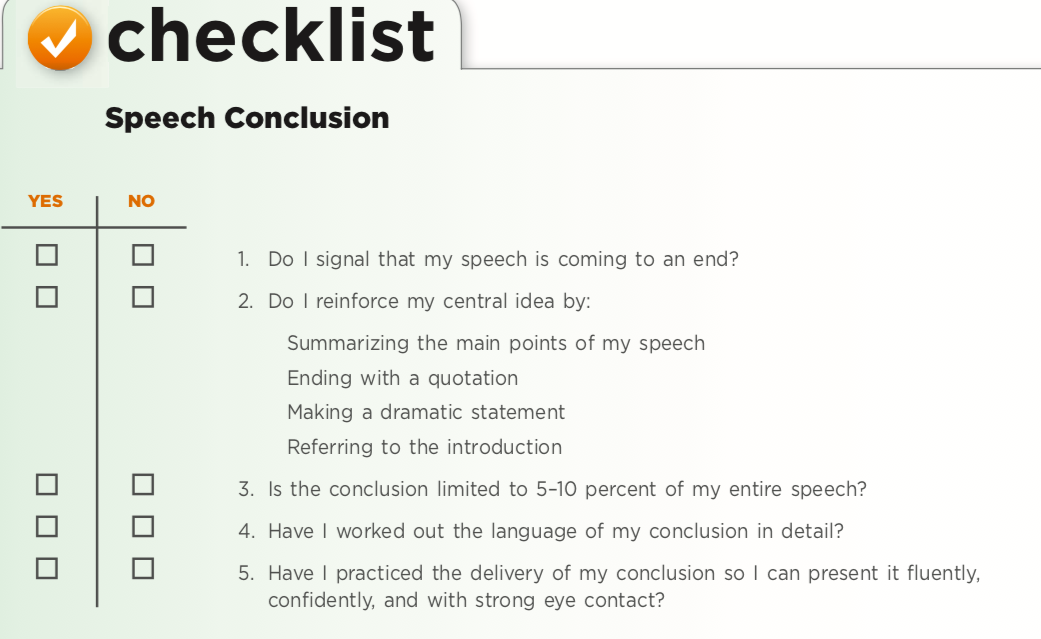
While the conclusion should be brief and tight, it has a few specific tasks to accomplish:

  • Reinforce the Thesis

  • Review the Main Points

  • Close Effectively


Take a deep breath! If you made it to the conclusion, you are on the brink of finishing. Below are the tasks you should complete in your conclusion:

Reinforce the Thesis

When making the transition to the conclusion, attempt to make clear distinctions (verbally and nonverbally) that you are now wrapping up the information and providing final comments about the topic. Refer back to the thesis from the introduction with wording that calls the original thesis into memory. Assert that you have accomplished the goals of your thesis statement and create the feeling that audience members who actively considered your information are now equipped with an understanding of your topic. Reinforce whatever mood/tone you chose for the speech and attempt to create a big picture of the speech.

Review the Main Points

Within the conclusion, re-state the main points of the speech. Since you have used parallel wording for your main points in the introduction and body, don't break that consistency in the conclusion. Frame the review so the audience will be reminded of the preview and the developed discussion of each main point. After the review, you may want to create a statement about why those main points fulfilled the goals of the speech.

Close Effectively

Finish strongly. When you close your speech, craft statements that reinforce the message and leave the audience with a clear feeling about what was accomplished with your speech. You might finalize the adaptation by discussing the benefits of listening to the

speech and explaining what you think audience members can do with the information.

Remember to maintain an informative tone for this speech. You should not persuade about beliefs or positions; rather, you should persuade the audience that the speech was worthwhile and useful. For greatest effect, create a closing line or paragraph that is artistic and effective. Much like the attention-getter, the closing line needs to be refined and practiced. Your close should stick with the audience and leave them interested in your topic. Take time to work on writing the close well and attempt to memorize it so you can directly address the audience and leave them thinking of you as a well-prepared, confident speaker.


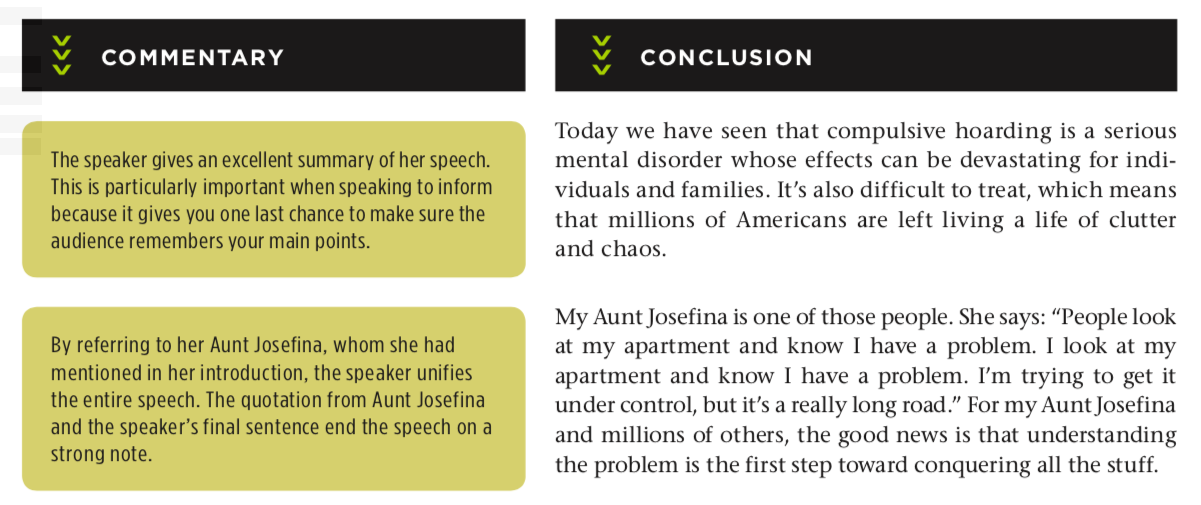
Sample conclusion from The Art of Public Speaking 

Materials based on The Art of Public Speaking, Eighth Edition by Stephen E. Lucas. © 2004 by the McGraw-Hill Companies. Copyright ©2001 The McGraw-Hill Companies,Inc. All rights reserved

请完成以下quiz: