Introduction
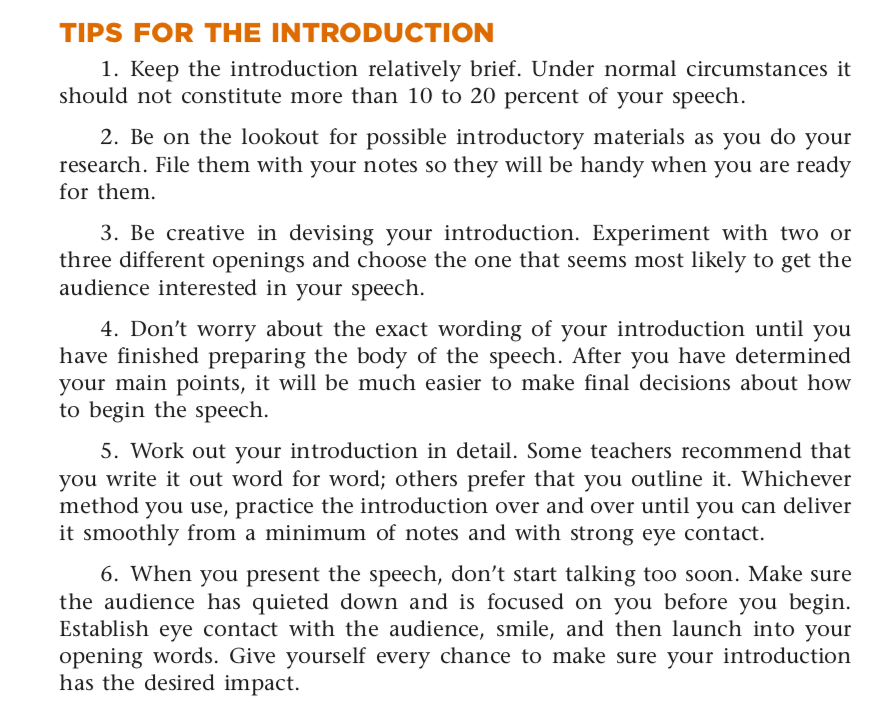
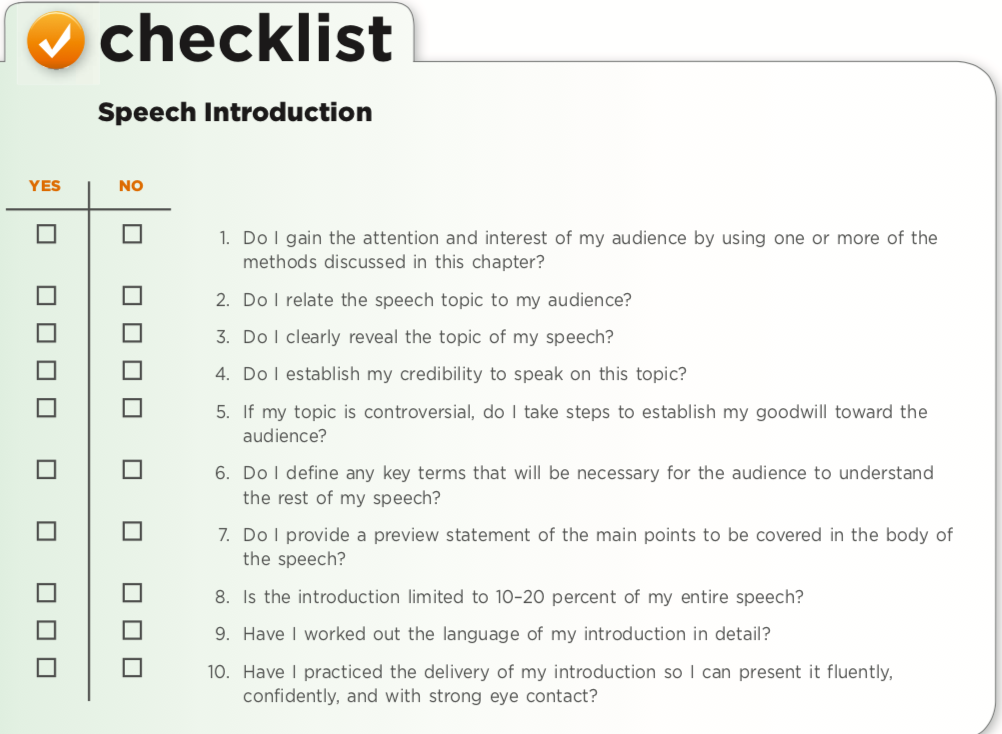
The introduction sets the tone of the entire speech. The introduction should be brief and to-the-point as it accomplishes these several important tasks. Typically, there are six main components of an effective introduction:
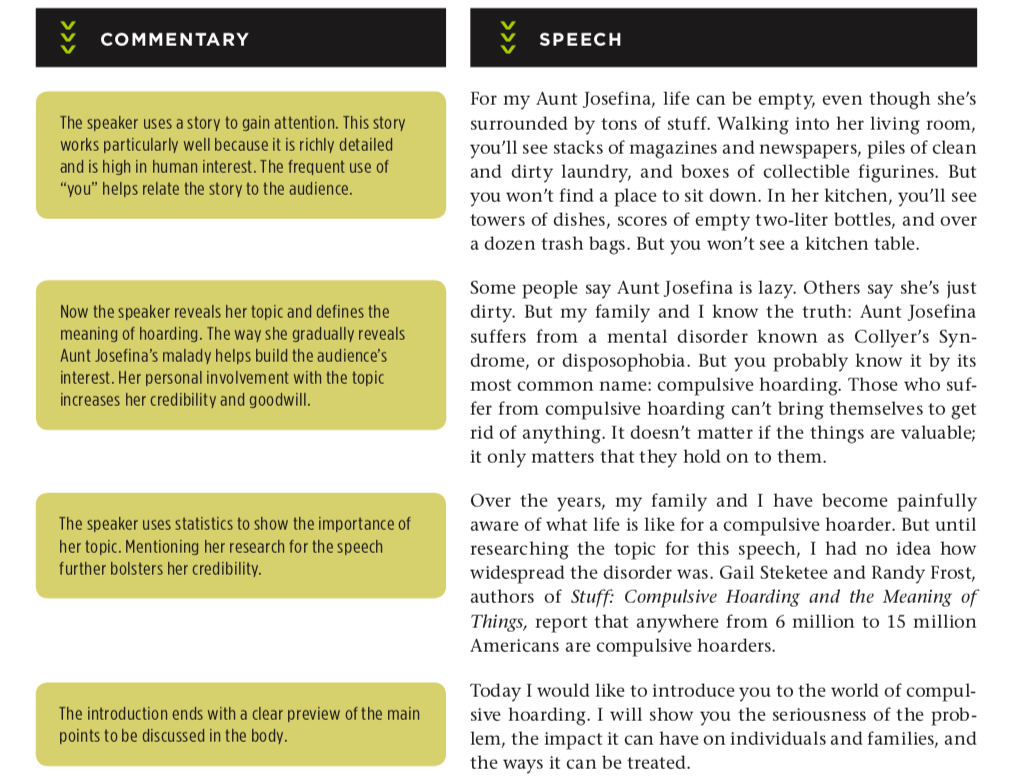
Attention Getters
Thesis Statement
Audience Adaptation
Credibility Statement
Preview
Transition to the Body
As in any social situation, your audience makes strong assumptions about you during the first eight or ten seconds of your speech. For this reason, you need to start solidly and launch the topic clearly. Focus your efforts on completing these tasks and moving on to the real information (the body) of the speech. Typically, there are six main components of an effective introduction. These tasks do not have to be handled in this order, but this layout often yields the best results.
Attention Getters
The attention-getter is designed to intrigue the audience members and to motivate them to listen attentively for the next several minutes. There are infinite possibilities for attention-getting devices. Some of the more common devices include using a story, a rhetorical question, or a quotation. While any of these devices can be effective, it is important for you to spend time strategizing, creating, and practicing the attention-getter .
Most importantly, an attention-getter should create curiosity in the minds of your listeners and convince them that the speech will be interesting and useful. The wording of your attention-getter should be refined and practiced. Be sure to consider the mood/tone of your speech; determine the appropriateness of humor, emotion, aggressiveness, etc. Not only should the words get the audiences attention, but your delivery should be smooth and confident to let the audience know that you are a skilled speaker who is prepared for this speech.
A Story
The crowd was wild. The music was booming. The sun was shining. The cash registers were ringing.
This story-like re-creation of the scene at a Farm Aid concert serves to engage the audience and causes them to think about the situation you are describing. Touching stories or stories that make audience members feel involved with the topic serve as good attention-getters. You should tell a story with feeling and deliver it directly to the audience instead of reading it off your notecards.
Example Text:
One dark summer night in 1849, a young woman in her 20's left Bucktown, Maryland, and
followed the North Star. What was her name? Harriet Tubman. She went back some 19 times to
rescue her fellow slaves. And as James Blockson relates in a 1984 issue ofNational Geographic, by
the end of her career, she had a $40,000.00 price on her head. This was quite a compliment from
her enemies (Blockson 22).
Rhetorical Question
Rhetorical questions are questions designed to arouse curiosity without requiring an answer. Either the answer will be obvious, or if it isn't apparent, the question will arouse curiosity until the presentation provides the answer.
An example of a rhetorical question to gain the audiences attention for a speech about fly-fishing is, "Have you ever stood in a freezing river at 5 o'clock in the morning by choice?"
Example Text:
Have you ever heard of a railroad with no tracks, with secret stations, and whose conductors were considered criminals?
Quotation
A quotation from a famous person or from an expert on your topic can gain the attention of the audience. The use of a quotation immediately launches you into the speech and focuses the audience on your topic area. If it is from a well-known source, cite the author first. If the source is obscure, begin with the quote itself.
Example Text:
"No day dawns for the slave, nor is it looked for. It is all night--night forever . . . ." (Pause) This
quote was taken from Jermain Loguen, a fugitive who was the son of his Tennessee master and a
slave woman.
Unusual Statement
Making a statement that is unusual to the ears of your listeners is another possibility for gaining their attention.
Example Text:
"Follow the drinking gourd. That's what I said, friend, follow the drinking gourd." This phrase was
used by slaves as a coded message to mean the Big Dipper, which revealed the North Star, and
pointed toward freedom.
Humor
You might chose to use tasteful humor which relates to the topic as an effective way to attract the audience both to you and the subject at hand.
Example Text:
"I'm feeling boxed in." [PAUSE] I'm not sure, but these may have been Henry "Box" Brown's very
words after being placed on his head inside a box which measured 3 feet by 2 feet by 2 1\2 feet
for what seemed to him like "an hour and a half." He was shipped by Adams Express to freedom
in Philadelphia (Brown 60,92; Still 10).
Shocking Statistic
Another possibility to consider is the use of a factual statistic intended to grab your listener's attention. As you research the topic you've picked, keep your eyes open for statistics that will have impact.
Example Text:
Today, John Elway's talents are worth millions, but in 1840 the price of a human life, a slave, was
worth $1,000.00.
Thesis Statement
The thesis statement is crucial for clearly communicating your topic and purpose to the audience. Be sure to make the statement clear, concise, and easy to remember. Deliver it to the audience and use verbal and nonverbal illustrations to make it stand out.
Example Text:
Today I'd like to tell you about the Underground Railroad.
Audience Adaptation
In your introduction, you need to adapt your speech to your audience. To keep audience members interested, tell them why your topic is important to them. To accomplish this task, you need to undertake audience analysis prior to creating the speech. Figure out who your audience members are, what things are important to them, what their biases may be, and what types of subjects/issues appeal to them. In the context of this class, some of your audience analysis is provided for you--most of your listeners are college students, so it is likely that they place some value on education, most of them are probably not bathing in money, and they live in Colorado. Consider these traits when you determine how to adapt to your audience.
As you research and write your speech, take note of references to issues that should be important to your audience. Include statements about aspects of your speech that you think will be of special interest to the audience in the introduction. By accomplishing this task, you give your listeners specific things with which they can identify. Audience adaptation will be included throughout the speech, but an effective introduction requires meaningful adaptation of the topic to the audience.
You need to find ways to get the members of your audience involved early in the speech. The following are some possible options to connect your speech to your audience:
Reference to the Occasion
Consider how the occasion itself might present an opportunity to heighten audience receptivity. Remind your listeners of an important date just passed or coming soon.
Example Text:
This January will mark the 130th anniversary of a "giant interracial rally" organized by William Still
which helped to end streetcar segregation in the city of Philadelphia (Katz i).
Reference to the Previous Speaker
Another possibility is to refer to a previous speaker to capitalize on the good will which already has been established or to build on the information presented.
Example Text:
As Alice pointed out last week in her speech on the Olympic games of the ancient world, history
can provide us with fascinating lessons.
The credibility statement establishes your qualifications as a speaker. You should come up with reasons why you are someone to listen to on this topic. Why do you have special knowledge or understanding of this topic? What can the audience learn from you that they couldn't learn from someone else? Credibility statements can refer to your extensive research on a topic, your life-long interest in an issue, your personal experience with a thing, or your desire to better the lives of your listeners by sifting through the topic and providing the crucial information.
Remember that Aristotle said that credibility, or ethos, consists of good sense, goodwill, and good moral character. Create the feeling that you possess these qualities by creatively stating that you are well-educated about the topic (good sense), that you want to help each member of the audience (goodwill), and that you are a decent person who can be trusted (good moral character). Once you establish your credibility, the audience is more likely to listen to you as something of an expert and to consider what you say to be the truth. It is often effective to include further references to your credibility throughout the speech by subtly referring to the traits mentioned above.
Competence
Show your listeners that you are qualified to speak by making a specific reference to a helpful resource. This is one way to demonstrate competence.
Example Text:
In doing research for this topic, I came across an account written by one of these heroes that has
deepened my understanding of the institution of slavery. Frederick Douglass', My Bondage and My
Freedom, is the account of a man whose master's kindness made his slavery only more
unbearable.
Good Will
Your listeners want to believe that you have their best interests in mind. In the case of an informative speech, it is enough to assure them that this will be an interesting speech and that you, yourself, are enthusiastic about the topic.
Example Text:
I hope you'll enjoy hearing about the heroism of the Underground Railroad as much as I have
enjoyed preparing for this speech.
Preview the Main Points
The preview informs the audience about the speech's main points. You should preview every main body point and identify each as a separate piece of the body. The purpose of this preview is to let the audience members prepare themselves for the flow of the
speech; therefore, you should word the preview clearly and concisely. Attempt to use parallel structure for each part of the preview and avoid delving into the main point; simply tell the audience what the main point will be about in general.
Use the preview to briefly establish your structure and then move on. Let the audience get a taste of how you will divide the topic and fulfill the thesis and then move on. This important tool will reinforce the information in the minds of your listeners. Here are two examples of a preview:
Topical
Simply identify the main points of the speech. Cover them in the same order that they will appear in the body of the presentation.
For example, the preview for a speech about kites organized topically might take this form: "First, I will inform you about the invention of the kite. Then, I will explain the evolution of the kite. Third, I will introduce you to the different types of kites. Finally, I will inform you about various uses for kites." Notice that this preview avoids digressions (e.g., listing the various uses for kites); you will take care of the deeper information within the body of the speech.
Example Text:
I'll tell you about motivations and means of escape employed by fugitive slaves.
Chronological
Simply identify the main points of the speech. Cover them in the same order that they will appear in the body of the presentation.
For example, the preview for a speech about the Pony Express organized chronologically might take this form: "I'll talk about the Pony Express in three parts. First, its origins, second, its heyday, and third, how it came to an end." Notice that this preview avoids digressions (e.g., listing the reasons why the Pony Express came to an end); you will cover the deeper information within the body of the speech.
Example Text:
I'll talk about it in three parts. First, its origins, second, its heyday, and third, how it came to an
end.
Transition to the Body
After you accomplish the first five components of the introduction, you should make a clean transition to the body of the speech. Use this transition to signal a change and prepare the audience to begin processing specific topical information. You should round out the introduction, reinforce the excitement and interest that you created in the audience during the introduction, and slide into the first main body point.
Sample introduction from The Art of Public Speaking
Materials based on The Art of Public Speaking, Eighth Edition by Stephen E. Lucas. © 2004 by the McGraw-Hill Companies. Copyright ©2001 The McGraw-Hill Companies,Inc. All rights reserved