目录

  • 1 Course Plan
    • 1.1 Syllabus
    • 1.2 Calendar
    • 1.3 Grading
    • 1.4 Questionnaire
  • 2 Chapter 1 Introduction to Linguistics
    • 2.1 Definition of linguistics
    • 2.2 The scope of linguistics
    • 2.3 Some important distinctions in linguistics
    • 2.4 Definition of language
    • 2.5 Functions of language
    • 2.6 Design features of language
    • 2.7 PPT课件
  • 3 Chapter 2 Phonetics and Phonology
    • 3.1 Phonetics
      • 3.1.1 Production of speech sounds
      • 3.1.2 Classification of English consonants
      • 3.1.3 Classification of English vowels
    • 3.2 Phonology
      • 3.2.1 Phone, phoneme and allophone
      • 3.2.2 Suprasegmental features
    • 3.3 Test of Chapter 2
    • 3.4 PPT课件
  • 4 Chapter 3 Morphology
    • 4.1 Introduction to morphology
    • 4.2 Derivation
    • 4.3 Compounding
    • 4.4 Other ways of word-formation
    • 4.5 PPT课件
    • 4.6 TED Talk
  • 5 Chapter 4 Syntax
    • 5.1 Syntax and syntactic relations
    • 5.2 IC analysis
    • 5.3 Phrase structure rules
    • 5.4 Deep structure and surface structure
    • 5.5 PPT
    • 5.6 TEST on syntax
  • 6 Chapter 5 Semantics
    • 6.1 Approaches to meaning
    • 6.2 Seven types of meaning
    • 6.3 Sense relations between words
    • 6.4 Sense relations between sentences
    • 6.5 Componential Analysis
    • 6.6 PPT课件
    • 6.7 Ambiguity
    • 6.8 TEST on semantics
  • 7 Chapter 6 Cognitive linguistics
    • 7.1 Psycholinguitics
      • 7.1.1 PPT
    • 7.2 Cognitive linguistics
      • 7.2.1 识解(construal)
      • 7.2.2 范畴化和隐喻(categorization and metaphor)
      • 7.2.3 意向图式(Image Schema)
      • 7.2.4 概念整合理论
      • 7.2.5 PPT
  • 8 Chapter 7 Pragmatics
    • 8.1 Introduction to pragmatics
    • 8.2 Speech act theory
    • 8.3 Implicature & CP
    • 8.4 PPT
    • 8.5 TEST on pragmatics
  • 9 Chapter 8 Language and society
    • 9.1 Introduction to sociolinguistics
    • 9.2 Dialectal variation
    • 9.3 Code-switching
    • 9.4 Linguistic descrimination
    • 9.5 TEST on sociolinguistics
    • 9.6 Language and society PPT
  • 10 Chapter 9 Language and Culture
    • 10.1 The relationship between language and culture
    • 10.2 Sapir-Whorf & cultural contact
    • 10.3 TEST on language and culture
    • 10.4 Lanuguage and culture PPT
  • 11 Chapter 11 Language Acquisition
    • 11.1 Linguistics and teaching methods
    • 11.2 PPT
  • 12 Theories and schools of modern linguistics
    • 12.1 Introduction video
    • 12.2 PPT
  • 13 Questionnaire
    • 13.1 Questionnaire-1
    • 13.2 Questionnaire -A
  • 14 考研指导
    • 14.1 考研指导讲座
TED Talk
  • 1 思考题
  • 2 参考答案

Questions for thought:

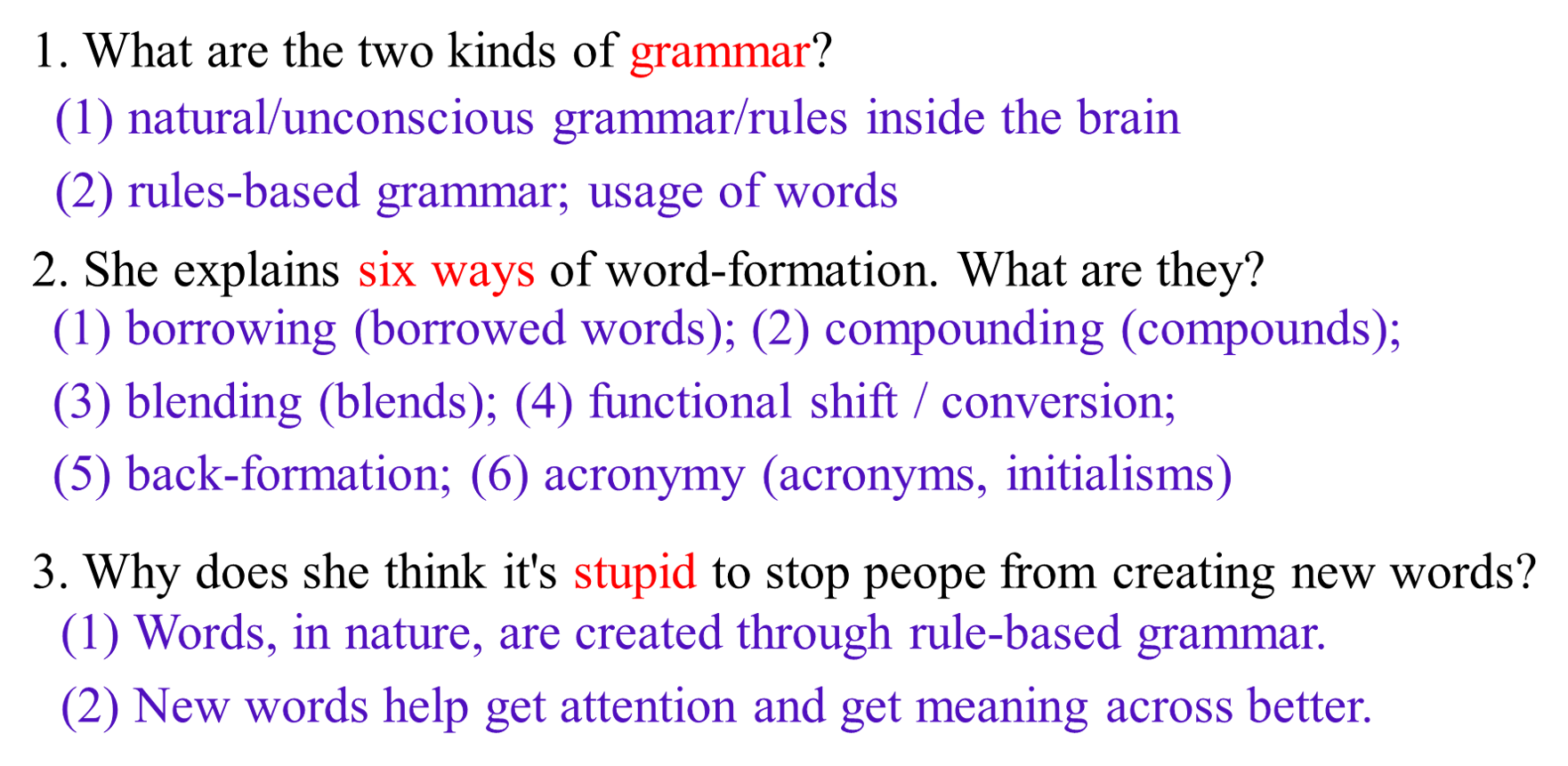
1. What are the two kinds of grammar?

2. She explains six ways of word-formation. What are they?

3. Why does she think it's stupid to stop people from creating new words?