目录

  • 1 绪论(Introduction)
    • 1.1 中式烹调工艺概述(Overview of Chinese cooking technology)
  • 2 锅烹类技法实训(Pot cooking skills training)
    • 2.1 学习目标(Learning objectives)
    • 2.2 锅烹类技法导读(Introduction to pot cooking techniques)
    • 2.3 项目一:滑炒技法(Item 1: Slippery frying technique)
    • 2.4 项目二:爆炒技法(Item 2: Stir fry technique)
    • 2.5 项目三:清炒技法(Item 3: Clear frying technique)
    • 2.6 项目四:生炒技法(Item 4:Raw frying technique)
    • 2.7 项目五:熟炒技法(Item 5:Cooked frying technique)
    • 2.8 项目六:煸炒技法(Item 6:Stir-fry technique)
    • 2.9 项目七:贴制技法(Item 7:Paste technique)
    • 2.10 项目八:煎制技法(Item 8:Decocting technique)
    • 2.11 项目九:盐焗技法(Item 9:Salt baking technique)
    • 2.12 本章小结(Summary of this chapter)
    • 2.13 本章检测题(Test questions in this chapter)
  • 3 油烹类技法实训(Oil cooking skills training)
    • 3.1 学习目标(Learning objectives)
    • 3.2 油烹类技法导读(Introduction to oil cooking techniques)
    • 3.3 项目一:清炸技法(Item 1:Blasting technique)
    • 3.4 项目二:干炸技法(Item 2:Dry frying technique)
    • 3.5 项目三:纸包炸技法(Item 3:Paper fried technique)
    • 3.6 项目四:卷炸技法(Item 4:Roll blasting technique)
    • 3.7 项目五:碎屑料炸技法(Item 5:Chip blasting technique)
    • 3.8 项目六:泡油炒技法(Item 6:Oil soaking frying technique)
    • 3.9 项目七:红烧技法(Item 7:Braised technique)
    • 3.10 项目八:红扣技法(Item 8:Red button technique)
    • 3.11 项目九:脆熘技法(Item 9:Crispy frying technique)
    • 3.12 本章小结(Summary of this chapter)
    • 3.13 本章检测题(Test questions in this chapter)
  • 4 水烹类技法实训(Practical training of water cooking techniques)
    • 4.1 学习目标(Learning objectives)
    • 4.2 水烹类技法导读(Introduction to water cooking techniques)
    • 4.3 项目一:煮制技法(Item 1:Boiling technique)
    • 4.4 项目二:浸制技法(Item 2:Soaking technique)
    • 4.5 项目三:灼制技法(Item 3:Poaching technique)
    • 4.6 项目四:烩制技法(Item 4:Decocting technique)
    • 4.7 项目五:煲制技法(Item 5:Stewing technique)
    • 4.8 项目六:煨制技法(Item 6:Simmering technique)
    • 4.9 项目七:焖制技法(Item 7:Braiseing technique )
    • 4.10 本章小结(Summary of this chapter)
    • 4.11 本章检测题(Test questions in this chapter)
  • 5 汽烹类技法实训(Steam cooking skills training)
    • 5.1 学习目标(Learning objectives)
    • 5.2 汽烹类技法导读(Introduction to steam cooking techniques)
    • 5.3 项目一:清蒸技法(Item 1:Steaming technique)
    • 5.4 项目二:干蒸技法(Item 2:Dry steaming technique)
    • 5.5 项目三:粉蒸技法(Item 3:Dteaming with flour technique)
    • 5.6 项目四:蒸扣技法(Item 4:Bowl steaming technique)
    • 5.7 项目五:蒸瓤技法(Item 5:Stuffing steaming technique)
    • 5.8 项目六:蒸炖技法(Item 6:Steaming and Stewing technique)
    • 5.9 本章小结(Summary of this chapter)
    • 5.10 本章检测题(Test questions in this chapter)
  • 6 辐射类技法实训(Training of Radiation Cooking Techniques)
    • 6.1 学习目标(Learning objectives)
    • 6.2 辐射类技法导读(Introduction to Radiation Cooking Techniques)
    • 6.3 项目一:明炉烤技法(Item 1:Open-oven roasting technique)
    • 6.4 项目二:暗炉烤技法(Item 2:Closed-oven roasting technique)
    • 6.5 项目三:泥烤技法(Item 3:Mud roasting technique)
    • 6.6 项目四:烘烤技法(Item 4:Baking roasting technique)
    • 6.7 本章小结(Summary of this chapter)
    • 6.8 本章检测题(Test questions in this chapter)
  • 7 特殊类技法实训(Training of Special Cooking Techniques)
    • 7.1 学习目标(Learning objectives)
    • 7.2 特殊类技法导读(Introduction to special techniques Techniques)
    • 7.3 项目一:凉拌技法(Item 1:Cold mixing technique)
    • 7.4 项目二:制冻技法(Item 2:Cold jelly technique)
    • 7.5 项目三:生醉技法(Item 3:live alcohol-saturating technique)
    • 7.6 项目四:熟醉技法(Item 4:Alcohol-cooking technique)
    • 7.7 项目五:拔丝技法(Item 5:Wire drawing technique)
    • 7.8 项目六:制羹技法(Item 6:Thick soup making technique)
    • 7.9 项目七:铁扒技法(Item 7:Grilling technique)
    • 7.10 项目八:熏制技法(Item 8:Smoking technique)
    • 7.11 本章小结(Summary of this chapter)
    • 7.12 本章检测题(Test questions in this chapter)
项目四:卷炸技法(Item 4:Roll blasting technique)
  • 1 知识储备——卷炸...
  • 2 实训示例——炸桂...
  • 3 拓展学习资料(&nb...

知识储备——卷炸

Knowledge reserve——Roll blasting technique

技法介绍/Introduction to techniques

用一种薄片形状的食用原料将另一种食用馅心原料包裹做成卷筒形状,粘裹上糊,放入热油锅中炸,炸至外表色金黄、质酥脆的烹调技法,叫卷炸法。卷炸法制成的菜肴具有外酥脆、里鲜嫩,色泽金黄,滋味鲜美的特点

The cooking technique of wrapping another kind of edible filling material into a roll shape with a thin slice shaped edible material, pasting and wrapping it with paste, and frying it in a hot oil pan until it is golden in appearance and crisp in quality is called roll frying. The dishes made by roll frying method have the characteristics of crispy outside, fresh inside, golden color and delicious taste.

成品要求滋味鲜醇为主,故对原料选择应严格,不鲜或异味较大的不能使用;把握好料中的水分,为了使其达到成菜质感,应适当添加肥肉以保证卷炸后菜肴口感具有滋润细的效果。掌握好油温,熟馅卷油温应采用6~7热炸生馅卷包应采用两次炸制—次4~5炸至熟透第二次油6~7热炸至外酥

The finished product requires fresh and mellow taste, so the selection of raw materials should be strict, and those that are not fresh or have a strong odor cannot be used; Grasp the moisture in the stuffing. In order to achieve the texture of finished dishes, fat should be added appropriately to ensure that the taste of the dishes after frying has the effect of moisture and tenderness. Grasp the oil temperature. The cooked filling roll should be fried with 60 ~ 70% oil temperature. The raw filling roll should be fried twice, the first time with 40 ~ 50% oil temperature until it is ripe, and the second time with 60 ~ 70% oil temperature until it is crisp.

技法要求/Technical requirements

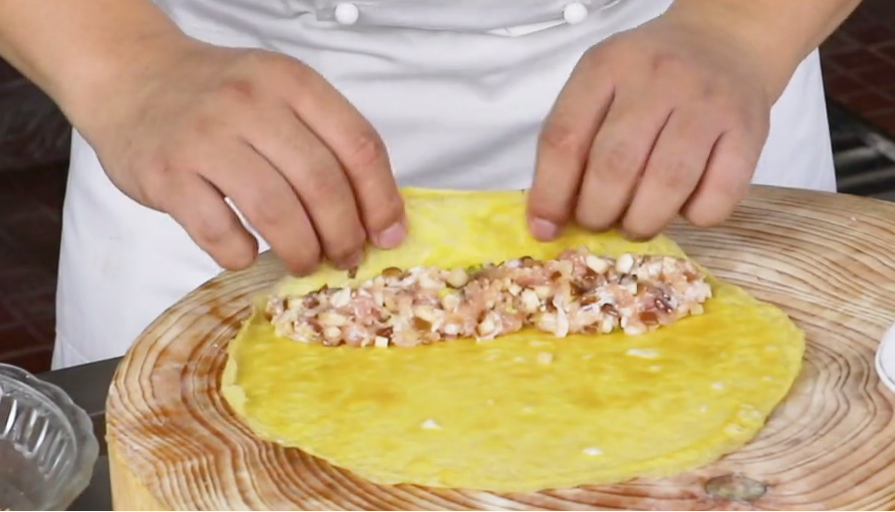
1.针对不同卷包料分别采取烙蛋皮,修整网状或烫制,腐皮有水浸软加工等方法。根据卷包方法加工成丝、颗粒、茸泥、条形等。

1. For different wrapping materials, methods such as baking egg skin, trimming mesh or scalding, and soaking rotten skin in water are adopted. It is processed into silk, granules, antler mud, strip, etc. according to the rolling method.

2.卷包炸的馅料—般以咸鲜味为主,应减少具有辛辣味调料的比例。注意掌握馅料中的调料辅料的比例以达到细嫩。

2. The fillings for roll wrapping and frying are generally salty and delicious, and the proportion of spices with spicy flavor should be reduced. Pay attention to the proportion of seasoning and auxiliary materials in the filling to achieve tenderness.

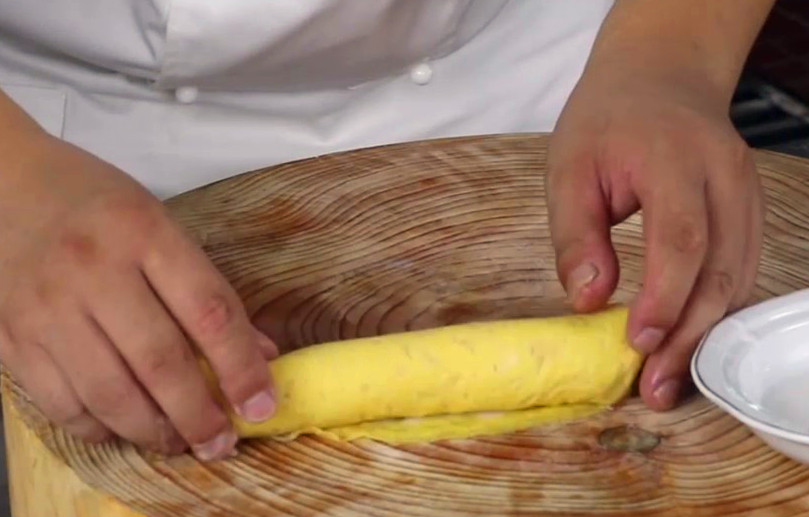
3.裹料用可食性皮料,卷裹前应将馅料压紧,卷裹时以两层为宜,皮料的交口处应以蛋清淀粉粘牢;如卷裹料用不可食性皮料,要求包裹大小规格一致,包裹时封口要平整严实,以免炸时透油,而且在食用的时候还容易解散皮料。

3. Edible leather shall be used for wrapping. The filling shall be compacted before wrapping. It is appropriate to wrap it in two layers, and the intersection of leather shall be firmly adhered with egg white starch; If inedible leather is used as wrapping material, the size and specification of the package shall be consistent, and the seal shall be flat and tight when wrapping, so as to avoid oil penetration during frying, and it is easy to dissolve the leather material when eating.

4.炸制油温应根据包卷馅的老嫩,形状大小或生馅与熟馅之别,选择适宜的油温,其火候应以皮酥脆,馅鲜嫩为佳。炸后应立即上桌,还可配上葱酱碟或椒盐碟等。

4. The frying oil temperature should be selected according to the old and tender filling, shape and size, or the difference between raw filling and cooked filling. The best heat should be crisp skin and fresh and tender filling. It should be served immediately after frying. It can also be served with Scallion sauce dish or salt and pepper dish.

代表菜品/Representative dishes

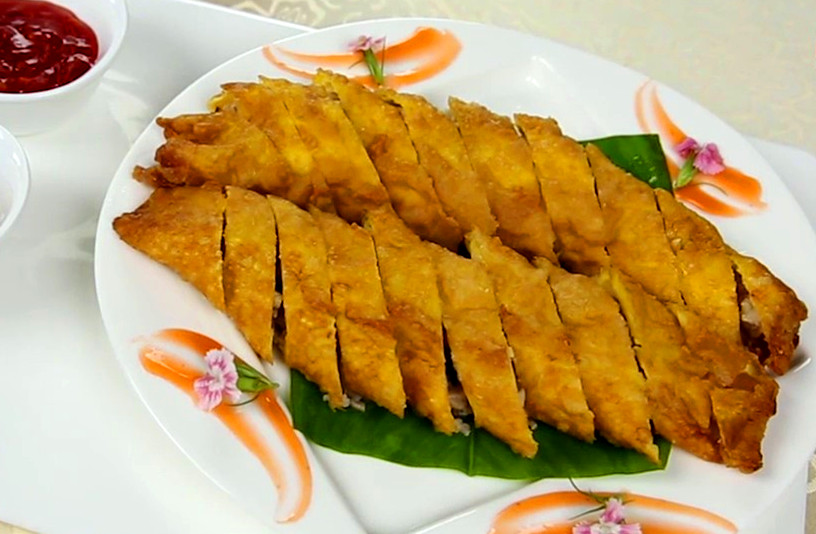
浙江菜“干炸响铃”见图2-4-1,广东菜“三鲜春卷”,四川菜“腐皮虾卷”,江苏菜“网油鸭卷”,山东菜“荠菜鱼卷”,北京菜“炸卷肝”见图2-4-2等。

Zhejiang cuisine "dry fried bell" (see figure 2-4-1), Guangdong cuisine "three fresh spring rolls", Sichuan cuisine "rotten skin shrimp rolls", Jiangsu cuisine "net oil duck rolls", Shandong cuisine "shepherd's purse fish rolls", Beijing cuisine "fried liver rolls" (see figure 2-4-2), etc.
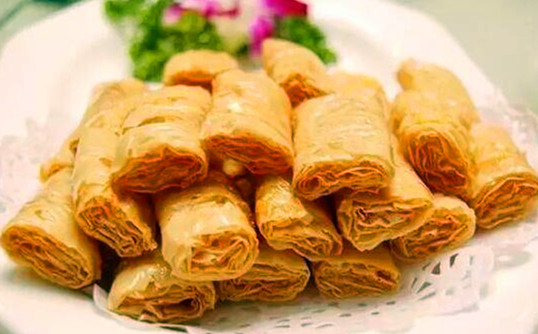
                图 2-4-1 干炸响铃  Fig. 2-4-1 dry explosion bell
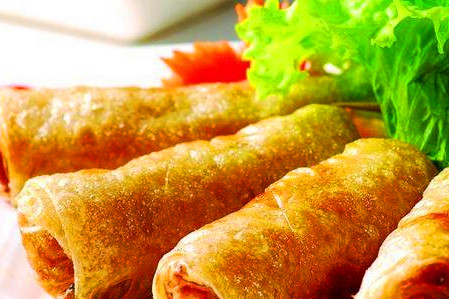
            图 2-4-2 炸卷肝 Fig. 2-4-2 fried roll liver