
How is the weather today? And what was the weather like yesterday?
Every radio and TV show, and many newspapers and websites, report the weather. They give weather forecasts (what they think the weather well be in the future) and sometimes they report on what the weather has been in the past.
Talking about the weather is a neutral topic of conversatio with people you don't konw well; for example, when you're waiting ofr a bus or sitting in a donctor's office.
Lead-in
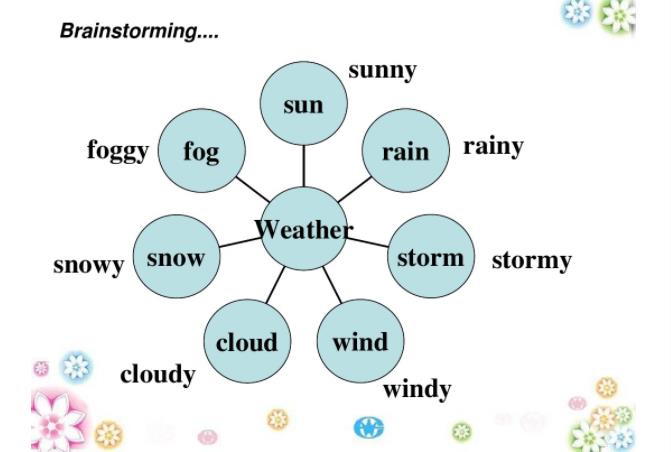
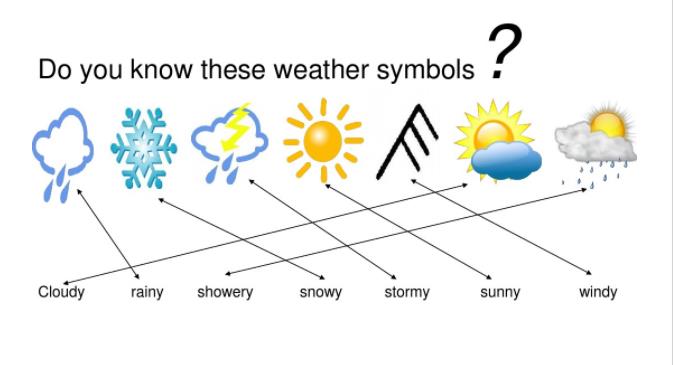

Pair work
1. Figure out the meaning of each word
G(1) blustery; chilly; freezing; muggy; breezy; drizzly; sweltering; clear; mild; humid; overcast
G(2) downpout; shower; sleet; blizzard; hail; gale; thunder; mist; frost; dew
2. Can you put the following phrases into Chinese?
(1) weather bureau; (2) weatherman; (3) today's graphic; (4) continental climate; (5) oceanic climate; (6) monsoon climate; (7) subtropical zone; (8) visibility
[Cultural Tip]
In the United States, Fahrenheit is still the scale for measuring temperature. On the Fahrenheit scale, water freezes at 32 and boils at 212. On the Celsius (also known as centigrade) scale, water freezes at 0° and boils at 100°. On the Fahrenheit scale, normal human body temperature is 98.6°.
Task 1
Listening Aids
Alaska: 阿拉斯加(美国州名)
Amarillo: 阿马里洛(美国得克萨斯州西北部城市)
Laredo: 拉雷多(美国得克萨斯州南部城市)
In this task, you are going to learn something about the different weather patterns in Texas, US.
Choose the best answer to each of the following questions.
1) Which of the following statements is correct in describing the size of Texas?
a) Texas is the largest state in the US.
b) Texas is the second largest state in the US.
c) Texas ranks the forty-ninth in terms of the size.
d) Texas is smaller than Alaska, but it is a little bigger than many other states in the US.
2) Which of the following statemnt is correct about the weather in Texas?
a) Texas has different kinds of weather patterns as it is such a big state.
b) The weather in Alaska must be more varied than that in Texas, since it covers a larger area.
c) Texas has the coldest place in winter in the US.
d) Texas has the warmest place in summer in the US.
3) If you were going to travel in Texas, how would you plan your tour to enjoy nice weather everywhere you went?
a) Visit Laredo in summer and Amarillo in winter.
b) Visit Laredo in winter and Amarillo in summer.
c) Visit Laredo in spring and Amarillo in autumn.
d) Visit Laredo in winter and Amarillo in autumn.
Task 2
Listenig Aids
draughty (adj.): with cold air blowing through
drizzle (n.): weather that is a combination of light rain and mist
notorious (adj.): famous or well-known for sth. bad
In this part, you are going to hear a comment on the British climate and the British weather from an international student studying there.
A. Decide whether the following statements are true (T) or false (F) according to the tape.
1) The extreme weather in Britain never lasts long. [ ]
2) There is a huge amount of rain in Britain. [ ]
3) People coming to Britain should be prepared for the notorious fogs. [ ]
B. Choose the best answer to each of the following questions.
1) What is Nick's explanation for the bad reputation of the British climate?
a) It is very cold.
b) It rains heavily.
c) The dense fog often frustrates people.
d) The weather often changes quickly and unpredictably.
2) What does NOT account for the fact that you could feel cold at almost any time of the year in Britain?
a) Draughty British houses.
b) Little sunshine.
c) Fog.
d) Humidity.
3. Which of the following is NOT Nick's implication by saying "to understand the meaning of the splended word 'drizzle'"?
a) He advised people coming to Britain to bring an umbrella.
b) He realized thatt British weather is terrible.
c) He thought learning English well could help foreigners to live in Britain.
d) He thought it rains often but not always heavily in Britain.
C. Fill in the blanks with what you hear on the tape.
Why then, he asked, has the British _________ such a bad _________? He answered by saying it was because of the __________, __________ weather. There was no part of the year at which you could be certain the weather would be _________ or _________, __________ or _________, _________ or _________. A _________ day in July could be as cold as a _________ day in January.

