
Task 3
Listening Aids
folk dance: a traditional dance from a particular area
square dance: a type of traditional country dance in which four pairs of dancers face each other in a square, and sb. calls out the movements they should do 方块舞
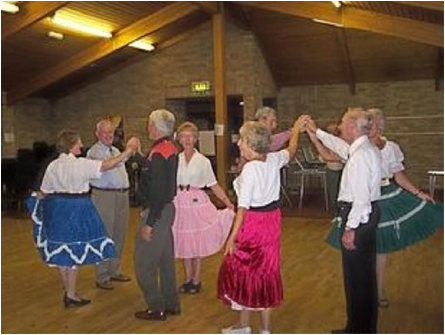
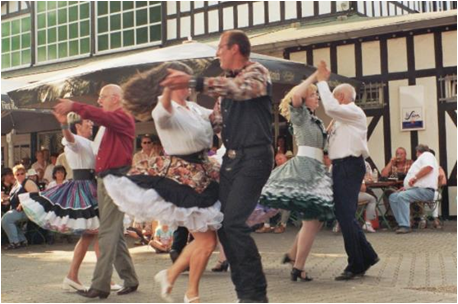
In this task, you'll listen to a conversation about folk dances in the United States.
A. answer the following questions.
1) What is the difference between the folk dances in the US and other countries?
____________________________________________________________________________
2) How many dancers are there in a folk dance in the US according to the man?
______________________________________________________________________
3) Why is it called square dance?
______________________________________________________________________
4) How does the man tell the dancers what they should do?
______________________________________________________________________
5) What kind of clothes do people wear in folk dancing?
______________________________________________________________________
B. Decide whether the following statements are true (T) or false (F) according to the tape.
1) There is only one folk dancing group in each city in the United states. [ ]
2) Usually there are four men and four women in a folk dancing group. [ ]
3) In square dancing, there are four people on each side of the square. [ ]
4) A man usually speaks quickly to tell the dancers what they should do. [ ]
5) People dance fast, therefore there is not much time for them to think of the instructions in the song. [ ]
C. Complete the following sentences with what you hear on the tape.
1) In square dancing, usually _________________________ when they start, with a man and a woman _______________________________.
2) Then there's a man who tells the dancers _________________________________. He usually ________________________, and _________________________ while they dance.
3) Folk dancing in the Unites States is ery fast; people ______________________.
4) The dancers wear ________________________. They make the dances ______________________.
Task 4
Pre-listening discussion
Talk about some of the interesting customs in China (e.g. customs associated with marriage, birthday, New Year, change of seasons, etc.)
Listening Aids
Czech: 捷克【欧洲中部国家】
Lent (n.): the 40 days before Easter when some Christians eat less food or stop doing sth. that they enjoy 大斋节
omelet (n.): eggs mixed together and cooked in hot fat, sometimes with other foods added
In this task, you'll listen to six customs in different countries.
A. Answer the following questions.
1) What was known as "Setsubun"?
______________________________________________________________
2) What did many Chinese families burn to bring good luck before the Chinese Lunar New Year?
______________________________________________________________
3) What was the old custom in choosing what to wear by brides in America?
______________________________________________________________
4) Why did the people of Ponti, Italy eat an omelet made with 1,000 eggs before Lent?
______________________________________________________________
5) What was a "Smrt"?
______________________________________________________________
6) What did people do on St. Anthony's Day in Mexico?
______________________________________________________________
B. Describe the six customs in your own words.
Dictation
In this task, you'll hear an introductory passage on social customs and behaviours.
Write down each word you hear
__________________________________________________________________________________
__________________________________________________________________________________
__________________________________________________________________________________
__________________________________________________________________________________

