

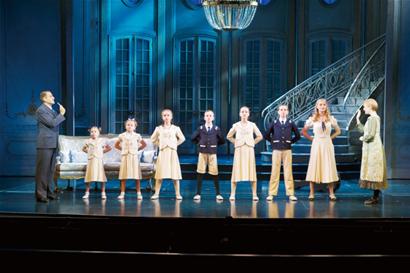
The Sound of Music is one of the most classic Hollywood musicals.It is based on Maria Augustus Travolta’s (玛利亚·奥古斯都·特拉普) autobiography. The Sound of Music was first shown on Lunt-Fontanne Theatre (鲁德-方特恩剧院) of Broadway (百老汇) on November 16,1959.The film was released by 20th Century Fox in 1965 and has been one of the top blockbusters in Hollywood. It is a heartwarming film that tells the story of the rise of Nazi power in Austria in the 1930s just prior to WWII, the Nazi influence is felt more or less as a background to the story until the final minutes of the movie, and how one family coped with the historic and frightening events swirling around them.
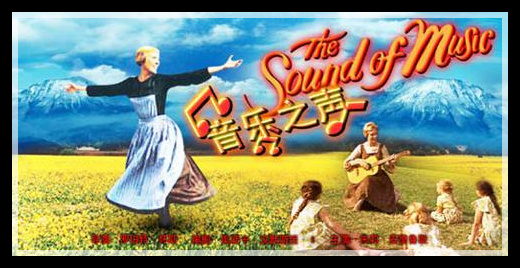
Sweet songs are the biggest attractions of the film and after half a century are still sung unabated. For example the theme song “the Sound of Music” expresses the love to the nature, the active songs “The Lonely Goatherd” and “Do-Re-Mi”, and the song “Edelweiss” full of the love to the county, the lovely children singing of “So Long, Farewell” and so on. These songs let people fully experience the art and the beauty of nature. It is music that makes all the things harmonious and leads it to a happy ending. It seems the power of music is great and what really touches everyone's heart is the pure love hidden behind the music. Throughout the movie the beautiful songs have made these pleasant and cherished art images exist in the human world forever.
Edelweiss(雪绒花)
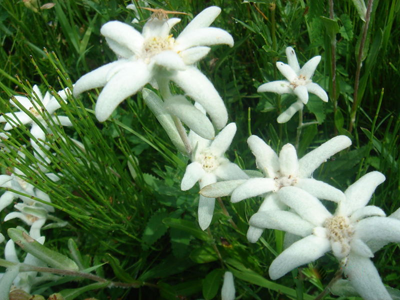
"Edelweiss" is a show tune from the 1959 Rodgers and Hammerstein(罗杰斯与汉默斯坦)musical The Sound of Music. It is named after the edelweiss,a white flower found high in the Alps(阿尔卑斯山脉). It was created for the character of Captain Von Trapp, a hero in the 1959 Broadway production of the musical by folk-singer Theodore Bikel(西奥多·比凯尔). In the musical Captain Von Trapp and his family sing this song as a statement of Austrian patriotism in the face of the pressure put upon him to join the navy of Nazi Germany. It is also Captain Von Trapp's subliminal goodbye to his beloved homeland, using the flower as a symbol of his loyalty to it. In the 1965 film adaptation, the song is also sung by the Captain earlier in the film as he rediscovers music and a love for his children.
Nazi Germany

Nazi Germany is the common English name for the period in German history from 1933 to 1945,when Germany was governed by a dictatorship under the control of Adolf Hitler(阿道夫·希特勒)and the Nazi Party (NSDAP).Under Hitler's rule,
Salzburg Festival 萨尔斯堡音乐节
The Salzburg Festival has been held in Salzburg atirregular intervals since 1877 and becomes a prominent festival of music anddrama established officially in 1920. It is held each summer (for five weeksstarting in late July) within the Austrian town of Salzburg, the birthplace ofWolfgang Amadeus Mozart. One highlight is the annual performance of theEveryman dramatization by Hugo von Hofmannsthal. Since 1967, there is also anannual Salzburg Easter Festival, held by a separate organization.
Nonnberg Abbey 侬山修道院
Nonnberg Abbey is a monastery in Salzburg, Austria.It was founded ca. 714 by Saint Rupert of Salzburg and is the oldest women'sreligious house in the German-speaking world. Its first abbess was SaintErentrudis of Salzburg, who was either a niece or a sister of Saint Rupert. ThroughMaria Augusta Kutschera, later Maria Augusta von Trapp, who was a postulant inthe abbey after World War I and whose life was the basis for the film The Soundof Music, the abbey has acquired international fame.
★扩展
更多详情解析请参见推荐论文重温经典电影《音乐之声》的主题内涵.pdf(下载附件 1.05 MB)

