目录

  • 1 Unit 1 Communication
    • 1.1 导入 Lead-in
    • 1.2 对话 Dialogue
    • 1.3 课文 Text
    • 1.4 句型练习 Pattern Practice
    • 1.5 语言练习 Language Practice
    • 1.6 阅读练习 Reading Practice
  • 2 Unit 2 Family
    • 2.1 导入 Lead-in
    • 2.2 对话 Dialogue
    • 2.3 课文 Text
    • 2.4 句型练习 Pattern Practice
    • 2.5 语言练习 Language Practice
    • 2.6 阅读练习 Reading Practice
  • 3 Unit 3 Climate
    • 3.1 导入 Lead-in
    • 3.2 对话 Dialogue
    • 3.3 课文 Text
    • 3.4 句型练习 Pattern Practice
    • 3.5 语言练习 Language Practice
    • 3.6 阅读练习 Reading Practice
  • 4 Unit 4 Study
    • 4.1 导入 Lead-in
    • 4.2 对话 Dialogue
    • 4.3 课文 Text
    • 4.4 句型练习 Pattern Practice
    • 4.5 语言练习 Language Practice
    • 4.6 阅读练习 Reading Practice
  • 5 Unit 5 Revision 1
    • 5.1 新建课程目录
  • 6 Unit 6 Digital Products
    • 6.1 导入 Lead-in
    • 6.2 对话 Dialogue
    • 6.3 课文 Text
    • 6.4 句型练习 Pattern Practice
    • 6.5 语言练习 Language Practice
    • 6.6 阅读练习 Reading Practice
  • 7 Unit 7 Persistence
    • 7.1 导入 Lead-in
    • 7.2 对话 Dialogue
    • 7.3 课文 Text
    • 7.4 句型练习 Pattern Practice
    • 7.5 语言练习 Language Practice
    • 7.6 阅读练习 Reading Practice
  • 8 Unit 8 Childhood
    • 8.1 导入 Lead-in
    • 8.2 对话 Dialogue
    • 8.3 课文 Text
    • 8.4 句型练习 Pattern Practice
    • 8.5 语言练习 Language Practice
    • 8.6 阅读练习 Reading Practice
  • 9 Unit 9 Teamwork
    • 9.1 导入 Lead-in
    • 9.2 对话 Dialogue
    • 9.3 课文 Text
    • 9.4 句型练习 Pattern Practice
    • 9.5 语言练习 Language Practice
    • 9.6 阅读练习 Read Practice
  • 10 Unit 10 Revision 2
    • 10.1 新建课程目录
阅读练习 Reading Practice


Good Manners

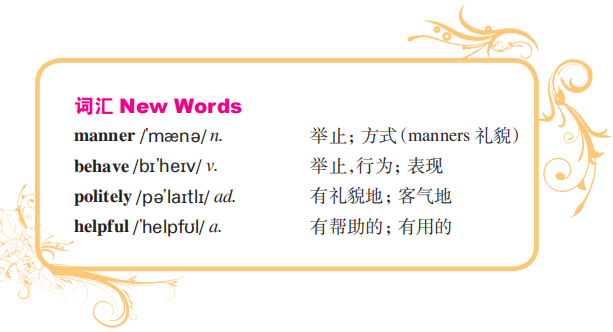
We say that a person has good manners if he or she behaves politely and is kind and helpful to others. Everyone likes a person with good manners, but what are good manners?

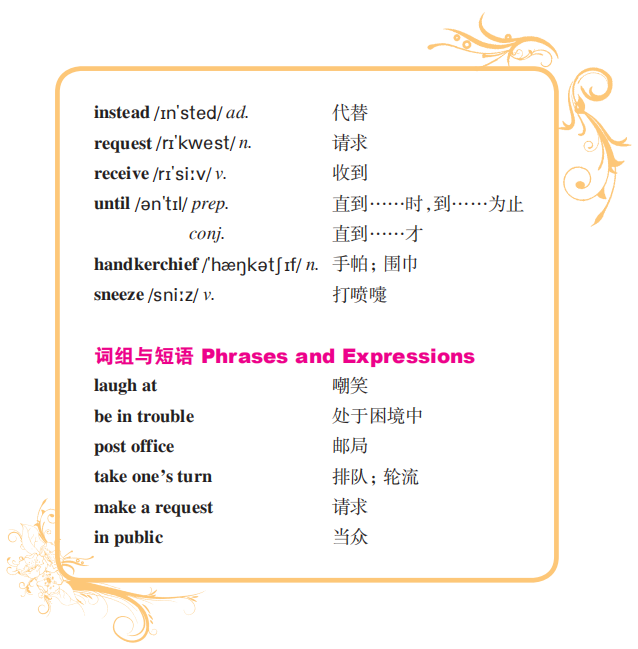
A person with good manners never laughs at people when they are in trouble. Instead, he tries to help them. He is always kind. When people are waiting for a bus, or in a post office, he takes his turn. He does not push to the front of the line.

He says “Please” when he makes a request, and “Thank you” when he receives something. He stands up when he is speaking to a lady or an older person. He does not sit down until the other people are seated. He does not interrupt other people when they are talking. He does not talk loudly in public. When he is eating he does not speak with his mouth full of food. He uses a handkerchief when he sneezes or coughs.