
【Vocabulary & Phrases】

【Reading】
Structureof Automobiles
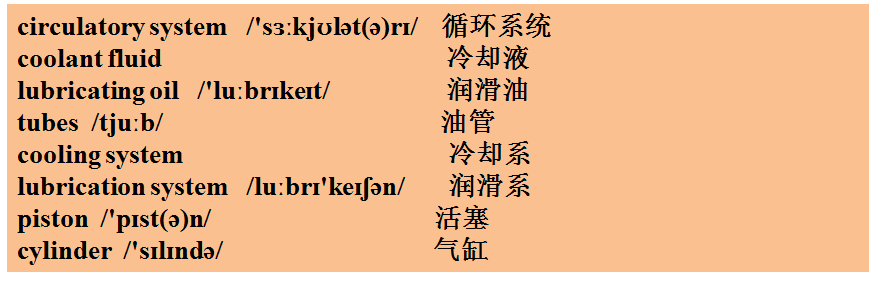
Thousands of individual parts make up the modern automobile. Much like the human body,these parts are arranged into several semi-independent systems, each with a differentfunction. For example, the human circulatory system comprises the heart, bloodvessels, and blood. The automobile contains analogous circulatory systems forcoolant fluid (mostly water), for lubricating oil, and for fuel. The engine—the “heart” of the automobile —is comprised of pistons, cylinders, tubes todeliver fuel to the cylinders, and other components. Each system is necessaryfor making the automobile run and reducing noise and pollution.
The major systems of an automobile are the engine, fuel system, transmission,electrical system, cooling and lubrication system, and the chassis, whichincludes the suspension system, braking system, wheels and tires, and the body.These systems will be found in every form of motor vehicle and are designed tointeract with and support each other.
1. Engine
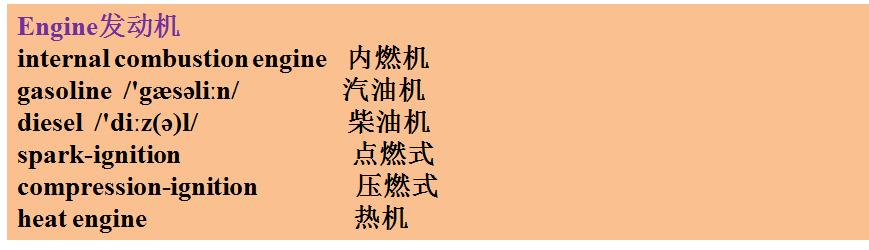
The engine acts as the power unit. The internal combustion engine is most common:this obtains its power by burning a liquid fuel inside the engine cylinder.There are two types of engine: gasoline (also called a spark-ignition engine)and diesel (also called a compression-ignition engine). Both engines are calledheat engines; the burning fuel generates heat which causes the gas inside thecylinder to increase its pressure and supply power to rotate a shaft connectedto the transmission.
2. Body
The body of a car is usually composed of steel or aluminum,althoughfiberglass and plastic are also used. The body is actually a part of thechassis, the whole formed by welding stamped components into a single unit.While the body forms the passenger compartment, offers storage space, andhouses the automobile’s systems,it has otherimportant functions as well. Passenger safety is achieved by providing structuralsupport strong enough to withstand the force of an accident. Other parts of thecar, such as the front and hood, are designed to crumple in a crash, therebyabsorbing much of the impact. A firewall between the engine and the interior ofthe car protects the passengers in case of an engine fire. Lastly, the body’sshape contributes to reducing the level of wind resistance as the car moves,allowing the driver better handling and improving fuel efficiency.
3. Chassis
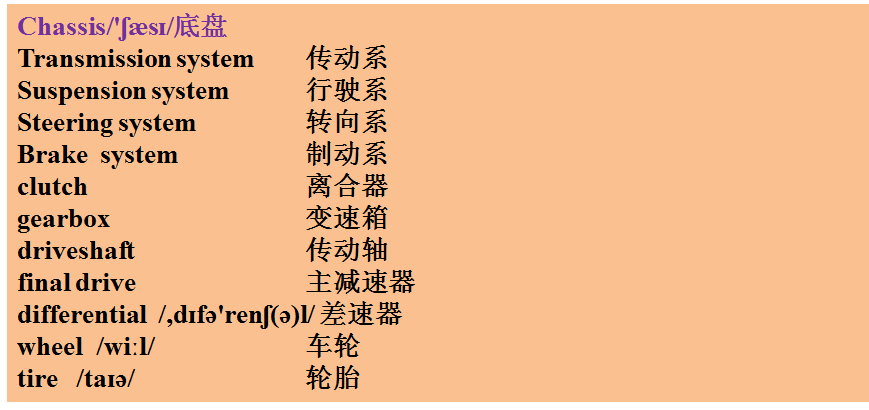
The chassis is the framework to which the various parts of the automobile aremounted. The chassis must be strong enough to bear the weight of the car, yetsomewhat flexible in order to sustain the shocks and tension caused by turningand road conditions. Attached to the chassis are the wheels and steeringassembly, the suspension, the brakes, and the body. The chassis includes thetransmission, suspension, steering, and brake systems.
Transmissionsystems — conveys the drive to the wheels. The main components are clutch, gearbox,driveshaft, final drive, and differential.
Suspension— absorbs the road shocks.
Steering— controls the direction of the movement.
Brake— slows down the vehicle.
4. Electrical System
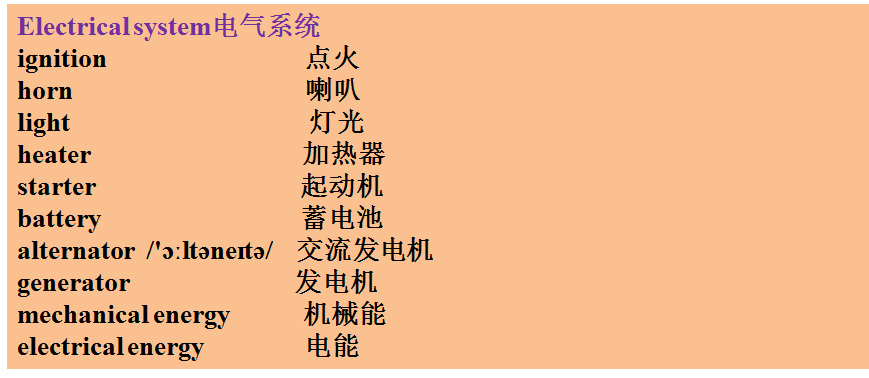
The electrical system supplies electricity for the ignition, horn, lights, heater,and starter. The electricity level is maintained by a charging circuit. Thiscircuit consists of the battery, alternator (or generator). The battery stores electricity.The alternator changes the engine’s mechanical energy into electrical energy andrecharges the battery.
【Speaking】
Role play the dialogue with your partner!

