Bildungsroman
Bildungsroman is a German word meaning "novel of education". It is a novel that traces the spiritual, moral, psychological, or social development and the growth of the main character, usually from youth to maturity. That is why sometimes it is called a coming-of-age novel. The genre originated in Germany in the latter half of the 18th century and has since become a popular genre in European and Anglo-American literature. The plot of such a novel has the following features: It describes the growth of the protagonist from child to adult in the novel. At an early stage, the hero or heroine leaves home or the family setting because of some loss or discontent and embarks on a journey. The growth process then becomes both "an apprenticeship to life" and a "search for meaningful existence within society." The journey is then essentially the quest story of the protagonist and ends when he/she is accommodated into society and arrives at some new understanding of human nature and life.
Picaresque Novel
Originated in Spain, the genre was popular in Europe in the 17th and 18th centuries and continues to influence modern literature. The picaresque novel, often realistic in manner and satirical in nature, recounts in a first-person narrative the episodic adventures of a roguish hero of low social class (Spanish, picaro), who drifts from place to place and fromone social milieu to another in an effort to survive. The device of using a clever and dynamic central figure gives the author the opportunity to question the traditional religious and moral values and to present fresh moral insights into society.
Realistic Novel
A type of novel that places a strong emphsis on the truthful representation of the actual in fiction. Tenerally, the realist is a believer in pragmatism, and the truth he seeks to find and express is a relativistic truth, associated with discernible consequences and verifiable by experience. Gennerall, too, the realist is a believer in democracy, and the materials he elects to to describe are the common, the average, the everyday.
--Holman's Handbook to Literature
A type of novel characterized as the fictional attempt to give the effect of realism by representing complex characters with mixed motives who are rooted in a social class, operate in a highly developed social structure, interatct with many other characters, and undergo plausible and everyday modes of experience.
--Abrams' Glossary of Literary Terms
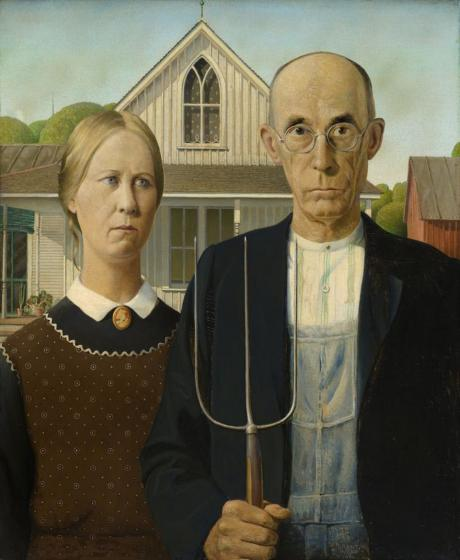
Local colorism
Local Colorism as a trend became dominant in
American literature in the late 1860s and early
1870s. It is a variation of American literary realism.
It is also the earliest representation of American
realistic literature.
Generally, the writings of local colorists are
concerned with the life of a small, well-defined
region or province. The task of local cotourists is
to write or present local characters of the very
regions in truthful depiction distinguished from
others.
It representatives are Mark Twain and Hamlin
Garland whose"Under the Lion's Paw"is a good
example of local color fiction.
Post-Civil War America was large and diverse
enough to sense its own local differences.
Regional voices had emerged."Local colorism"is
a unique variation of American literary realism.
They worked from personal experience and
suggested that the native life was shaped by the
curious conditions of the locale. Their materials
were necessarily limited and topics disparate, yet
they had certain common artistic concerns.