Text C The Gulf War
1. The excitement caused by the drawing down of the Cold War was dramatically overshadowed by the August 2, 1990, invasion of the small nation of Kuwait by Iraq. Iraq, under Saddam Hussein, and Iran, under its Islamic fundamentalist regime, had emerged as the two major military powers in the oil-rich Persian Gulf area. The two countries had fought a long war in the 1980s. Less hostile to the United States than Iran, Iraq had won some support from the Reagan and Bush administrations. The occupation of Kuwait, posing a threat to Saudi Arabia, changed the diplomatic calculation overnight.
2. President Bush strongly condemned the Iraqi action, called for Iraq’s unconditional withdrawal, and sent a major deployment of U.S. troops to the Middle East. He assembled one of the most extraordinary military and political coalitions of modern times, with military forces from Asia, Europe, and Africa, as well as the Middle East.
3. In the days and weeks following the invasion, the U. N. Security Council passed 12 resolutions condemning the Iraqi invasion and imposing economic sanctions on Iraq. On November 29, it approved the use of force if Iraq did not withdraw from Kuwait by January 15, 1991. Gorbachev's Soviet Union, once Iraq's major arms supplier, made no effort to protect its former client.
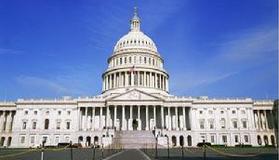
4. Bush also confronted a major constitutional issue. The U. S. Constitution gives the legislative branch the power to declare war. Yet in the second half of the 20th century, the United States had become involved in Korea and Vietnam without an official declaration of war and with only legislative authorization. On January 12,1991,three days before the U. N. deadline, Congress granted President Bush the authority of war- making power.
5. The United States, in coalition with Great Britain, France, Italy, Saudi Arabia, Kuwait, and other countries, succeeded in liberating Kuwait with a U.S.--led air campaign that lasted slightly more than a month. With the superior speed, mobility, and firepower, the allied forces overwhelmed the Iraqi forces in a land campaign lasting only100 hours.
6. The victory, however, was incomplete and unsatisfying. The U.N. resolution called only for the expulsion of Iraq from Kuwait. Saddam Hussein remained in power, savagely repressing the Kurds in the north and the Shiites in the south, both of whom the United States had encouraged to rebel. Hundreds of oil-well fires, deliberately set in Kuwait by the Iraqis, took until November 1991 to extinguish. Saddam's regime also apparently prevented U. N. inspectors who worked to locate and destroy Iraq's weapons of mass destruction, including nuclear facilities more advanced than had previously been suspected and huge stocks of chemical weapons.
7. The Gulf War enabled the United States to persuade the Arab states, Israel, and a Palestinian delegation to begin direct negotiations aimed at resolving the complex and interlocked issues that could eventually lead to a lasting peace in the region. The talks began in Madrid, Spain, on October 30, 1991. In turn, they set the stage for the secret negotiations in Norway that led to what at the time seemed a historic agreement between Israel and the Palestine Liberation Organization, signed at the White House on September13, 1993.
Questions for Discussion or Reflection
(1) What was the major cause of the Gulf War?
(2) What was the major constitutional issue that Bush confronted?
(3) What else do you know about the Gulf War? Discuss the significance and the impact of the war with your partner.

