Text D The Space Race
1. During Eisenhower's second term, outer space had become an arena for U. S.-Soviet competition. In 1957, the Soviet Union launched Sputnik - an artificial satellite thereby demonstrating it could build more powerful rockets than the United States. The United States launched its first satellite, Explorer I, in 1958. But three months after Kennedy became president, the U.S.S.R. put the first man in orbit. Kennedy responded by committing the United States to land a man on the moon and bring him back “before this decade is out”. With Project Mercury in 1962, John Glenn became the first U. S. astronaut to orbit the Earth.
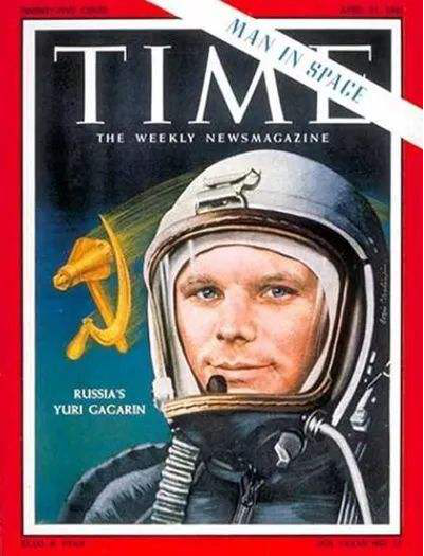
On April 12, 1961, Yuri Gagarin became the first human member to enter space, making the Soviet Union defeat the United States again.
2. After Kennedy's death, President Lyndon Johnson enthusiastically supported the space program. In the mid-1960s, U.S. scientists developed the two-person Gemini spacecraft. Gemini achieved several firsts, including an eight-day mission in August 1965--- the longest space flight at that time and in November1966,the first automatically controlled reentry into the Earth’s atmosphere. Gemini also accomplished the first manned linkup of two spacecraft in flight as well as the first U.S. walks in space.
3. The three-person Apollo spacecraft achieved Kennedy's goal and demonstrated to the world that the United States had surpassed Soviet capabilities in space. On July 20, 1969, with hundreds of millions of television viewers watching around the world, Neil Armstrong became the first human to walk on the surface of the moon.
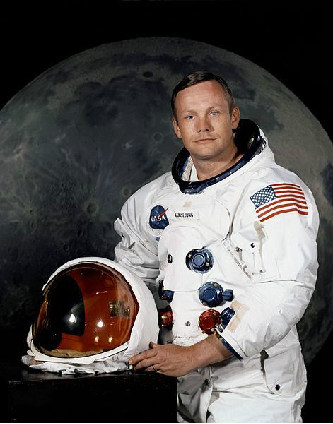
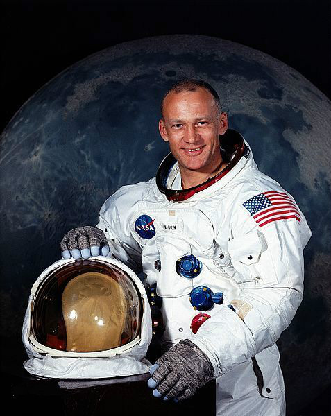
Neil Armstrong and Buzz Aldrin, in Apollo XI, were the first men to walk on the moon in 1969.
4. Other Apollo flights followed, but many Americans began to question the value of manned space flight. In the early 1970s, as other priorities became more pressing, the United States scaled down the space program. Some Apollo missions were scrapped; only one of two proposed Skylab space stations was built.
Questions for Discussion or Reflection
(1) What is Sputnik?
(2) Who was the first U.S. astronaut to orbit the Earth?
(3) What demonstrated to the world that the United States had
surpassed Soviet in space?
(4) Who was the first man to walk on the surface of the moon?
(5) Do you think that the space race is justifiable?
Proper Names
Alan Shepard 艾伦·谢泼德 (美国第一位进入太空的宇航员)
Buzz Aldrin 巴兹·奥尔德林 (第二位登上月球的宇航员)
Fidel Castro 菲德尔·卡斯特罗
Martin Luther King 马丁·路德·金
Neil Armstrong 尼尔·阿姆斯特朗(第一位登上月球的宇航员)
Stokely Carmichael 斯托克利·卡迈克尔 (黑人民权领袖)
the Bay of Pigs invasion 猪湾事件
The Civil Rights Act 《美国民权法案》
the Paris Peace Accords 《巴黎和平协议》
the Space Race 太空竞赛
the Vietnam War 越南战争
the Woodstock Festival 伍德斯托克音乐节
Notes
1. The Bay of Pigs Invasion: It is an unsuccessful attempt
by United States -- backed Cuban exiles to overthrow the
government of Fidel Castro. Increasing friction between the U. S.
government and Castro’s administration led President
Dwight D. Eisenhower to break off diplomatic relations with Cuba
in January1961. Even before that, however, the Central
Intelligence Agency had been training anti-revolutionary Cuban
exiles for a possible invasion of the island. The invasion plan was
approved by Eisenhower’s successor, John F. Kennedy.
2. The Civil Rights Act ( 1964): This act, signed into
law by President Lyndon Johnson on July 2, 1964,prohibited
discrimination in public places, provided for the integration of
schools and other public facilities, and made employment
discrimination illegal. This document was the most sweeping civil
rights legislation since Reconstruction.
3. Hippies:The hippie subculture originally a youth
was movement that began in the United States during the
early 1960s and spread around the world. These people inherited
the countercultural values of the Beat Generation, created their own
communities, listened to psychedelic rock, embraced the sexual
revolution, and used drugs to explore alternative states of
consciousness.
4. Hispanic Americans: Hispanic and Latino Americans
are Americans of origins in Hispanic countries of Latin America or
in Spain. The group encompasses distinct sub-groups by national
origin and race, and there is much diversity of race and ancestry
within national origin groups as well. Hispanic and Latino
Americans are the largest ethnic minority in the United States;
African Americans, in turn, are the largest racial minority after
white Americans in general.
5. The Woodstock Festival: Woodstock is a music festival. The
festival exemplified the counterculture of the late 1960s to early
1970s and the “hippie era”. Thirty-two of the best-known
musicians of the day appeared during the sometimes rainy weekend
in front of nearly half a million concertgoers. Although attempts
have been made over the years to emulate the festival, the original
event has proven to be unique and legendary. It is widely regarded
as one of the greatest moments in popular music history and was
listed on “Rolling Stone's 50 Moments That Changed the History
of Rock and Roll”.
6. Stokely Carmichael: He is an American black activist active in
the1960s American Civil Rights Movement. He rose to
prominence first as a leader of the Student Nonviolent Coordinating
Committee (SNCC).

