Unit 5 The Westward Movement

Unit Goals
● To understand the motivations of people’s moving westward.
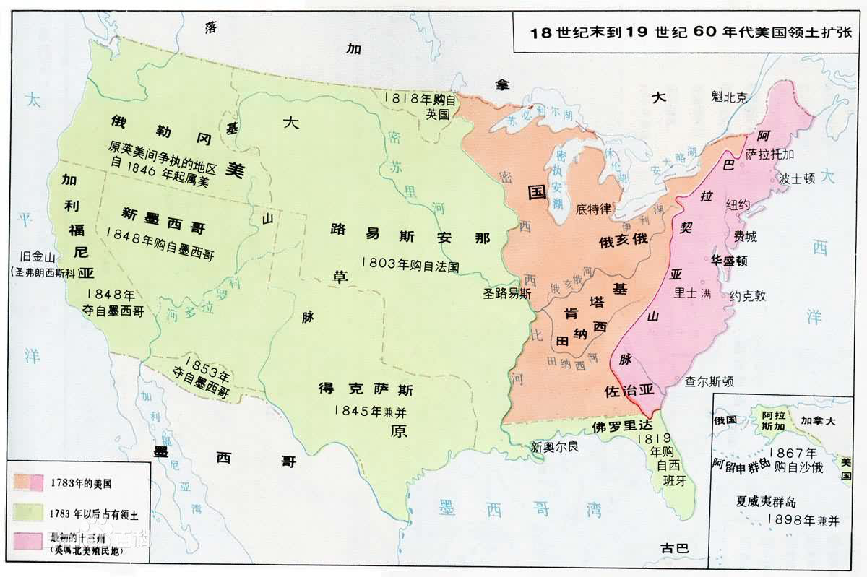
● To learn about the territory expansion of the U. S.
● To be acquainted with the Gold Rush.
● To learn the useful words and expressions concerning the history of Westward Movement of America.
● To improve English language skills.
Before You Read
1. What impact did the migration have on Native Americans and the environment?
————————————————
Impacts ————————————————
————————————————
————————————————
2. Do you think the westward expansion could repeat itself in another part of the world?
3. What could be the possible motivations of the westward expansion?
4. Form groups of three or four students. Try to find, on the Internet or in the library, more information about the West Movement which interests you most. Prepare a 5-minute classroom presentation.
Start to Read
Text A The Frontier of the American West
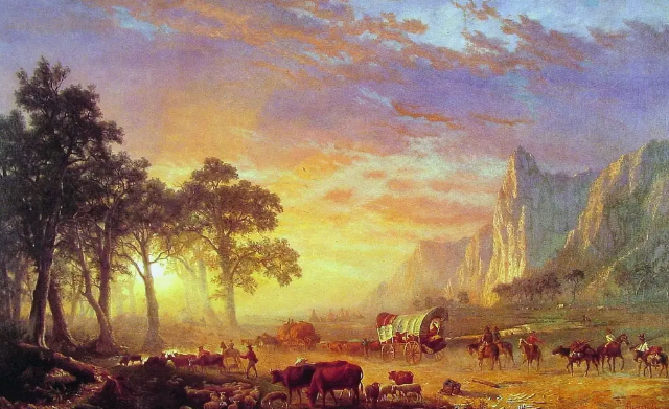
1. American Westward Movement largely meant movement of people from the settled regions of the United States to lands farther west. Between the early 17th and late 19th centuries, Anglo-American peoples and their societies expanded from the Atlantic Coast to the Pacific Coast. This westward movement, across what was often called the American frontier, was of enormous significance. By expanding the nation’s borders to include more than three million square miles, the United States became one of the most powerful nations of the 20th century. However, this expansion also resulted in great suffering, destruction, and cultural loss for the Native Americans of North America.
2. After the 13 colonies won their independence from Great Britain and became the United States, they began to settle their land to the west. The first area of settlement was the U.S. territory that spanned to the Mississippi River. The population of the United States in 1790 was 3,929,214.
3. Before Anglo-American westward expansion, North America had been shaped by many other forces and cultures. There were hundreds of Native American tribes who had been living on the continent for thousands of years before any Europeans arrived. Many of these tribes disappeared because of the assault of European exploration and settlement.
4. England established its first Atlantic colonies in Virginia at Jamestown in 1607 and in Massachusetts. These first English frontiers illustrated two of the most common motivations for people moving westward. The first motivation was the hope of finding great wealth quickly through developing and trading the colonies’ resources. Jamestown was settled for this reason. The earliest dreams of mining for gold and producing wine and silk came to nothing, but in time Virginians found prosperity in the rich soil, especially by raising and exporting tobacco. Over the next 400 years, the economic motive, in particular the desire for good and cheap farmland would be the most powerful attractions for people moving west.
5. The second common motivation was the hope of practicing their religion without government intervention. The Puritan settlers of Massachusetts wanted to build a community based on religious ideas that were opposed by the British government. The frontier was home to dozens of colonies looking for freedom, religious and otherwise.
6. Those first Atlantic colonies also illustrated the contradictory roles that government played in westward expansion. The Puritans settled in Massachusetts with the permission, and sometimes the protection, of the same government whose policies they were trying to escape. Governments, first England and then the United States, always encouraged movement westward in a variety of ways. These governments bought or seized land from others and gave it away or sold it cheaply to emigrants. The governments used their military to protect settlers and financed developments, such as transportation, that made settlement easier.
7. People heading west came to expect the government’s aid and support. At the same time, settlers often resisted efforts by distant authorities to regulate how they used and lived their new lands. From the first colonies to the final farming frontiers of the 20th century, this conflicting relationship between pioneers and government was a large part of the frontier story.
8. It took Americans a century and a half to expand as far west as the Appalachian Mountains, a few hundred miles from the Atlantic coast. It took another 50 years to push the frontier to the Mississippi River. By 1830, fewer than 100,000 pioneers had crossed the Mississippi.
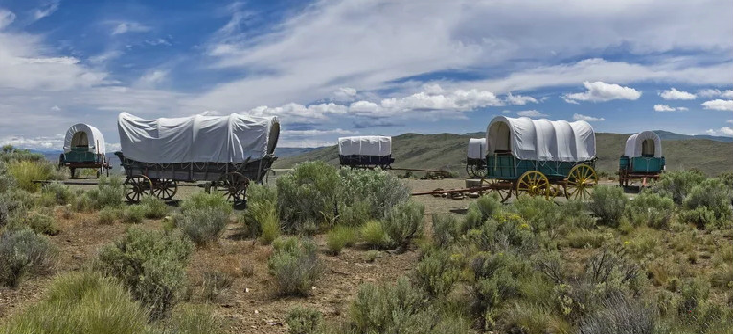
9. Only a small number of explorers and traders had ventured far beyond the Mississippi River. These trailblazers drew a picture of the American West as a land of promise, a paradise of plenty, filled with fertile valleys and rich land. During the 1840s, tens of thousands of Americans began the process of settling the West beyond the Mississippi River. Thousands of families chalked GTT (“Gone to Texas”) on their gates or on their wagons, and joined the trek westward. By 1850, pioneers had pushed the edge of settlement all the way to Texas, the Rocky Mountains, and the Pacific Ocean.
10. On January 24, 1848, less than 10 days before the signing of the peace treaty ending the Mexican War, James W. Marshall, a 36-year old carpenter and handyman, noticed several bright bits of yellow mineral near a sawmill that he was building. To test if the bits were “fool’s gold,” which shatters when struck by a hammer, Marshall “tried it between two rocks, and found that it could beaten into a different shape but not broken.” He told the men working with him: “Boys, by God, I believe I have found a gold mine.”
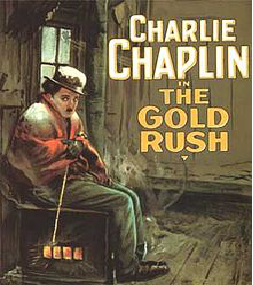

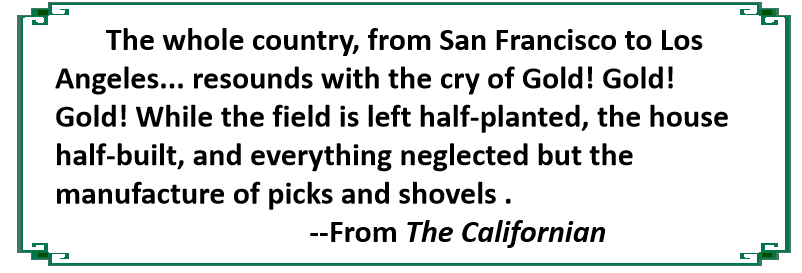
11. On March 15, a San Francisco newspaper, The Californian, printed the first account of Marshall’s discovery. Within two weeks, the paper had lost its staff and was forced to shut down its printing press. In its last edition it told its readers:
12. “The whole country, from San Francisco to Los Angeles…resounds with the cry of Gold! Gold! Gold! While the field is left half-planted, the house half-built, and everything neglected but the manufacture of picks and shovels.”
13. In 1849, 80,000 men arrived in California. Only half were Americans; the rest came from Britain, Australia, Germany, France, Latin America, and China. Sailors jumped ship; husbands left wives; apprentices ran away from their masters; farmers and business people deserted their livelihoods. By July, 1850, sailors had abandoned 500 ships in San Francisco Bay. Within a year, California’s population had swollen from 14,000 to 100,000. The population of San Francisco, which stood at 459 in the summer of 1847, reached 20,000 within a few months.
14. The Gold Rush transformed California from a sleepy society into one that was wild, unruly, ethnically-diverse, and violent. Philosopher Josiah Royce, whose family arrived in the midst of the gold rush, declared that the Californian was “morally and socially tried as no other American ever has been tried.” In San Francisco alone there were more than 500 bars and 1,000 gambling dens. In the span of 18 months, the city burned to the ground six times.
15. The Gold Rush era in California lasted less than a decade. By 1860, the romantic era of California gold mining was over. Prospectors had found more than $350 million worth of gold.
16. The exploration and settlement of the Far West is one of the great epics of the 19th century history. But America’s dramatic territorial expansion also created severe problems. In addition to providing the United States with its richest mines, greatest forests, and most fertile farm land, the Far West intensified the sectional conflict between the North and South and raised the ultimately divisive question of whether slavery would be permitted in the western territories.