
Text C Causes of the American Revolution
In explaining why the Revolution took place, it is necessary to look both at underlying causes and at the precipitating events. The Revolution was, in part, the consequence of long-term social, political, and cultural transformations. Between 1680 and 1776, a distinctly American society emerged, a society that differed significantly from Britain. In the course of a century, the colonies had diverged markedly from Britain. A variety of long-run trends gave the 13 American colonies certain common characteristics which made them very different from England.
1) The absence of a titled aristocracy
The colonies had no legally privileged social classes, and they did not have many of the other characteristics of a monarchical society. They had no standing army and had a government bureaucracy that was smaller and far less powerful than that found in Britain. While there were wealthy merchants and planters in the colonies, economic stratification was less pronounced than in Britain and membership in this affluent segment of the population was volatile and changing. To be sure, colonial society in the 18th century was, in certain respects, becoming more aristocracy. Colonial elites increasingly emulated the values and lifestyle of the English aristocracy. They aped the English elites’ dress and manners, and copied their furniture and architecture. Nevertheless, compared with Britain, few Americans had fortunes large enough to lead lives of leisure.
2) The widespread ownership of property
Except for slaves, most physical labor was performed by people who owned their own farms or shops or could expect eventually to be economically independent. Relatively few of the colonists were tenant farmers, and most yeomen maintained a remarkable degree of independence. Even in the Chesapeake region or the Hudson River Valley, where much of the land was leased, farmers still could acquire long-term leases on relatively easy terms.
3) _________________________
The colonies not only displayed a religious diversity unmatched in the western world, they were also more willing to tolerate religious difference. Four colonies – Delaware, New Jersey, Pennsylvania, and Rhode Island – had no established church. Five other states disestablished the Church of England even before the Revolution broke out.
4) The relative absence of poverty
In the 18th century England, half the population was at least occasionally dependent on charity for subsistence. Apart from slaves, the American population was far better off. Nothing better illustrates the relative affluence of the white population than the fact that the colonies were on average three inches taller than their English counterparts.
5) A lack of urban development
In 1760, the largest city in the colonies, Philadelphia, had just 20,000 inhabitants. In that year, the total number of Americans living in cities or towns with more than 3,000 residents was no greater than 70,000. The colonies had few of the attributes of an urban society: there was no large-scale manufacturing, no stock markets, few large cities, and virtually no banks in British North America.
6) A relative lack of deference to authority
The American colonists were far less deferential and less willing to accept subordination than their British or European counterparts. The colonies enjoyed the broadest suffrage of any people in the western world. Although the right to vote in colonial America was restricted to property owners, property owning was so widespread that roughly 80 percent of white adult males could vote. Although relatively few men actually voted in elections, the principle of self-government was well-developed. To gain political office, social leaders felt increasingly forced to make direct appeals to the people. Compared with Britain, popular participation in decision making was much more pronounced. Militia officers were often selected by their companies, and ministers were often hired by their congregations.
7) _________________________________________
In 1776, one-fifth of the inhabitants of the American colonies lived in bondage. Most of the growth of slavery had taken place since 1680. In 1680, Africans accounted for just five percent of population in Maryland and Virginia. But in 1760, enslaved Africans comprised nearly 40 percent of Virginia’s population. By 1776, the number of slaves in the colonies had reached 500,000. Slaves could be found in each of the 13 colonies, and were especially numerous in New Jersey and in New York’s Hudson River Valley.
The widespread presence of slavery made adult white males acutely aware of the difference between independence and dependence. Colonial Americans knew what it was like to be subjected to the will, authority, and domination of another person. By the 1770s, a growing number of Americans had begun to see their society as fundamentally different from European society. Their society was a “republican” society, a society free of many of the trappings of aristocracy and of the corruptions associated with cities and large-scale manufacturing and financial institutions. From this perspective, Americans were simpler, more independent, and more virtuous than Europeans.
Questions for Discussion or Reflection
1. The passage elaborates on the common characteristics of the thirteen colonies. However, some sub-titles remain vacant. Please read the two paragraphs first and then supply the missing sub-title for each.
2. Finish the following multiple-choice questions according to what you learned in the passage above.
(1) Between ____________, a distinctly American society emerged. It was a society that differed significantly from Britain.
A. 1680 and 1776 B. 1682 and 1772
C. 1680 and 1767 D. 1676 and 1776
(2) Which of the following is NOT the common characteristic of the 13 American colonies?
A. A lack of urban development.
B. The relative absence of poverty.
C. The widespread ownership of property.
D. A relative lack of deference to democracy.
(3) Most physical labor, except for _____________, was performed by people who owned their own farms or shops or could expect eventually to be economically independent.
A. tenant farmers B. slaves
C. yeomen D. aristocracy
(4) Which of the following was done by the American colonies to make people defer to authority?
A. Making direct appeals to the people.
B. Participation in decision making.
C. Militia officers were selected and ministers were hired.
D. All of above.
(5) Slaves could be found in all of the 13 colonies, and they were especially numerous in ____________.
A. Maryland and Virginia
B. New York’s Hudson River Valley
C. New Jersey and in New York’s Hudson River Valley
D. Philadelphia and in New York’s Hudson River Valley
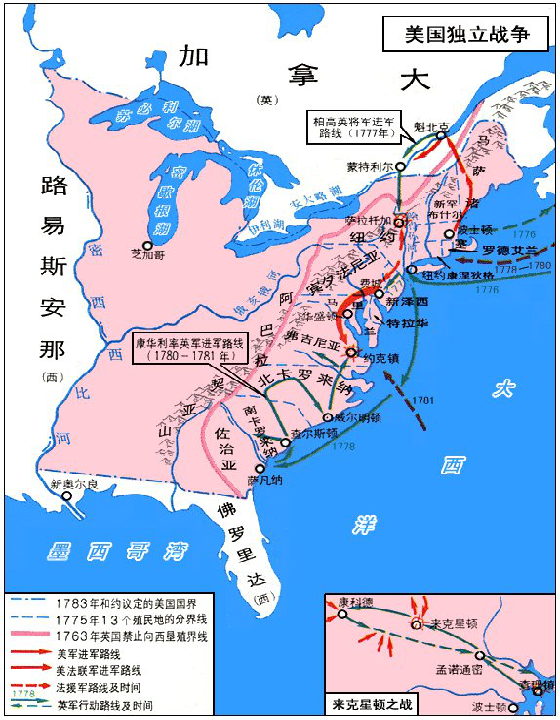
Proper Names
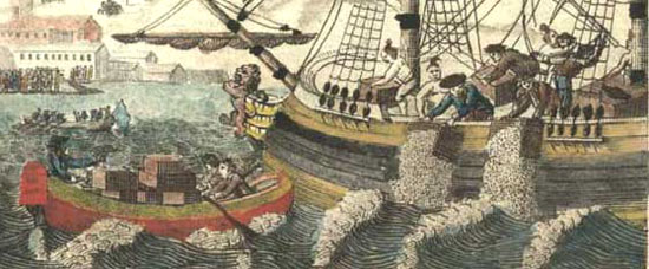
Boston Tea Party 波士顿倾茶事件
Common Sense 《常识》
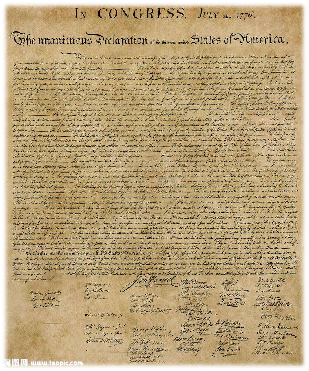
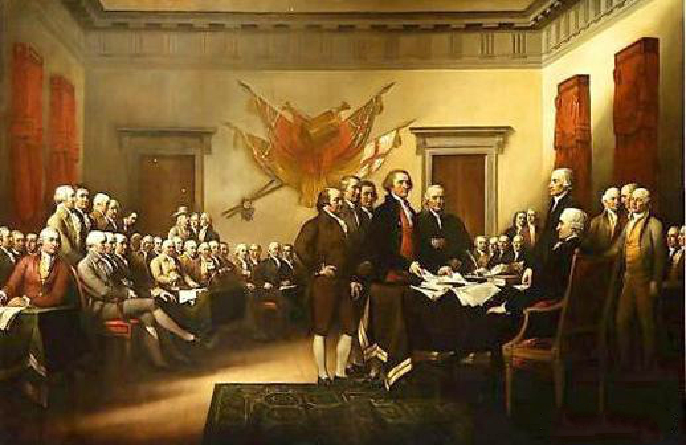
the Declaration of Independence 《独立宣言》
the East India Company 东印度公司
the First Continental Congress 第一次大陆会议
the Intolerable Acts 不可容忍法令
the Second Continental Congress 第二次大陆会议
the Seven Year’s War 七年战争
the “Sons of Liberty” 自由之子
the Stamp Act 印花税法
the Sugar Act 糖税法
The Treaty of Paris 《巴黎协定》
Notes
1. Thomas Jefferson: He was the author of the Declaration of Independence and the third president of the United States. Jefferson also founded the University of Virginia and built one of America’s most celebrated houses, Monticello, in Charlottesville, Virginia.
2. The Liberty Bell: It refers to the bell in Philadelphia, Pennsylvania, an enduring symbol of American freedom. First rung on July 8, 1776 to celebrate the adoption of the Declaration of Independence, it cracked in 1836 during the funeral of John Marshall, Chief Justice of the U.S. Supreme Court.
3. The Seven Years’ War (1756-1763): It was a war that involved all of the major European powers of the period. The war began with Frederick the Great of Prussia’s invasion of Saxony and ended France’s position as a major colonial power in the Americas until the time of the French Revolution. It was the first conflict in human history to be fought around the globe, although most of the combatants were either European nations or their overseas colonies.

