Unit 3
The Road to Independence

The real epic advertisement of the declaration of independence with Chinese subtitles.mp4
Unit Goals
※ To know the situation before the War of Independence.
※ To learn the history of the revolutionary period.
※ To understand the significance of the Declaration of
Independence.
※ To learn the useful words and expressions about the War of
Independence.
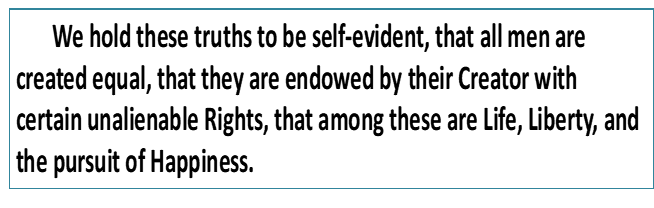
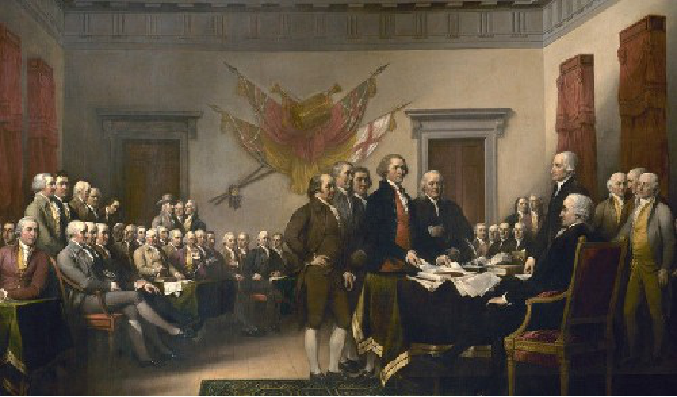
※ To improve English language skills.
Before You Read
1. What is your interpretation of “independence”? Are you independent now in any sense? Are you independent financially or spiritually? Do you agree with the following statements about “independence”? Share your views with your classmates.
2. What do you know about the causes of the War of Independence?
3. Find some information about the author of the Declaration of Independence. And share the information with your classmates.
4. Form groups of three or four students. Try to find, on the internet or in the library, more information about the War of Independence which interests you most. Get ready for a 5-minute presentation in class.
Start to read
Text A The War of Independence

1. Although some believe that the history of the American Revolution began long before the first shots were fired in 1775, England and America did not begin an overt parting of the ways until 1763. In that year the Seven Years’ War (1754-1763) ended, during which Britain and France fought over the control of North American colonies. In the end Great Britain defeated France and removed the long-standing threat to the colonies. However, Britain also accumulated a large debt over the course of war. To help pay off the debt, Britain turned to the colonies to generate revenue and in so doing they came into conflict with the interest of the colonies.
2. The colonies had grown vastly in economic strength and cultural attainment, and actually all had long years of self-government behind them. Long accustomed to a large measure of independence, the colonies were demanding more freedom. Fast increasing in population, and needing more land for settlement, various colonies claimed the right to extend their boundaries as far west as the Mississippi River.
3. The British government, which needed more money to support its growing empire, took measures. The first step was the enforcement of the “Sugar Act” of 1764. This act outlawed the importation of foreign liquor; it also put a modest duty on molasses from all sources and levied taxes on wines, silks, coffee, and a number of other luxury items. Another measure, known as the “Stamp Act”, sparked the greatest resistance. It provided that revenue stamps be attached to all newspapers, pamphlets, licenses or other legal documents, the revenue to be used for “defending, protecting and securing ” the colonies. Trade with the mother country fell off sharply in the summer of 1765, as prominent men organized themselves into the “Sons of Liberty” — secret organizations formed to protest the Stamp Act, often through violent means.
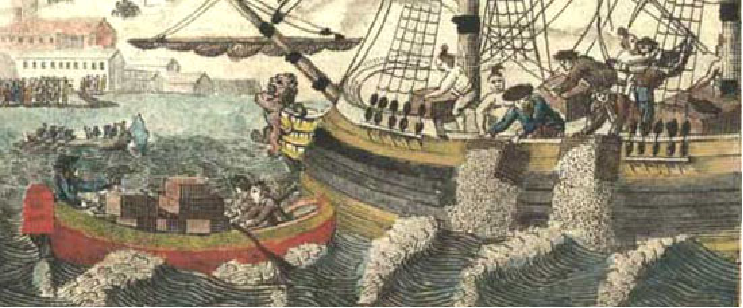
4. The powerful East India Company, finding itself in critical financial situation, appealed to the British government, which granted it the sole right on all tea exported to the colonies. Aroused by the loss of the tea trade, the colonial traders agitated for independence. On the night of December 16, 1773, Sons of Liberty disguised as Indians and led by Samuel Adams boarded three British ships and dumped their tea cargo into Boston harbor. This action was called the Boston Tea Party.

5. The Boston Tea Party made the British government irritated. It passed a series of acts, generally called “the Intolerable Acts” in America, early in 1774 to punish the Bostonians. The British government had intended to punish one colony, but the Acts alarmed all other colonies. Contrary to Britain’s expectation, the Intolerable Acts became a driving force in uniting the 13 colonies.
6. On September 5, 1774, in response to the British “the Intolerable Acts”, the colonies held the First Continental Congress. Representatives from each colony, except Georgia, met in Philadelphia. The purpose of the First Continental Congress was not to seek independence from Britain. The Congress had three objectives: to compose a statement of colonial rights, to identify British parliament’s violation of those rights, and to provide a plan that would convince Britain to restore those rights. They agreed to meet again in May 1775, if the British did not change their policies.
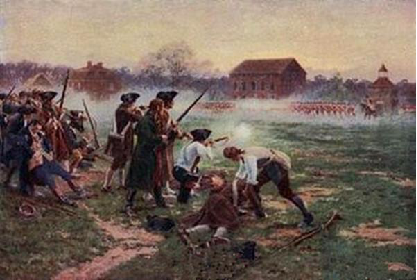
7. Before Congress met again, the situation had changed. Moving against the possibility of armed violence by the colonists, Britain sent around 2000 soldiers from Boston on the night of April 18, 1775, to confiscate munitions that the colonists were storing at Concord — twenty-six miles northeast of Boston. During the night, the fellow riders went from house to house, quietly giving warning to people who belonged to a group called Minutemen — so named because they were said to be ready to fight in a minute. On the morning of April 19, 1775, the first shots of the Revolutionary War were fired at Lexington, Massachusetts. It was, in the often quoted phrase of Ralph Waldo Emerson, “the shot heard round the world.”
8. While the alarms of Lexington and Concord were still resounding, the Second Continental Congress met in Philadelphia, Pennsylvania, on May 10, 1775. By May 15, the Congress voted to go to war, establishing the militia as the Continental Army to represent the thirteen states and appointing Colonel George Washington of Virginia as commander-in-chief of the American forces.
9. In January 1776, Thomas Paine, a political theorist and writer who had come to America from England in 1774, published a 50-page pamphlet, Common Sense. Within three months, 100,000 copies of the pamphlet were sold. Paine attacked the idea of hereditary monarchy. Circulated throughout the colonies, Common Sense helped to crystallize the desire for separation.
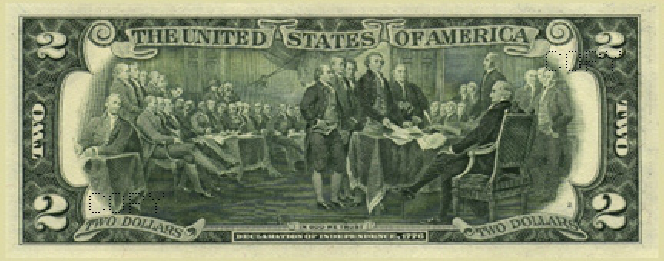
10. However, there still remained the task of gaining each colony’s approval of a formal declaration. Immediately, a committee of five, headed by Thomas Jefferson of Virginia, was appointed to prepare a formal declaration. Largely Jefferson’s work, the Declaration of Independence, adopted July 4, 1776, not only announced the birth of a new nation, but also set forth a philosophy of human freedom.
11. To further the American cause, Benjamin Franklin was sent to Paris in 1776. His wit and intellect soon made their presence felt in the French capital, and played a major role in winning French assistance. France began providing aid to the colonies in May 1776, and the Franco-American alliance soon broadened the conflict. In June 1778 British ships fired on French vessels, and the two countries went to war.
12. After several years of being at war, British government decided to pursue peace negotiations in Paris in early 1782. Signed on September 3, the Treaty of Paris acknowledged the independence, freedom, and sovereignty of the 13 former colonies, now states. The new United States stretched west to the Mississippi River, north to Canada, and south to Florida, which was returned to Spain. The task of knitting together a nation remained.