Read More
Text B Colonial Life of the Early Settlers
1. The earliest settlers lived in the roughest sort of shelter. Some lived in the caves they had dug in the side of steep banks, and some built houses with bark peeled from trees. A common American home during colonial times was the “log cabin”. Some houses were built of bricks, but wood was still the common building material.
2. The American colonists got their food from several places. The modern supermarket that we know today, where you can get all kinds of food, was not an option back then. People who lived on the Atlantic coast often caught fish and whales. They sold fish and whale blubber at fish markets, which were usually down by the docks. Farmers who grew wheat, barley, corn, tobacco, or rice hauled their crops to a town market, where the crops were sold to people in that town or to traders who would ship the goods to other colonies. (These traders would send the goods by boat, on rivers or along the ocean coast, or on wagons.) A great many American colonies also took care of their own food needs. It was not uncommon for a farm family to have crops growing near the ocean while chickens, pigs, and cows were grazing nearby and for that same family to fish for clams and other fish down at the ocean-side. In this way, the family would not have to buy food from anyone else. They might have apple trees and rows of corn and wheat. They might turn that corn into cornbread or cornmeal mush. They might turn that wheat into flour themselves and use it to bake bread. They might also hunt wild animals, like deer, rabbits, and turkeys. The farms of the 13 colonies took up a much larger amount of the total land available than do farms today. Still, farming is very much a way of life for many people today, just as it was for the American colonists.
3. If you were a school-age person in colonial America, you might have gone to a public or private school, just like you would today. But what you learned and how you learned it have changed throughout the years.
4. In the New England colonies, parents believed that their children should learn about Christianity. To that end, parents taught their children to read so they could read the Bible. And once those kids knew how to read, they could read school books as well. New England villages having more than 100 families set up grammar schools, which taught boys Latin and math and other subjects needed to get into college. And although girls could read, they were not allowed to go to grammar school or to college.
5. Middle Colonies schools were also largely religious but taught the teachings of one religion. If you were a Catholic, you learned about the Catholic religion. Most schools were private. Students also learned other subjects so they could get into college. Again, girls were not allowed to attend, unless they were Quakers.
6. School-age kids in the Southern Colonies were taught at home, for the most part, by their parents or by private tutors. When these kids became teenagers, they would then go off to college or to Europe. As in the other colonies, Southern girls did not go to school. Schools were generally small, not like the large ones many kids go to today. Kids learned to read from special books called hornbooks. Kids in colonial America were taught a trade, usually the one their fathers did, so they could continue the family business when their fathers retired. Often, kids would go to school and learn a trade.
7. Farming in colonial differed in many ways from farming today. The most significant difference was in what crops were grown and where. Farmers in the New England Colonies had a rough time of it. Much of the soil was not good for growing crops, especially near the ocean. Also, the early and long-lasting winters killed many crops quickly. Still, New England farmers often grew enough food to feed their families and maybe even help feed other families. The main kind of food New Englanders contributed to the economy was fish. Farmers in the Middle Colonies were the most prosperous of all. They grew wheat, barley, oats, rye, and corn. The Middle Colonies were often called the “breadbasket” because they grew so much food. Wheat could be ground to make flour, and both wheat and flour could be sold in other colonies or in Europe. Farmers in the Southern Colonies grew several things. The most popular crop was tobacco. The Jamestown colonists had grown tobacco originally, and tobacco farms sprung up all over Virginia and North Carolina. The two southernmost states (South Carolina and Georgia) also grew indigo and rice. Farm equipment was also different. Colonial farmers did not have the large machines that today’s farmers have and so had to rely on manpower and animal power.
8. Clothing was simple and rough. The most common clothes were “homespun”, with materials of wool and flax. Many people expected to wear the same clothes year after year until they were completely worn out.
1. Questions for Discussion or Reflection.
(1) What was the common building material? What sort of house did early settlers live in?
(2) What do you know about the farm produce and sea foods available to the early settlers?
(3) What did people learn in the New England colonies?
(4) What does it mean by "grammar school"?
(5) Can you briefly state the differences in the educational systems of the three regions of
colonial America?
(6) Summarize the differences of farming in the three regions of colonial America.
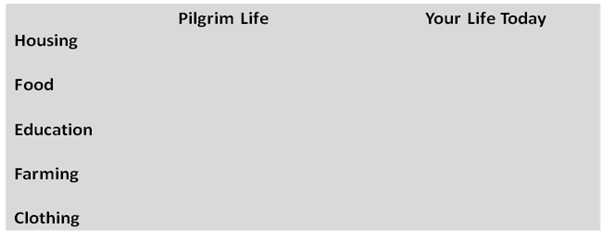
2. Complete the following chart, and compare the life of the Pilgrims in the 1600’s with your life today.