
American History and Culture

课程简介:
This course is designed to help students to widen the view of culture, extend train of thought, guide the students to a large amount of information on the basis of thinking, explore actively, and improve students’ Humanistic quality. Under the understanding of American history, we can analyse American social and cultural aspects with objective, calm, rational attitudes. The contents include the history of United States, the development of city, religions and festivals, and educational system, country of immigration.
本课程旨在帮助学生开阔文化视野,拓展思路,引导学生在掌握大量信息的基础上勤于思考,积极探讨,提高学生的人文精神素质。在理解美国历史发展,演变的基础上,以客观、冷静、理性的态度深入剖析美国社会与文化的方方面面。内容包括美国的历史变迁、城市发展、宗教和节日、教育制度、移民国家与多元文化、美国的法律社会与法制体系、美国社会的热点问题以及我对美国人的看法等若干个专题。重点在于了解美国由一个蛮荒的大陆发展成为世界上首屈一指的超级大国的文化背景,了解其发展及强盛的内因和本质。
本课程以教师自制教材为主,补充电影报刊及网络资源等多媒体材料,然后以讨论并解决问题的方式让学生对美国的社会历史、生活习俗和风土人情等有一个直观的印象。
课程考核:
As for the evaluation of the course, students’ usual performance consisting of practical performance, class speech and homework will account for 40% of the total score while the final exam will account for the remaining 60%.
本课程的考核以总评形式进行,平时成绩占总评成绩的40%,期末卷面成绩占60%。平时成绩由实践成绩+课堂发言+课后作业组成。期末考试以闭卷笔试方式进行,考核内容为本课程所有涉及内容,试卷成绩计入总评成绩60%。
课程内容:
Text Book: Introduction to the History of the USA
Unit 1 The Age of Exploration / 1
Unit 2 The Colonial America / 14
Unit 3 The Road to Independence / 27
Unit 4 The Young Republic / 39
Unit 5 The Westward Movement / 52
Unit 6 The Civil War / 64
Unit 7 Reconstruction (1865 1877) / 77
Unit 8 The Gilded Age (1877——1917) / 88
Unit 9 America in World War I (1914——1918) / 100
Unit 10 The Roaring Twenties / 113
Unit 11 The Great Depression / 125
Unit 12 America in World War II / 136
Unit 13 Postwar American Society / 151
Unit 14 America in Transition / 164
Unit 15 Toward a New Century / 177
学习方法:
本课程涵盖的内容丰富,涉及面颇广,所以教学上以同学们阅读理解课文章节,以及教师讲授为主,并结合相关历史事件的视频音频资料的播放与观看,从多个层面来讲解、阐述、分析美国的社会与文化特色,并从社会学和政治学方面进行跨学科的分析和说明,以启发式的方式激发同学们思考,帮助他们客观、理性、批判性地理解和解读美国,同学们也可以借此学习,拓宽、深化自己对人生的思考、领悟。
每个单元三至五篇文章,课堂上重点讲授第一篇,结合视频观看及同学们对相关历史问题和事件的反思和讨论,课后练习及其他的文章由同学们课下自主完成。
2020新年伊始,受COVID-19影响,我们无法正常象过去一样如期回到美丽的校园,温暖的寝室和熟悉的课堂,但生活还在继续,学习和思考历史会使我们更成熟睿智,请同学们以饱满的热情投入新学期的学习,充分利用这个平台,上课时间积极登录到堂,认真学习平台的课件以及音视频资料,课下勤于阅读,认真完成相关作业,积极提高自己,等待春暖花开,我们的再次重聚!
Questions To be started:
1. Are you interested in learning about history?
2. How do you learn about history?
3. Do you like to read history books, biographies, autobiographies?
4. What can you learn from the history?
5. If you are asked to record our time, what would you note down first?
Quotations To be started:
1. ------ 以铜为镜,可以正衣冠;以史为镜,可以知兴替;以人为镜,可以知得失。
2. ------ 灭人之国,必先去其史;灭人之枋 ,败人之纲纪,必先去其史;绝人之材,
湮塞人之教, 必先去其史;夷人之祖宗,必先去其史。
3. ------Those who do not respect history are doomed to repeat the
mistakes of history.
不尊重历史的人,注定要重犯历史的错误。
4. ------History should not only eliminate prejudice, but also foster
enthusiasm.
历史不应该仅有消除偏见,它还应该孕育热情。
5. ------History also teaches us the relativity of wisdom and value.
历史亦可教我们以智慧和价值的相对性。
Unit 1 The Age of Exploration
Unit Goals
※To understand the motivations of the exploration ofthe New World.
※ To learn about the history of early exploration.
※ To know the Puritan beliefs and the origin of Thanksgiving.
※ To learn the historical terms that describe the age of exploration of America.
※ To learn the important basic words and expressions that describe the age of the
exploration.
※ To improve English language skills.
Before You Read
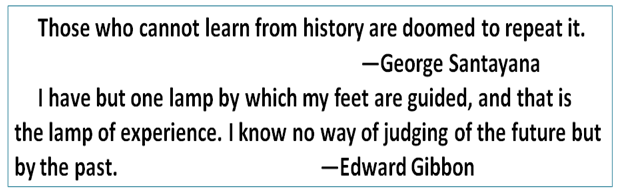
1. Read the quotes at the beginning of the unit. Consider whether the quotes make sense in your study of the American history.
2. Suppose there is a piece of land little known to us on this globe. If you, captain of a ship made in the 15th century, were on a voyage crossing the Pacific or the Atlantic for the land, what problems you likely to encounter?
Possible Problems: _______________________________________________________________________
_______________________________________________________________________
_______________________________________________________________________
_______________________________________________________________________
3. Do you know why many Europeans left their homelands for the New World?
Possible Reasons: ________________________________________________________________________
________________________________________________________________________
_________________________________________________________________________
4. Form groups of three or four students. Try to find, on the Internet or in the library, more information about the age of exploration which interests you. Prepare a 5-minute Classroom presentation.
Word Bank
Start to read
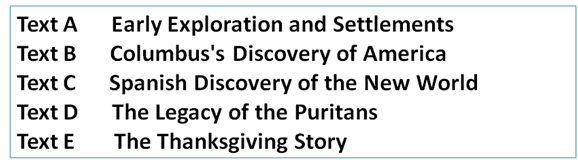
Text A Early Exploration and Settlements
1. The age of exploration beginning in the late 1400s was an important era in the discovery and development of land yet unknown to Europeans. During this period, Europeans sought new sea routes to Asia in pursuit of economic gain, glory, and opportunities to spread Christianity. Although these were motivations for explorers, the impact of the discoveries resulted in significant changes and achievements that created possibilities, and opened a new world for all of Europe.
2. The desire to explore the unknown has been a driving force in human history since the dawn of time. From the earliest documented accounts, ancient civilizations have explored the earth by sea. Early adventurers were motivated by religious beliefs, the desire for conquest, the need to establish trade routes, and hunger for gold. Modern history books begin the age of exploration with fourteenth century, but there is evidence that exploration between Europe and Asia began much earlier. The Han Dynasty of China and the Roman Empire, likewise, had regular trade relations and even exchanged a few diplomats.
3. Early explorers did not sail into the unknown without some idea of their final destination. Although they were searching for a specific land or route, they oftentimes were surprised at what they discovered. Sometimes the country they were seeking was only known in legend or rumor.
4. The captain of the ship needed funding and manpower and could not get underway without support from a rich benefactor. Most voyages during the fourteenth century were made in the name of the royal ruler of a particular government. The crewmen who signed on to these long and dangerous voyages were not the most experienced seamen, but large numbers of them needed to help man the sails and to allow for attrition(损耗) due to illness and death. The ships that the royal leaders provided were not always new, but the captain took what he was given.
5. The captain himself was not always an experienced seaman. Desires for wealth or political favor were often his only motivations for undertaking dangerous voyages. He could be a merchant, adventurer, soldier, or gentleman of the court. Under his command were the pilot or first mate(大副) (who was in charge of navigation), and the crew (who worked the sails and rigging and made repairs to the ship while in uncharted(地图上未标注的) water.
6. Little cooking was done at sea. Food stores often consisted of pickled or dried meat and ship’s biscuits (made from flour with a little water to make them hard). By the end of the voyage, these biscuits would be full of black insects called weevils(象甲虫). Other foods included cheese, onions, dried beans, and salted fish or recently caught fresh fish. Without fresh fruit and vegetables which contain vitamin C, sailors suffered from a fatal condition called scurvy(坏血病). Water supply was another serious problem. Fresh water did not always keep in barrels and wine turned sour. Fresh water was the first thing the crew looked for whenever the ship reached land.
7. The first English immigrants to what is now the United States crossed the Atlantic long after thriving(蓬勃发展的) Spanish colonies had been established in Mexico, the West Indies and South America. Like all early travelers to the New World, they came in small, overcrowded ships. During their 6 to 12 week voyages, they lived on meager rations(微薄配给). Many died of disease; ships were often battered(连续猛击) by storms and some were lost at sea.
8. Most European emigrants left their homelands to escape political oppression, to seek the freedom to practice their religion or for adventure and opportunities denied to them at home. Between 1620 and 1635, economic difficulties swept England. Many people were jobless and could not survive. Even skilled artisans(技工) could earn little more than a bare living. Poor crops yields added to the distress. In addition, the Industrial Revolution had created a burgeoning(激增的) textile industry, which demanded an ever-increasing supply of wool to keep the looms(织布机) running. Landlords enclosed farmlands and evicted(驱赶) the peasants in favor of sheep cultivation. Colonial expansion became an outlet for this displaced peasant population.

