Chapter Overview
Summary--From the Intercultural Perspective
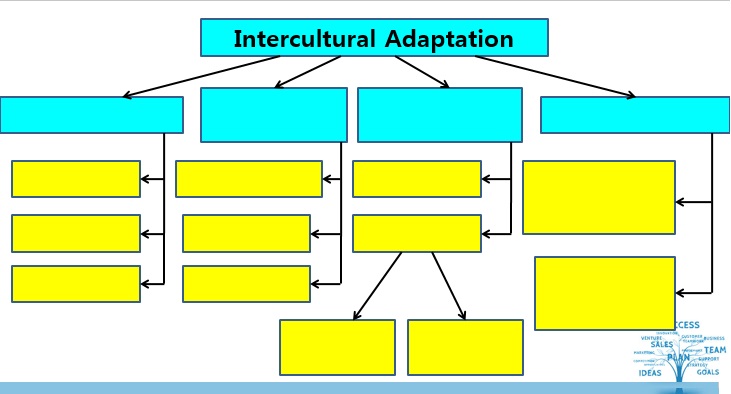
Read Summary on Pages 308-309 and go over all the information we deal with in Chapter 9. And then fill in the diagram concerning the structure and key points of the chapter.
Cultures are dynamic and ever-changing. We live in a global village today, and we have more opportunities to experience different cultures than our ancestors. What will happen when we meet another culture different from our own? Acculturation takes place in order to communicate effectively. Acculturation refers to an individual’s learning and adopting the norms and values of the new host culture. So acculturation simply means the socialization process we go through when we learn another culture other than our own.
There are four possible modes of acculturation. Assimilation is a process in which members of an ethnic group are absorbed into the dominant culture, losing their culture in the process. Integration is a process of desiring a high level of interaction with the host culture while maintaining identity with their native culture. Separation is when individuals prefer low levels of interaction with the host culture and associated microcultural groups while desiring a close connection with, and reaffirmation of, their native culture. If such separation is initiated and enforced by the dominant society, this is called segregation. Marginalization occurs when the individual chooses not to identify with his or her native culture or with the host culture. Three factors, namely the role of communication, the role of the host environment, and the role of predisposition can best explain the acculturation process.
However, the cultural adaptation is not smooth. If a person lives in a new culture for some time (typically a few months or more), that Individual usually experiences culture shock, which refers to the traumatic experience that an individual may encounter when entering a different society. Symptoms of culture shock can be physical, such as skin eruptions, and they can also be psychological, such as insomnia and frustration. Culture shock takes seven forms: language shock, role shock, transition shock, culture fatigue, education shock, adjustment stress, and culture distance. Also, culture shock can have influences on individuals’ life, including positive and negative ones.
Actually, culture shock is a relatively short-term feeling of disorientation, while the long-term adaptation process into a new culture is called intercultural adaptation. Intercultural adaptation refers broadly to the process of increasing our level of fitness to meet the demands of a new cultural environment. Intercultural adaptation can be described as a four-stage process, called U-curve pattern, including honeymoon stage, crisis stage, adjustment stage and biculturalism stage. When people return home after an extended stay in a foreign culture, they experience another round of culture shock in their native culture, called reverse culture shock described as W-curve pattern.
Although biculturalism stage may take years, some strategies may help us avoid culture shock and engage in intercultural adaptation.
Case Analysis for Chapter 9
Exploring Ideas
Adaptation into a new culture can be both exciting and frustrating. Provide examples concerning the exciting aspects as well as the frustrating aspects.
Keywords for Chapter 9
(1)Acculturation:It refers to an individual’s learning and adapting to the norms and values of the new host culture. (文化适应:文化适应指人们学习和适应新文化的社会规范和价值观念的过程。)
(2)Assimilation:It is a process in which members of an ethnic group are absorbed into the dominant culture, losing their culture in the process. (同化:同化指一个民族群体的人们逐渐失去自己原有的文化,接受新的主流文化的过程。)
(3)Integration: It takes place when some people desire a high level of interaction with the host culture while maintaining identity with their native culture. This kind of acculturation is called integration. (文化融合:文化融合指人们在文化适应过程中高度接受新的主流文化,同时又保留了自己文化的完整性)。
(4)Separation:When individuals prefer low levels of interaction with the host culture and associated microcultural groups while desiring a close connection with, and reaffirmation of, their native culture, the mode of acculturation is called separation. (分离:分离指人们在文化适应过程中对自己原有文化进行重新肯定认同、保留了原有文化,对新的主流文化及与其相关的微观文化不接受不认可)。
(5)Segregation:It occurs when the more politically and economically powerful culture does not want the intercultural contact, the separation is initiated and enforced by the dominant society.(隔离:隔离当经济和政治上更强大的新主流文化不接受人们与它进行文化接触,人们就会被这种文化隔离在外。)
(6)Marginalization:It occurs when the individual chooses not to identify with his or her native culture or with the host culture. (边缘化:边缘化指人们不仅失去自己原有的文化身份,而且无法融入新的主流文化。)
(7)Culture shock:It refers to the traumatic experience that an individual may encounter when entering a different culture. (文化冲击/文化休克:文化冲击/文化休克指人们在进入一种新文化环境中遭遇的痛苦和难忘的经历。)
(8)Intercultural adaptation:It refers broadly to the process of increasing our level of fitness to meet the demands of a new cultural environment. (跨文化适应:跨文化适应指人们不断提高自己的适应能力,以期达到新文化环境的需要。)
Now you've finished studying Chapter 9, have you mastered all the key points in this chapter? If the answer is YES, move on to Assessment to check your comprehension and mastery of Chapter 9.

