
Text C Intercultural Adaptation
Pre-reading Activities:
Consult someone from your culture who has been living in another culture for a relatively long period of time. Ask him/her to tell you his/her feelings and experiences when he/she was in that culture.
Text C Study:
Read Text C through Page 297 to Page 300 to get the key idea of this text. The following is the text audio for your reference.
Find out the answers to the following questions:
1. What is the title of Text C? How do you understand it?
2. Please write down the subtitles of Text C and make clear the structure in the text.
3. Read Text C, and underline the content that you think are important.
4. Find out the definition of intercultural adaptation, and try to translate it into Chinese.
5. How different is intercultural adaptation from culture shock?
6. How many models of intercultural adaptation are there according to the text? What are they? And how are they different or related to each other?
7. Look at the following diagram. Answer the following questions:
1) What pattern of intercultural adaptation is this diagram depicted? Try to describe what is happening.
2) Point out each period and tell: a) What happens in each period (i.e. its marks and charactieristics)? and b) What happens to the individual(s) in each period / stage?
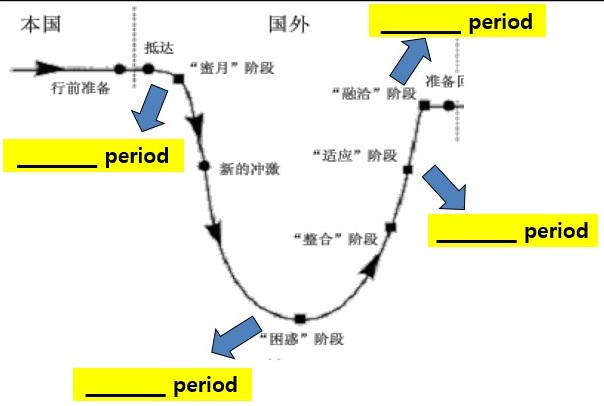
8. Can you extend this curve to describe the other model of intercultural adaptation? Have a try!
9. Read Text D through Page 304 to Page 306 to observe how to avoid and manage culture shock so that one can better engage in intercultural adaptation.
Now, study the text via watching the following mini-lecture which aims to help you better understand the process of interculture adaptation.
After-reading Check:
Case 55 Analysis
Please read Case 55 Missing China! on Page 303. The following is the case audio for your reference.
Missing China!
John has been living in China on and off for over four-and-half years, and will be going home to Vancouver on June 30 with his wife who got her immigrant visa in April. He has gone home three times since first coming to China to teach English in 2003, and it gets harder to adjust each time because of the big changes happening all over the city. New buildings have gone up while others have come down, people have either moved on or passed on, all these factors made him feel uneasy when he was home, and couldn’t wait to return to China. The only time John felt at ease was in his bedroom using his own computer, listening to his favorite radio station, and watching his favorite TV shows (He misses ice hockey while in China!).
After reading the case, discuss the following questions with your group members, and get ready to report your findings to the class.
1) What is John experiencing? Why do you think John has such kind of feeling?
2) What is the relationship between this case and the text above?
3) Can you give John some advice on how to deal with such problem?
4) Think about some ways to cheer John up and help him adapt again to his native culture.

