
目录

  • 1 Chapter 1 Culture
    • 1.1 Course Lead-in
    • 1.2 Chapter Lead-in
    • 1.3 Text A The Nature of Culture
    • 1.4 Text B Definitions of Culture
    • 1.5 Text C Characteristics of Culture
    • 1.6 Text D Cultural Identity
    • 1.7 Text E Cultures Within Culture
    • 1.8 Extended Reading and Translation​
    • 1.9 Summary
  • 2 Chapter 2 Communication & IC
    • 2.1 Chapter Lead-in
    • 2.2 Text D Intercultural Communication
    • 2.3 Texts A&C Communication
    • 2.4 Text B Charateristics of Communication
    • 2.5 Summary
    • 2.6 Extended Reading and Translation​
    • 2.7 Extended Reading on Confucianism
  • 3 Chapter 3 Culture's Influence on Perception
    • 3.1 WORD STUDY CH3
    • 3.2 Chapter Lead-in
    • 3.3 Text A Overview: Human Perception
    • 3.4 Text B Cross-cultural Differences in Sensation and Perception
    • 3.5 Text C Barriers to Accurate Perception in IC
    • 3.6 Summary
    • 3.7 Extended Reading and Translation​
  • 4 Chapter 4 IC Barriers
    • 4.1 Chapter Lead-in
    • 4.2 Text A Emotional Problems as Barriers to IC
    • 4.3 Text B Attitudinal Problems as Barriers to IC
    • 4.4 Text C Translation Problems as Language Barriers
    • 4.5 Summary
    • 4.6 Extended Reading and Translation​
  • 5 Chapter 5 Verbal IC
    • 5.1 Chapter Lead-in
    • 5.2 Text A & Text B Language and Culture
    • 5.3 Text C Verbal Communication Styles
      • 5.3.1 Text C Edward T. Hall's Context—Culture Theory
    • 5.4 Text D Language Diversity
    • 5.5 Summary
    • 5.6 Extended Reading and Translation​
  • 6 Chapter 6 Nonverbal IC
    • 6.1 Chapter Lead-in
    • 6.2 Text A & Text B Significance and Functions of Nonverbal Communication
    • 6.3 Text C Paralanguage and Silence
    • 6.4 Text D Time and Space
    • 6.5 Text E Other Categories of Nonverbal Communication
    • 6.6 Summary
    • 6.7 Extended Reading and Translation
  • 7 Chapter 7 Cultural Patterns
    • 7.1 Chapter Lead-in
    • 7.2 Texts A&B Cultural Patterns
    • 7.3 Text D Kluckhohn and Strodtbeck's Value Orientation
    • 7.4 Text E Hofstede's Dimensions of Cultural Variability
    • 7.5 Summary
    • 7.6 Extended Reading and Translation
  • 8 Chapter 8 Cultural Influences on Context
    • 8.1 Chapter Lead-in
    • 8.2 Text A Communication and Context
    • 8.3 Text B The Business Context
    • 8.4 Summary
    • 8.5 Extended Reading and Translation
  • 9 Chapter 9 Intercultural Adaptation
    • 9.1 Chapter Lead-in
    • 9.2 Text A Acculturation
    • 9.3 Text B Culture Shock
    • 9.4 Text C Intercultural Adaptation
    • 9.5 Summary
  • 10 Chapter 10 IC Competence
    • 10.1 Course Introduction
      • 10.1.1 Western and Eastern Sharp Contrast
      • 10.1.2 Course Assignment
    • 10.2 Chapter 10 IC Competence
Text B Culture Shock

Text B Culture Shock

Pre-reading Activities:

Read the following article about culture shock to get the main idea.


Text B Study: 

Read Text B through Page 290 to Page 294 to get the key idea of this text. The following is the text audio for your reference.


Find out the answers to the following questions:

1. What is the title of Text B? How do you understand it?

2. Please write down the subtitles of Text B and make clear the structure in the text.

3. Read Text B, and underline the content that you think are important.

4. Find out the definition of culture shock, and try to translate it into Chinese.

5. What physical symptoms may one experience when getting into a new culture?

6. What psychological symptoms may one experience when getting into a new culture?

7. How many different forms of culture shock are listed? What are they?

8. What are the effects of culture shock?

After-reading Check:


Case 54 Analysis

Please read Case 54 A Fish out of Water on Page 295. The following is the case audio for your reference.


                           A Fish out of Water

      When an American student enters China, he feels that all or most of his familiar cues in his culture are removed. And he feels that he is like a fish out of water. No matter how broad-minded or full of good will he may be, he feels out of place in his new environment. This is followed by a feeling of frustration and anxiety. He reacts to the frustration by rejecting the environment which causes the discomfort: “the ways of Chinese are bad, because they make me feel bad.”

After reading the case, finish the following tasks with your group members.

1. Discuss the following questions with your group members, and get ready to report your findings to the class. 

    (1) Why does the student feel that he is like a fish out of water?

    (2) Do you think his feeling of frustration and anxiety is reasonable?

    (3) Do you think his remark is suitable? If you experience such situations, what will your responses be?

2. Now report your group's views below.


3. Complete the following items to check your comprehension of this case.


Culture Shock in Movie
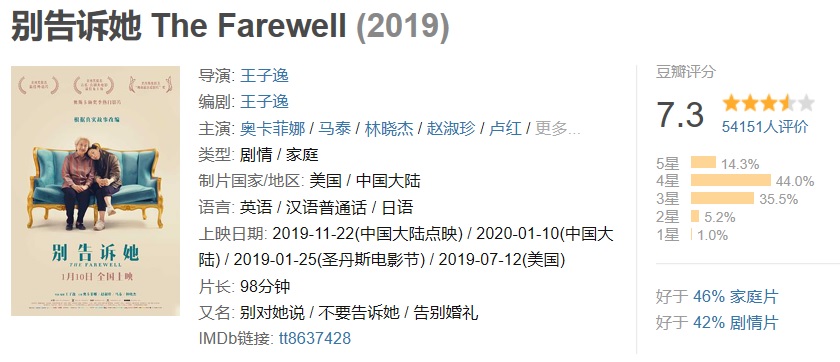
影片改编自华裔女导演王子逸自己的家庭故事,她也因本片被《综艺》杂志评选2019年必关注导演之一。 

该片讲述一个华人家庭的奶奶被诊断罹癌,但家人选择隐瞒奶奶,假借一场婚礼的名义让所有家人回家见奶奶最后一面,但对已经生活在不同国家、有着不同的文化认知的家人们来说,隐瞒病情并不一定是正确的做法,如在纽约长大的碧莉(奥卡菲娜饰演)认为知道自己病况是奶奶的人权,因此在这个华人家庭中上演的不只是一出闹剧,更是一场中西文化冲突,也是一部寻根的家庭喜剧。

Now you've finished studying Text B, have you mastered the key points in this text? If the answer is yes, then you are ready to study the next text. Congratulations!