
目录

  • 1 Chapter 1 Culture
    • 1.1 Course Lead-in
    • 1.2 Chapter Lead-in
    • 1.3 Text A The Nature of Culture
    • 1.4 Text B Definitions of Culture
    • 1.5 Text C Characteristics of Culture
    • 1.6 Text D Cultural Identity
    • 1.7 Text E Cultures Within Culture
    • 1.8 Extended Reading and Translation​
    • 1.9 Summary
  • 2 Chapter 2 Communication & IC
    • 2.1 Chapter Lead-in
    • 2.2 Text D Intercultural Communication
    • 2.3 Texts A&C Communication
    • 2.4 Text B Charateristics of Communication
    • 2.5 Summary
    • 2.6 Extended Reading and Translation​
    • 2.7 Extended Reading on Confucianism
  • 3 Chapter 3 Culture's Influence on Perception
    • 3.1 WORD STUDY CH3
    • 3.2 Chapter Lead-in
    • 3.3 Text A Overview: Human Perception
    • 3.4 Text B Cross-cultural Differences in Sensation and Perception
    • 3.5 Text C Barriers to Accurate Perception in IC
    • 3.6 Summary
    • 3.7 Extended Reading and Translation​
  • 4 Chapter 4 IC Barriers
    • 4.1 Chapter Lead-in
    • 4.2 Text A Emotional Problems as Barriers to IC
    • 4.3 Text B Attitudinal Problems as Barriers to IC
    • 4.4 Text C Translation Problems as Language Barriers
    • 4.5 Summary
    • 4.6 Extended Reading and Translation​
  • 5 Chapter 5 Verbal IC
    • 5.1 Chapter Lead-in
    • 5.2 Text A & Text B Language and Culture
    • 5.3 Text C Verbal Communication Styles
      • 5.3.1 Text C Edward T. Hall's Context—Culture Theory
    • 5.4 Text D Language Diversity
    • 5.5 Summary
    • 5.6 Extended Reading and Translation​
  • 6 Chapter 6 Nonverbal IC
    • 6.1 Chapter Lead-in
    • 6.2 Text A & Text B Significance and Functions of Nonverbal Communication
    • 6.3 Text C Paralanguage and Silence
    • 6.4 Text D Time and Space
    • 6.5 Text E Other Categories of Nonverbal Communication
    • 6.6 Summary
    • 6.7 Extended Reading and Translation
  • 7 Chapter 7 Cultural Patterns
    • 7.1 Chapter Lead-in
    • 7.2 Texts A&B Cultural Patterns
    • 7.3 Text D Kluckhohn and Strodtbeck's Value Orientation
    • 7.4 Text E Hofstede's Dimensions of Cultural Variability
    • 7.5 Summary
    • 7.6 Extended Reading and Translation
  • 8 Chapter 8 Cultural Influences on Context
    • 8.1 Chapter Lead-in
    • 8.2 Text A Communication and Context
    • 8.3 Text B The Business Context
    • 8.4 Summary
    • 8.5 Extended Reading and Translation
  • 9 Chapter 9 Intercultural Adaptation
    • 9.1 Chapter Lead-in
    • 9.2 Text A Acculturation
    • 9.3 Text B Culture Shock
    • 9.4 Text C Intercultural Adaptation
    • 9.5 Summary
  • 10 Chapter 10 IC Competence
    • 10.1 Course Introduction
      • 10.1.1 Western and Eastern Sharp Contrast
      • 10.1.2 Course Assignment
    • 10.2 Chapter 10 IC Competence
Text A Acculturation

Text A Acculturation

Pre-reading Activities:

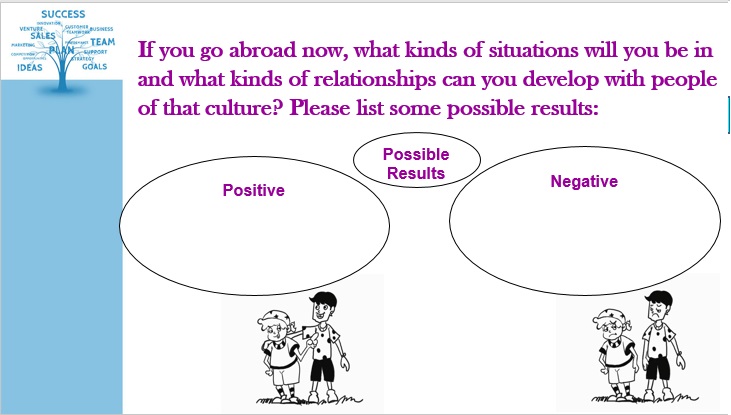
If you go abroad now, what kinds of situations will you be in and what kinds of relationships can you develop with people of that culture? Please list some possible results:

Text A Study: 

Read Text A through Page 281 to Page 286 to get the key idea of this text. The following is the text audio for your reference.


Find out the answers to the following questions:

1. What is the title of Text A? How do you understand it?

2. Please write down the subtitles of Text A and make clear the structure in the text.

3. Read Text A, and underline the content that you think are important.

4. Find out the definition of acculturation, and try to translate it into Chinese.

5. Who is J.W. Berry? What is his theory about? Can you sum up what he points out?

6. How many modes of acculturation are there? What are they? Could you compare the four modes of acculturation? Could you give us some examples for each mode?

7. Think about what happened to one's native culture and new culture in these different four modes of acculturation.

8. How many factors affect acculturation? What are they?

9. What is personal communication? What is social communication?

After-reading Check:

Case 53 Analysis

Read the following case and answer the questions.

                Practising English

One night a Chinese student majoring in English sat on the steps of the foreign students' residence and talked with two young male foreign students, one German and one American. They did not speak a word to her on their own initiative, but she asked many questions to get a conversation started. Every time they answered her with only one or two words. But she was determined to practise her English so she tried to keep the conversation going.

"How do you spend your weekend?" she asked.

The German boy answered immediately, "Fishing," and the two boys looked at each other meaningfully.

"Fishing?" She was really confused. "But where do you fish?" she asked.

"Fishing has two meanings. One is the literal meaning. The other is just sitting here or walking on the street and waiting for some girls to come up to us." Then they both burst out laughing. She was annoyed. She sat there silently and then suddenly stood up and walked away without saying goodbye.


Now you've finished studying Text A, have you mastered the key points in this text? If the answer is YES, then you are ready to study the next text. Congratulations!