目录

  • 1 Chapter 1 Culture
    • 1.1 Course Lead-in
    • 1.2 Chapter Lead-in
    • 1.3 Text A The Nature of Culture
    • 1.4 Text B Definitions of Culture
    • 1.5 Text C Characteristics of Culture
    • 1.6 Text D Cultural Identity
    • 1.7 Text E Cultures Within Culture
    • 1.8 Extended Reading and Translation​
    • 1.9 Summary
  • 2 Chapter 2 Communication & IC
    • 2.1 Chapter Lead-in
    • 2.2 Text D Intercultural Communication
    • 2.3 Texts A&C Communication
    • 2.4 Text B Charateristics of Communication
    • 2.5 Summary
    • 2.6 Extended Reading and Translation​
    • 2.7 Extended Reading on Confucianism
  • 3 Chapter 3 Culture's Influence on Perception
    • 3.1 WORD STUDY CH3
    • 3.2 Chapter Lead-in
    • 3.3 Text A Overview: Human Perception
    • 3.4 Text B Cross-cultural Differences in Sensation and Perception
    • 3.5 Text C Barriers to Accurate Perception in IC
    • 3.6 Summary
    • 3.7 Extended Reading and Translation​
  • 4 Chapter 4 IC Barriers
    • 4.1 Chapter Lead-in
    • 4.2 Text A Emotional Problems as Barriers to IC
    • 4.3 Text B Attitudinal Problems as Barriers to IC
    • 4.4 Text C Translation Problems as Language Barriers
    • 4.5 Summary
    • 4.6 Extended Reading and Translation​
  • 5 Chapter 5 Verbal IC
    • 5.1 Chapter Lead-in
    • 5.2 Text A & Text B Language and Culture
    • 5.3 Text C Verbal Communication Styles
      • 5.3.1 Text C Edward T. Hall's Context—Culture Theory
    • 5.4 Text D Language Diversity
    • 5.5 Summary
    • 5.6 Extended Reading and Translation​
  • 6 Chapter 6 Nonverbal IC
    • 6.1 Chapter Lead-in
    • 6.2 Text A & Text B Significance and Functions of Nonverbal Communication
    • 6.3 Text C Paralanguage and Silence
    • 6.4 Text D Time and Space
    • 6.5 Text E Other Categories of Nonverbal Communication
    • 6.6 Summary
    • 6.7 Extended Reading and Translation
  • 7 Chapter 7 Cultural Patterns
    • 7.1 Chapter Lead-in
    • 7.2 Texts A&B Cultural Patterns
    • 7.3 Text D Kluckhohn and Strodtbeck's Value Orientation
    • 7.4 Text E Hofstede's Dimensions of Cultural Variability
    • 7.5 Summary
    • 7.6 Extended Reading and Translation
  • 8 Chapter 8 Cultural Influences on Context
    • 8.1 Chapter Lead-in
    • 8.2 Text A Communication and Context
    • 8.3 Text B The Business Context
    • 8.4 Summary
    • 8.5 Extended Reading and Translation
  • 9 Chapter 9 Intercultural Adaptation
    • 9.1 Chapter Lead-in
    • 9.2 Text A Acculturation
    • 9.3 Text B Culture Shock
    • 9.4 Text C Intercultural Adaptation
    • 9.5 Summary
  • 10 Chapter 10 IC Competence
    • 10.1 Course Introduction
      • 10.1.1 Western and Eastern Sharp Contrast
      • 10.1.2 Course Assignment
    • 10.2 Chapter 10 IC Competence
Extended Reading on Confucianism

Extended Reading

Reading for Chinese culture Read  and get to know more about Confucianism. 

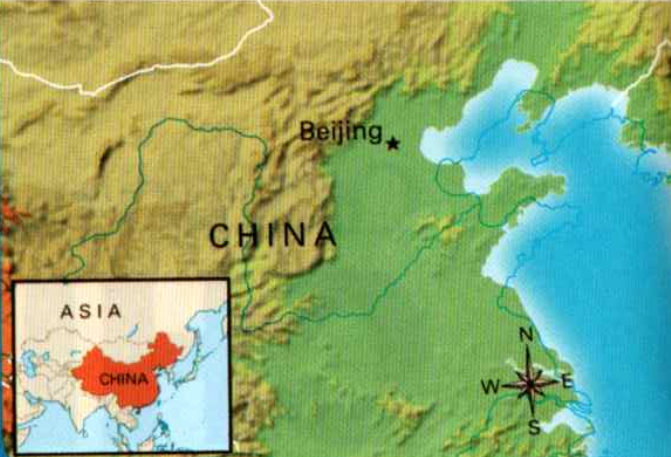
Before You Read What do you think modern day Chinas looks like? Before reading, take one minute to think about modern China. Tell what your impressions of what China looks like. 

Then recollect your knowledge of Confucius. What do you know about the philosopher Confucius? Where was Confucius born? Which centuries did he live in? How did he try to spread his philosophy? What dynasty made his philosophy official governmental policy?

Confucius 

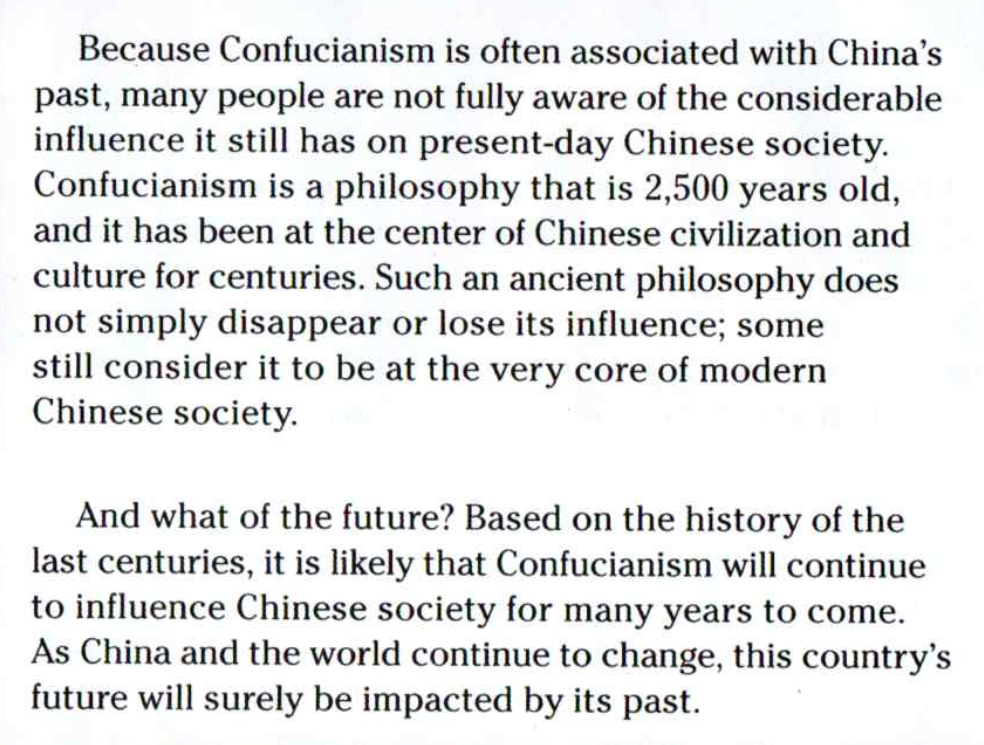
For over 2,500 year, Confucianism has influenced the development of China. Confucius was a philosopher and teacher who spoke about the importance of family, education, and harmony. Confucius's disciples carried his message and passed it on, untile Confucianism was adopted by the Han dynasty three centuries later. The people and nation of China have been greatly influenced by Confucianism, something that can still be seen in modern day China in a variety of ways. 


Words to Know  The story you are going to read is about the country of China, its history, the beliefs of some of its people, and its culture.


While You Read While reading the following parts, read attentively and finish the tasks in-between. 

While you are reading, get ready to find the information in the story to answer the questions:

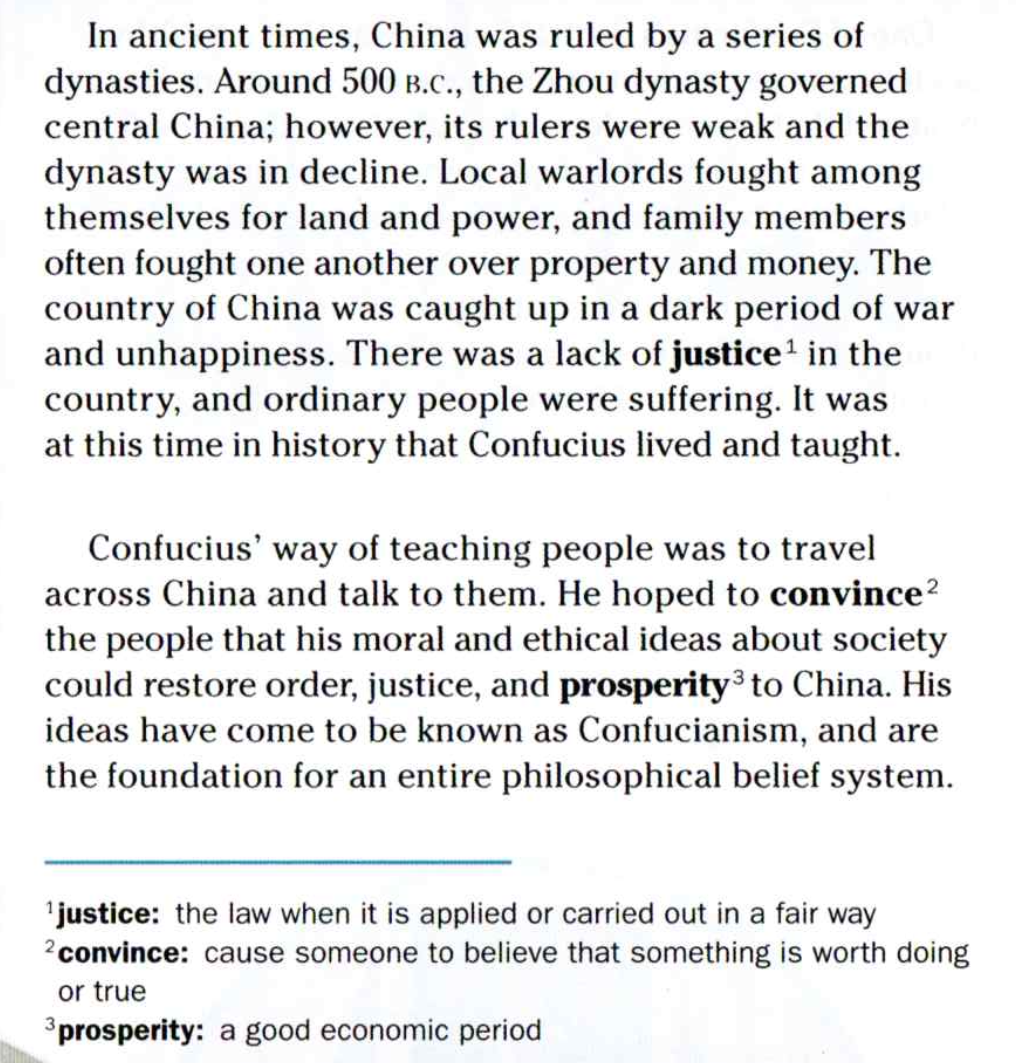
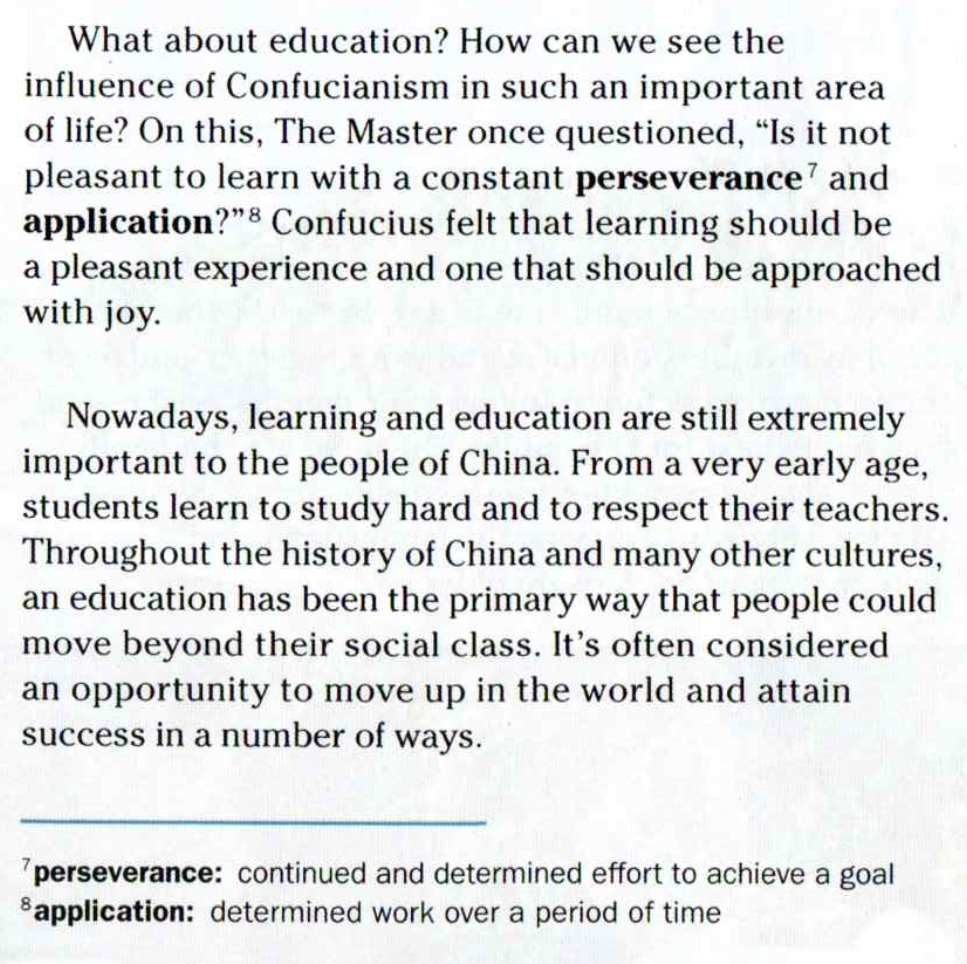
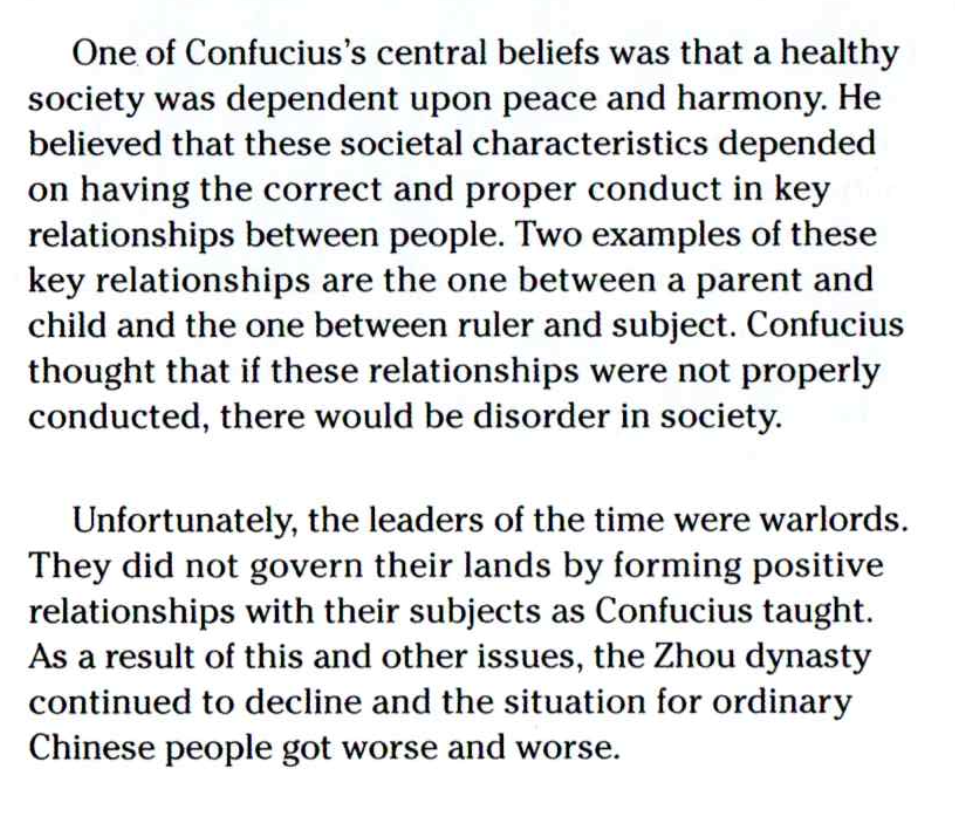
  1. What was China like around 500 BC?

  2. What type of relationship do a ruler and subject have?

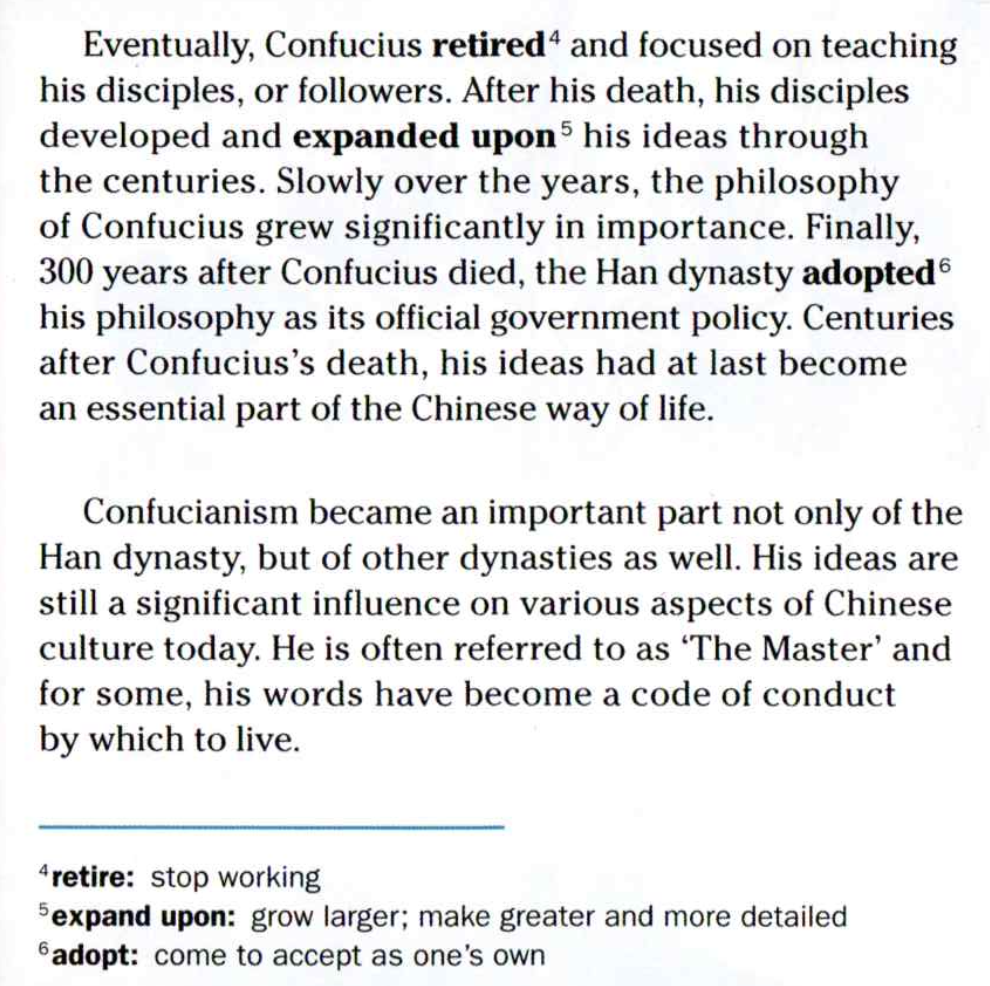
  3. Which dynasty adopted Confucius's ideas?

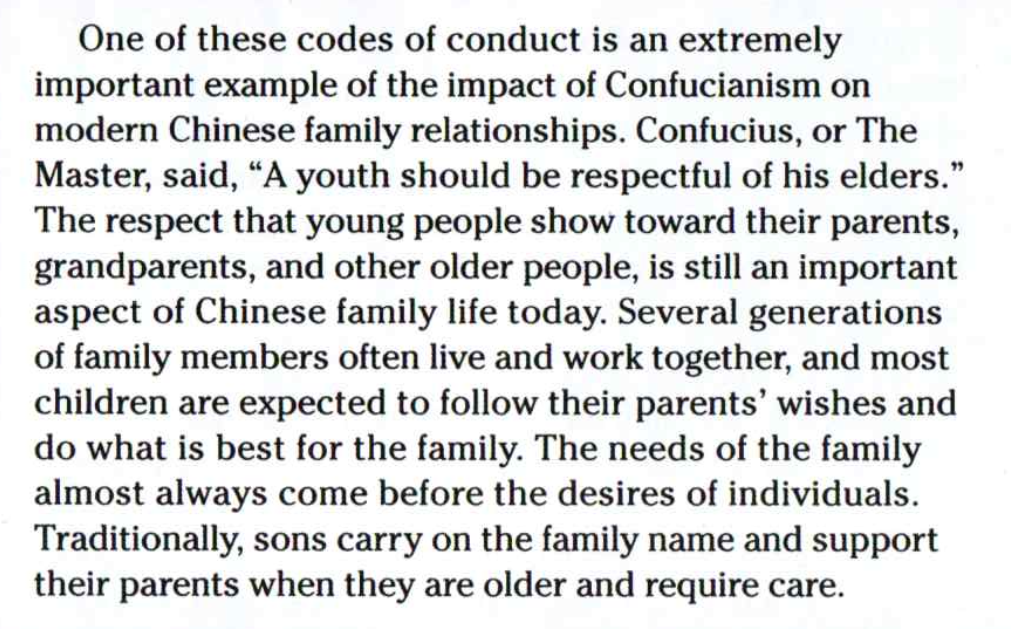
  4. What does Confucius say about young people and older people?

  5. What does Confucius feel should be a pleasant experience?

  6. How many Chinese people live abroad?


After You Read Finish the following items according to what you've read.


Congratulations!

You've completed the study of Chapter 2 of Interculture Communication.