
Text D Intercultural Communication
Pre-reading Activities:
Imagine you are organizing an international summer camp with students from different countries. What of the following should be your main concern?
a. Problems between students of different races;
b. Problems between students of the same races;
c. Problems between students of different cultures;
d. Problems between students who share the same nationality but not the same race.
Text D Study:
Read Text D through Page 57 to Page 60 to get the key idea of this text. The following is the text audio for your reference.
Find out the answers to the following questions:
1. What is the title of Text D? How do you understand it?
2. Please write down the subtitle in Text D and make clear the structure in the text.
3. What is the definition of intercultural communication?
4. Why is the study of intercultural communication emphasized?
5. What are the different forms of intercultural communication?
5. Get the key idea of each form of intercultural communication and make some examples to illustrate each.
Now please watch the mini-lecture which aims to help you better understand the key points in the text.
More Reading Materials
Reading One
You may have already heard the term "intercultural communication". In this section, we provide several commonly accepted academic and applied definitions to clarify this concept and process.
It is helpful when scholars and practitioners clarify what they mean by certain terms. The term "intercultural communication" represents broad ideas that are difficult to express in just one way. Thus we present several working definitions as starting points for exploring this topic:
Intercultural communication refers to the communication between people from two different cultures. (Chen & Starosta, 1998:28)
Intercultural communication is a symbolic, interpretive, transactional, contextual process, in which people from different cultures create shared meanings. (Lustig & Koester, 2007:46)
Intercultural communication refers to the effects on communication behavior, when different cultures interact together. Hence, one way of viewing intercultural communication is as communication that unfolds in symbolic intercultural spaces. (Arasaratnam, 2013:48)
You might want to consider which of these definitions best describes this idea and process for you. Perhaps you've seen another definition or statement that would be helpful for us and your fellow participants to see. If so, share your thoughts or other quotes (and their author and source if possible) with your group member or with us.
References
Arasaratnam, L. A. (2013). Intercultural communication competence. In A. Kurylo (Ed.), Intercultural communication: Representation and construction of culture (Chap 3, pp. 47-68). Los Angeles, CA: SAGE Publications.
Chen, G. M., & Starosta, W. J. (1998). Foundations of intercultural communication: Boston, MA: Allyn & Bacon.
Lustig, M. W., & Koester, J. (2007). Intercultural competence: interpersonal communication across cultures(5th ed.). Shanghai, China: Shanghai Foreign Language Education Press.
© Shanghai International Studies University
Reading Two
This article describes what we mean as Educators when we talk about the focus of this course regarding various elements of "Intercultural communication".
In our analysis, there are three important elements that mark a communicative act as being intercultural. They are generally:
contact (communication)
between different cultures (inter-), where
the cultural differences affect in the process.
First, contact: It does not matter whether this is face to face or through a medium (e.g., letter, email, online games, social media, etc.), but some kind of interaction must be taking place. Given the rapidly developing information and communication technology (ICT) of our era, communication is now facilitated on multiple platforms with audiences from all around the world.
Secondly, cultural differences exist in these contacts. Cultural differences can be categorized by nationality, ethnicity, religious belief, gender, age/generation, geographical region, political ideology, body (dis)ability, sexual orientation, etc. Hardly anyone belongs to only one cultural grouping, so it is natural that several categories might apply or be salient in any specific interaction. Note some examples given in the article.
Thirdly, cultural differences are what influences communication. When cultural differences can be noted as affecting the interaction, then it qualifies as a process of intercultural communication. Please note how these are illustrated in the article.
In sum, you can characterize any communication interaction as being intercultural if you can identify a cultural difference and show how it influences the communicative event. There is no magic line which isolates "intercultural" from other types of communication. Although in practice, many equate cultural differences to groups divided by nationality, ethnicity, or race, it is important that you keep in mind a broader understanding of the "cultures" that each of us embody. Reflecting further on the definitions provided in the downloadable article, or those from other learners in these steps, can help you expand your ideas on the scope of intercultural communication.
© CHI Ruobing, Shanghai International Studies University
After-reading Check:
Case 12 Study
Read Case 12, then try to summarize the case and analyze it from intercultural perspective.
Why Don't You Eat the Pizza?
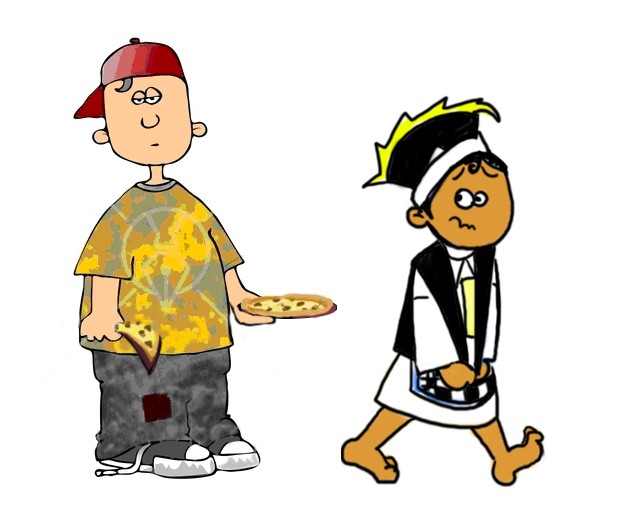
Kenneth, an American student, met Vernon,a student recently arrived from Malaysia, and they decided to have dinner together at the university cafeteria. In the cafeteria, Kenneth ordered a pizza and some other food for their dinner. Whenthe food was sent to them, Kenneth tore the pizza into pieces and handed one piece to Vernon, using his left hand. Vernon took that piece of pizza and put it on his plate without eating it. Kenneth wasquite confused about what had gone wrong, so he asked Vernon, “Are you all right?” “Yes, I’m fine,” Vernon replied. Kenneth kept on asking , “Why don’t you eat the pizza?” Vernon said nothing but began to eat the other food, ignoring the pizza. Kenneth was confused but he ceased his questioning. And the two just kept on eating without much conversation.
Being involved in discussion may help you think more critically.
Cultures in Movie
Watch the movie The Karate Kid, and try to figure out what forms of intercultural communication Dre Parker has experienced? Get ready to report your findings to the class.

Now you've finished studying Text D, have you mastered the key points in this text? If the answer is yes, then you are ready to move on to the last part of this chapter to sum up this chapter. Congratulations!

