
Chapter Overview
Summary--From the Intercultural Perspective
Although individuals, even in the same culture, tend to have different value patterns, there are overall values shaped by one's culture which are shared by the members of the group. Understanding a culture's value pattern is of great significance in terms of understanding their behaviors.
Shared beliefs, values, norms, and social practices that are stable over time and that lead to roughly similar behaviors across similar situations are known as cultural patterns.
A belief is an idea that people assume to be true about the world.
Values involve what a culture regards as good or bad, right or wrong, fair or unfair, just or unjust, beautiful or ugly, clean or dirty, valuable or worthless, appropriate or inappropriate, and kind or cruel.
Norms are the socially shared expectations of appropriate behaviors.
Social practices are the predictable behavior patterns that members of a culture typically follow.
Context is defined as the information that surrounds an event; it is inextricably bound up with the meaning of the event. Edward T. Hall introduced the high context communication and low context communication. A high context (HC) communication or message is one in which most of the infor¬mation is already in the person, while very little is in the coded, explicitly transmit¬ted part of the message. A low context (LC) communication is just the opposite; i.e., the mass of the information is vested in the explicit code. It is verbalized.
Kluckhohn and Strodtbeck's Value Orientations are based on: human nature, person-nature interface, time, activity and human relationships. These five aspects define group cultures according to different categories:
As for human nature orientation, cultures could be divided into six groups:
(1) Humans are evil but changeable;
(2) Humans are evil and unchangeable;
(3) Humans are neutral with respect to good and evil;
(4) Humans are a mixture of good and evil;
(5) Humans are good but changeable;
(6) Humans are good and unchangeable.
The person-nature orientation consists of three categories:
(1) Mastery over nature; (2) Harmony with nature; (3) Subjugation to nature.
As far as time orientation is concerned, cultures may belong to:
(1) The past orientation; (2) The present orientation; (3) The future orientation.
The activity orientation involves three groups:
(1) The doing orientation; (2) The being orientation; (3) The being-in-becoming orientation.
Finally, the relational orientation consists of three categories:
(1) Individualism; (2) Lineality; (3) Collaterality.
Geert Hofstede has identified four value dimensions that have a significant impact on behavior in all cultures. These dimensions are individualism and collectivism, uncertainty avoidance, power distance, and masculinity and femininity.
Individualistic cultures give more importance to individuals' needs when they do things such as setting goals.
Collectivism is characterized by a rigid social framework that distinguishes between in-groups and out-groups.
Uncertainty avoidance deals with the degree to which members of a culture try to avoid uncertainty.
Power distance is "the extent to which the less powerful members of institutions and organizations accept that power is distributed unequally". That is to say, how equal or unequal the people in a particular culture think people should be.
The major differentiation between masculine and feminine cultures is how gender roles are distributed in cultures.
Those dimensions offer certain measurements for researchers to study a specific culture or do comparative research work from intercultural perspective.
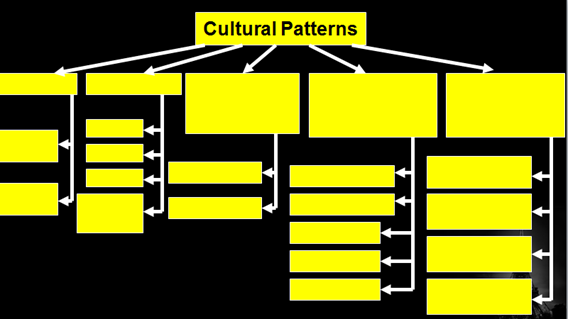
Now, try to draw up the chapter outline on your own with the assistance of the below.
Case Analysis for Chapter 7
Critical Thinking Questions
Keywords for Chapter 7
(1) Cultural pattern: Shared beliefs, values, norms, and social practices that are stable over time and that lead to roughly similar behaviors across similar situations are known as cultural patterns. (文化模式是指在相对稳定的共有的信仰、价值观、标准和社会实践,这些文化模式在相似的情形下会使人产生相似的行为。)
(2) Context: It is the information that surrounds an event, and is inextricably bound up with the meaning of the event.(语境是指事件发生时周围的信息,对事件的意义解读具有重要参考价值。)
(3) High context communication: is one in which most of the information is already in the person, while very little is in the coded, explicitly transmitted part of the message. (高语境交际是指在交际过程中大部分的信息靠交际人本身传递,只有少量信息被明确地用语言的形式传递。)
(4) Low context communication: is one in which the mass of the information is vested in the explicit code. (低语境交际是指大量的信息通过明确的语言编码被传递的交际。)
(5) Uncertainty avoidance: deals with the degree to which members of a culture try to avoid uncertainty. (不确定性规避指某一文化的成员对于不确定性因素的规避程度。)
(6) Power distance: is the extent to which the less powerful members of institutions and organizations accept that power is distributed unequally. (权力距离是指机构或组织中权利较小的成员对权利被不平等分配的接受程度。)
Chinese Culture
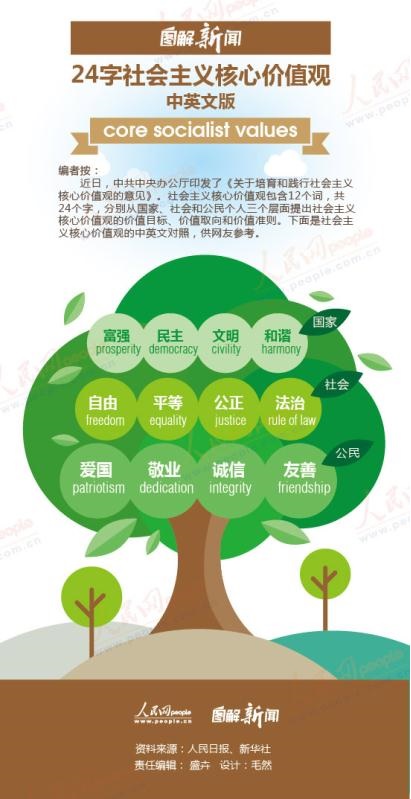
Chinese are socialized not to openly express their own personal emotions, especially the strong negative one.
“A harsh word dropped from the tongue cannot be brought back by a coach and six horses.”
Culture in Movie
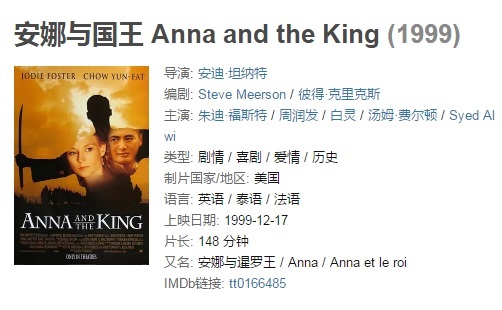
Watch the movie Anna and the King, and try to answer the following questions:
1) How do you think about the different power distance between Anna's culture (Western culture) and the King's culture (Eastern culture)?
2) Which one is high power distance culture? Which one is low power distance culture?
3) What questions do make Anna feel uncomfortable?
Cultural notes:
泰国,古称暹罗(Siam)。据《史记》记载,泰族(泰国的主体民族)发源于中国的南部,与中国的傣族在历史上是同一民族,原居住地是中国云南西双版纳地区。由于历史原因,于公元二十一世纪才移居到现今的泰国。这段时期,泰国存在过四个封建王朝,即素可泰王朝、大城王朝、吞武里王朝和曼谷王朝。
暹罗国号于1949年正式更名为“泰国”,意为“自由之国”。暹罗在文化上受到中国文化和印度文化的双重影响,尤其是自印度西传而来的佛教文化对其影响至深,至今都还是一个全民信奉佛教的宗教国家。

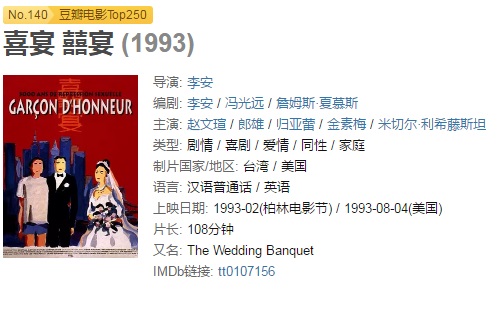
Watch the movie The Wedding Banquet, and try to answer the following questions:
1) How do you think about the different ceremonies of wedding between Eastern and Western cultures?
2) Which one is individualism? Which one is collectivism?

Watch the movie Roman Holiday, and try to answer the following questions:
1) How is it different from culture to culture in greeting ways?
2) What norms did the princess obey to suit her social status?
Now you've finished studying Chapter 7, have you mastered all the key points in this chapter? If the answer is YES, move on to Assessment to check your comprehension and mastery of Chapter 7.

