Text E Cultures Within Culture
Pre-reading Activities:
How would you classify culture into different categories? Go to library to look into how other scholars divide cultures into different categories.
Text Study:
Read Text E through Page 27 to Page 30 to get the key idea of this text. The following is the text audio for your reference.
Find out the answers to the following questions:
1. What is the title of Text E?
2. Please write down the subtitle in Text E and make clear the structure in the text.
3. What is subculture? In the definition, which words are unfamiliar? Please underline the key words that you think are very important. What subcultures have been very important through some cultures (such as British culture, American culture and Chinese culture)? List some and get ready to introduce one or two of them to the class.
4. How do you understand subculture in Chinese?
5. What is co-culture? Underline the key words that you think are very important.
6. How do you understand co-culture in Chinese?
7. Which term do the scholars prefer to use, "co-culture" or "subculture"? WHY?
8. What is sub-group? Underline the key words that you think are very important.
9. How do you understand sub-group in Chinese?
10. What are the characteristics of sub-group? Can you think of any goups who belong(ed) to sub-group?
Now please watch the mini-lecture which aims to help you better understand the key points in the text.
After-reading Check:
1. Diagram Filling
2. Reflection
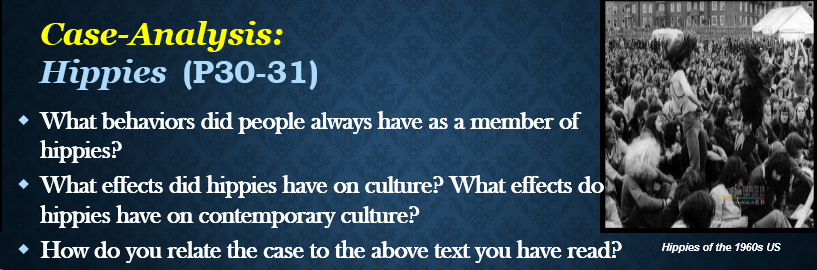
3. Case Study
Read Case 6 on Pages 30 and 31. Then answer the questions:
4. Exploring Ideas
What subgroups do you belong to? Discuss with your group members and see if you belong to the same subgroups.
5. Reading for American Cultural Diversity
Aside from the Native Americans who were living on the North American continent when the first European settlers arrived, all Americans came from foreign countries, or their ancestors did. Incidentally, some of the Native Americans are themselves members of separate and distinct Indian nations, each with its own language, culture, traditions, and even government. From the 1600s to birth of the new nation in 1776, most immigrants were from northern Europe, and the majority were from England. It was these people who shaped the values and traditions that became the dominant culture of the United States.
In 1815, the population of the United States was 8.4 million. Over the next 100 years, the country took in about 35 million immigrants, with the greatest numbers coming in the late 1800s and the early 1900s.
In 1882, 40,000 Chinese arrived, and between 1900 and 1907, there were more than 30,000 Japanese immigrants. But by far the largest numbers of the "new immigrants" were from central, eastern, and southern Europe. The "new immigrants" brought different languages and different cultures to the United States. Gradually most of them assimilated to the dominant American culture.
In 1908, a year when a million new immigrants arrived in the United States, Israel Zangwill wrote in a play:
America is God's Crucible, the great Melting-Pot where all the races of Europe are melting and re-forming... Germans and Frenchmen, Irishmen and Englishmen, Jews and Russians--into the Crucible with you al! God is making the American!
Since Zangwill first used the term melting pot to describe the United States, the concept has been debated. Two things are certain: the dominant American culture has survived and it has more or less successfully absorbed vast numbers of immigrants at various points in its history.
In the United States, people have become very sensitive to the language used to describe these groups, and they try to be "politically correct"(P.C.). For example: many black Ameiricans, particularly young people, prefer the term African American instead of black, to identify with their African heritage; some Spanish speakers prefer to be called Latinos (referring to Latine America) instead of Hispanics, while others prefer to be identified by their country of origin (Cuban-American or Cuban, Chicano, Mexican-American or Mexican).
Incidentally, when citizens of the United States refer to themselves as Americans, they have no intention of excluding people from Latin American countries. There is no word such as United Statesians in the English language, so people call themselves Americans. Thus, what is really a language problem has sometimes caused misunderstandings. Although citizens of Latin American countries may call the people in the United States North Americans, to most people in the United States this makes no sense either, because the term North American refers to Canadians and Mexicans as well as citizens of the United States (NAFTA, the North American Free Trade Agreement, for example, is trade agreement among Canada, the United States, and Mexico.)
Now you've finished studying Text E, have you mastered the key points in this text? If the answer is yes, then you are ready to move on to the last part of this chapter to sum up this chapter. Congratulations!

