
目录

  • 1 Chapter 1 Culture
    • 1.1 Course Lead-in
    • 1.2 Chapter Lead-in
    • 1.3 Text A The Nature of Culture
    • 1.4 Text B Definitions of Culture
    • 1.5 Text C Characteristics of Culture
    • 1.6 Text D Cultural Identity
    • 1.7 Text E Cultures Within Culture
    • 1.8 Extended Reading and Translation​
    • 1.9 Summary
  • 2 Chapter 2 Communication & IC
    • 2.1 Chapter Lead-in
    • 2.2 Text D Intercultural Communication
    • 2.3 Texts A&C Communication
    • 2.4 Text B Charateristics of Communication
    • 2.5 Summary
    • 2.6 Extended Reading and Translation​
    • 2.7 Extended Reading on Confucianism
  • 3 Chapter 3 Culture's Influence on Perception
    • 3.1 WORD STUDY CH3
    • 3.2 Chapter Lead-in
    • 3.3 Text A Overview: Human Perception
    • 3.4 Text B Cross-cultural Differences in Sensation and Perception
    • 3.5 Text C Barriers to Accurate Perception in IC
    • 3.6 Summary
    • 3.7 Extended Reading and Translation​
  • 4 Chapter 4 IC Barriers
    • 4.1 Chapter Lead-in
    • 4.2 Text A Emotional Problems as Barriers to IC
    • 4.3 Text B Attitudinal Problems as Barriers to IC
    • 4.4 Text C Translation Problems as Language Barriers
    • 4.5 Summary
    • 4.6 Extended Reading and Translation​
  • 5 Chapter 5 Verbal IC
    • 5.1 Chapter Lead-in
    • 5.2 Text A & Text B Language and Culture
    • 5.3 Text C Verbal Communication Styles
      • 5.3.1 Text C Edward T. Hall's Context—Culture Theory
    • 5.4 Text D Language Diversity
    • 5.5 Summary
    • 5.6 Extended Reading and Translation​
  • 6 Chapter 6 Nonverbal IC
    • 6.1 Chapter Lead-in
    • 6.2 Text A & Text B Significance and Functions of Nonverbal Communication
    • 6.3 Text C Paralanguage and Silence
    • 6.4 Text D Time and Space
    • 6.5 Text E Other Categories of Nonverbal Communication
    • 6.6 Summary
    • 6.7 Extended Reading and Translation
  • 7 Chapter 7 Cultural Patterns
    • 7.1 Chapter Lead-in
    • 7.2 Texts A&B Cultural Patterns
    • 7.3 Text D Kluckhohn and Strodtbeck's Value Orientation
    • 7.4 Text E Hofstede's Dimensions of Cultural Variability
    • 7.5 Summary
    • 7.6 Extended Reading and Translation
  • 8 Chapter 8 Cultural Influences on Context
    • 8.1 Chapter Lead-in
    • 8.2 Text A Communication and Context
    • 8.3 Text B The Business Context
    • 8.4 Summary
    • 8.5 Extended Reading and Translation
  • 9 Chapter 9 Intercultural Adaptation
    • 9.1 Chapter Lead-in
    • 9.2 Text A Acculturation
    • 9.3 Text B Culture Shock
    • 9.4 Text C Intercultural Adaptation
    • 9.5 Summary
  • 10 Chapter 10 IC Competence
    • 10.1 Course Introduction
      • 10.1.1 Western and Eastern Sharp Contrast
      • 10.1.2 Course Assignment
    • 10.2 Chapter 10 IC Competence
Chapter Lead-in

Chapter One Lead-in (P4):

Please read the following part and please highlight and underline the important words and key contents in Chapter 1.

 文化无处不在,包罗万象,它潜移默化地支配着人们的行为表现并深刻地影响着人们的处世态度。本章主要阐述了关于文化的概念,介绍了关于文化的各种隐喻,这些隐喻可以帮助学习者理解文化的内涵。此外,本章还对文化的功能、定义和特点等基本概念进行了阐述。人类学家、社会学家、心理学家、跨文化交际学家从不同的学科领域对文化的定义进行了具体的描述,这些定义既有交叉点,又有差异处。文化具有可习得性、动态性、普遍性、整体性和适应性等特点。人们从各个途径习得文化,文化渐渐演变成个人生命的一部分,在个人不断与社会互动的过程中,文化体现了其自身的灵活性和动态性。
    人们往往有意识地把自己归为人类某一群体的成员并形成文化身份。本章对文化与身份的关系,以及文化身份的定义、形成过程及其特点给予了着重描述。本章还对亚文化与共文化进行了比较分析,学者们对共文化这一术语更加认同,因其摒弃了亚文化所带来的歧视内涵。

Learning Objectives (P5):

In this chapter, students will learn how to:

  1. understand the concepts concerning culture;

  2. recognize the nature of culture;

  3. describe the functions and  characteristics of culture;

  4. summarize the process of the formation of cultural identity;

  5. evaluate cultural diversity.

Chapter Outline (P5):

Look at the Chapter Outline on Page 5, and think about the following questions:

  1. How many texts are there in Chapter 1? What are they? And what is each text about?

  2. Observe the framework under each part and make clear the major points in Chapter 1.
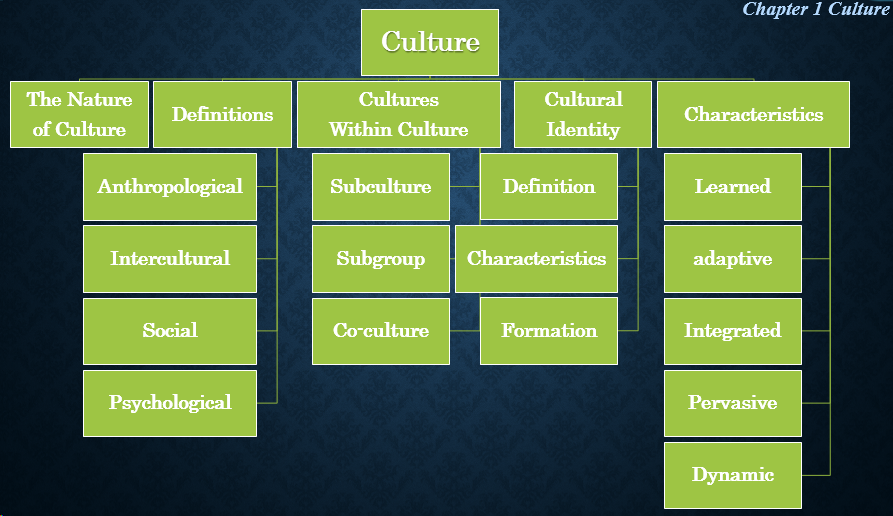
Key points for Chapter 1:

Please finish the following quiz to make you familiarized with the key points in this chapter.


Pre-class Activities: Lead-in Case (PP6-7)

Read the Lead-in Case An Interview in India on Pages 6 and 7. Following is the video of the case.


After reading and watching the case, try to answer the questions:

Following is a video clip about Indian wedding ceremony.


After reading the case, finish the following tasks with your group members.

1. Discuss the following questions with your group members, and get ready to report your findings to the class. 

  1. What is the case about?     

  2. What specific points are they talking about in the case?      

  3. What can be reflected in the case?      

  4. What should we learn from case?

  5. What do you know about Indian culture and Indian taboos? List some.

  6. In this case, is the interviewee proud of her culture? Why?

  7. What things does Trevor want to know about Indian culture in the case?

  8. Is Chinese culture the same as Indian culture? In what perspectives are they alike and in what other perspectives are they different?


2. Now report your group's views below.