
目录

  • 1 Chapter 1 Culture
    • 1.1 Course Lead-in
    • 1.2 Chapter Lead-in
    • 1.3 Text A The Nature of Culture
    • 1.4 Text B Definitions of Culture
    • 1.5 Text C Characteristics of Culture
    • 1.6 Text D Cultural Identity
    • 1.7 Text E Cultures Within Culture
    • 1.8 Extended Reading and Translation​
    • 1.9 Summary
  • 2 Chapter 2 Communication & IC
    • 2.1 Chapter Lead-in
    • 2.2 Text D Intercultural Communication
    • 2.3 Texts A&C Communication
    • 2.4 Text B Charateristics of Communication
    • 2.5 Summary
    • 2.6 Extended Reading and Translation​
    • 2.7 Extended Reading on Confucianism
  • 3 Chapter 3 Culture's Influence on Perception
    • 3.1 WORD STUDY CH3
    • 3.2 Chapter Lead-in
    • 3.3 Text A Overview: Human Perception
    • 3.4 Text B Cross-cultural Differences in Sensation and Perception
    • 3.5 Text C Barriers to Accurate Perception in IC
    • 3.6 Summary
    • 3.7 Extended Reading and Translation​
  • 4 Chapter 4 IC Barriers
    • 4.1 Chapter Lead-in
    • 4.2 Text A Emotional Problems as Barriers to IC
    • 4.3 Text B Attitudinal Problems as Barriers to IC
    • 4.4 Text C Translation Problems as Language Barriers
    • 4.5 Summary
    • 4.6 Extended Reading and Translation​
  • 5 Chapter 5 Verbal IC
    • 5.1 Chapter Lead-in
    • 5.2 Text A & Text B Language and Culture
    • 5.3 Text C Verbal Communication Styles
      • 5.3.1 Text C Edward T. Hall's Context—Culture Theory
    • 5.4 Text D Language Diversity
    • 5.5 Summary
    • 5.6 Extended Reading and Translation​
  • 6 Chapter 6 Nonverbal IC
    • 6.1 Chapter Lead-in
    • 6.2 Text A & Text B Significance and Functions of Nonverbal Communication
    • 6.3 Text C Paralanguage and Silence
    • 6.4 Text D Time and Space
    • 6.5 Text E Other Categories of Nonverbal Communication
    • 6.6 Summary
    • 6.7 Extended Reading and Translation
  • 7 Chapter 7 Cultural Patterns
    • 7.1 Chapter Lead-in
    • 7.2 Texts A&B Cultural Patterns
    • 7.3 Text D Kluckhohn and Strodtbeck's Value Orientation
    • 7.4 Text E Hofstede's Dimensions of Cultural Variability
    • 7.5 Summary
    • 7.6 Extended Reading and Translation
  • 8 Chapter 8 Cultural Influences on Context
    • 8.1 Chapter Lead-in
    • 8.2 Text A Communication and Context
    • 8.3 Text B The Business Context
    • 8.4 Summary
    • 8.5 Extended Reading and Translation
  • 9 Chapter 9 Intercultural Adaptation
    • 9.1 Chapter Lead-in
    • 9.2 Text A Acculturation
    • 9.3 Text B Culture Shock
    • 9.4 Text C Intercultural Adaptation
    • 9.5 Summary
  • 10 Chapter 10 IC Competence
    • 10.1 Course Introduction
      • 10.1.1 Western and Eastern Sharp Contrast
      • 10.1.2 Course Assignment
    • 10.2 Chapter 10 IC Competence
Summary

Chapter Overview


Summary--From the Intercultural Perspective

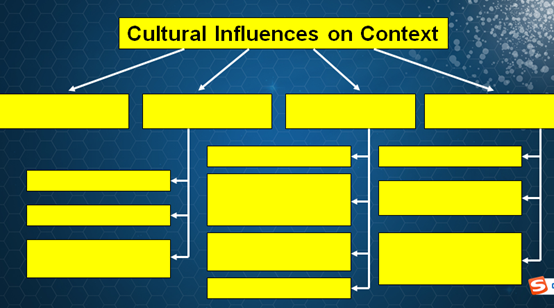
Read Summary on Pages 273-274 and go over all the information we deal with in Chapter 8. And then fill in the diagram concerning the structure and key points of the chapter.


Case Analysis for Chapter 8

Critical Thinking Questions


Keywords for Chapter 8

Communication is not devoid of external influence: all human interaction is influenced to some degree by the social, physical, and cultural settings in which it occurs. This is known as the communication context. (交际无法脱离外部环境的影响:所有的人类交际都或多或少受到社会、物理和文化场景的影响。这些场景被称为交际语境。)

Now you've finished studying Chapter 8, have you mastered all the key points in this chapter? If the answer is YES, move on to Assessment to check your comprehension and mastery of Chapter 8.