CHAPTER 8
§
Negotiations, Contracts, and Liabilities
LEARNER OUTCOMES
§
A. Identify the requirements for a contract.
B. Explain the relationship between an RFP, a proposal, and a contract for a meeting.
C. Give examples of legal issues that could arise in connection with a meeting.
D. List the basic elements of a hotel contract for a meeting.
E. Explain key facility contract clauses.
Chapter Summary
The meeting professional throughout his/her career will require negotiation skills, knowledge of contracts, and a general understanding on issues of liabilities when coordinating and implementing a meeting or event. Contracting develops as a result of a specific process that begins with a Request for Proposal (RFP).
The RFP is generated by the meeting professional to a supplier. A well written RFP is a road map toward a development of a contractual relationship between the meeting organizer and the supplier. S supplier response to the RFP is known as a proposal, and this becomes the starting point of negotiation process. Keeping an honest dialogue between the parties is a must.
The negotiation process in which people with shared interests, yet different goals, engage in an exchange of promises intended to achieve each party’s goals. It results in a form of agreement.
Some negotiations between the meeting professional, hotels, and/or convention centers are said to be the most challenging. This is due in part because of the two diametrically opposed concepts of booking. The meeting planner wants to reduce expenses and the goal of the facility is to maximize revenues!
There are several layers to negotiations and some of the most successful negotiations result when each party secures enough of its priority requests to move forward with the project and subsequently, a contract. The negotiation process has essentially three components or steps for consideration.
Step One:Establish goals and priority needs prior to the interaction with the other party. (Maintaining goals and priority needs minimize the risk of giving up too much or possibly too little.)
Step Two:Dates, Rates, and Space – These are the most important items for the meeting professional and the facility sales person.
· Dates available for the meeting
· Required numbers of sleeping rooms and function space over those dates
· Finding the right costs to stay within budget parameters
Step Three:The Negotiating Concessions – The concessions are those items in contractual agreement where one party provides something of value to the other party in exchange for something else! Knowledge of the “priorities” is a very valuable asset when negotiating for concessions. It is at this juncture that knowing hard versus soft costs at a particular property will be of value.
Hard costs relate to items or services that generate revenue for the property. Soft costs are generally those which can be absorbed by a property without undue expenses, such as an upgraded room.
Common negotiable items for meeting facility contracts include:
1.Guest room rate
2.Guest room upgrades
3.Meeting Dates
4.Meeting and function room rates
5.Complimentary or discounted meeting room or function space
6.Food and Beverage costs
7.Staff to guest service ratio for food and beverage functions
8.Registration assistance
9.VIP amenities and services
10.Commission for third party agents
11.Transportation services
After the parties have negotiated on these several noted area they prepare for the contract. Contracts have requirements that would make them valid. A contract has been defined as an “agreement between two or more parties that creates in each party a duty to do or not to do something, and a right to performances of the other’s duty, or a remedy for the breach if the other party fails to perform its duty.”
In the United States, the five legal elements are; an offer, acceptance, consideration, capacity, and a written document signed by both parties. A legal enforceable contract requires the five contract elements.
Contract performance generally means parties to a contract are expected to meet the obligations to which they have agreed. If one contracting party fails to perform a breach of contract has occurred.
When a party sues for breach of contract the court may award for damages. There are two types of damages. Actual damage (Compensatory damage) and liquidated damages (reasonable estimation of damage).
Every meeting is unique, therefore its contracts should meet the unique needs of the specific sponsoring organizations. Here is a listing of some common contract clauses.
· Acceleration
· Americans with Disabilities Act (ADA)
· Ancillary fees, taxes, surcharges
· Audit
· Change in ownership of hotel
· Condition of premises/deterioration in quality
· Concessions
· Construction of renovation
· Contingency
· Credit arrangements, master account
· Liquor liability
· Competing groups
· Pre – and post event pickup reports
· Quiet enjoyment
· Relocation
· Resale
· Third party agents and commissions
· Unavailability of fac8ility
· Waivers
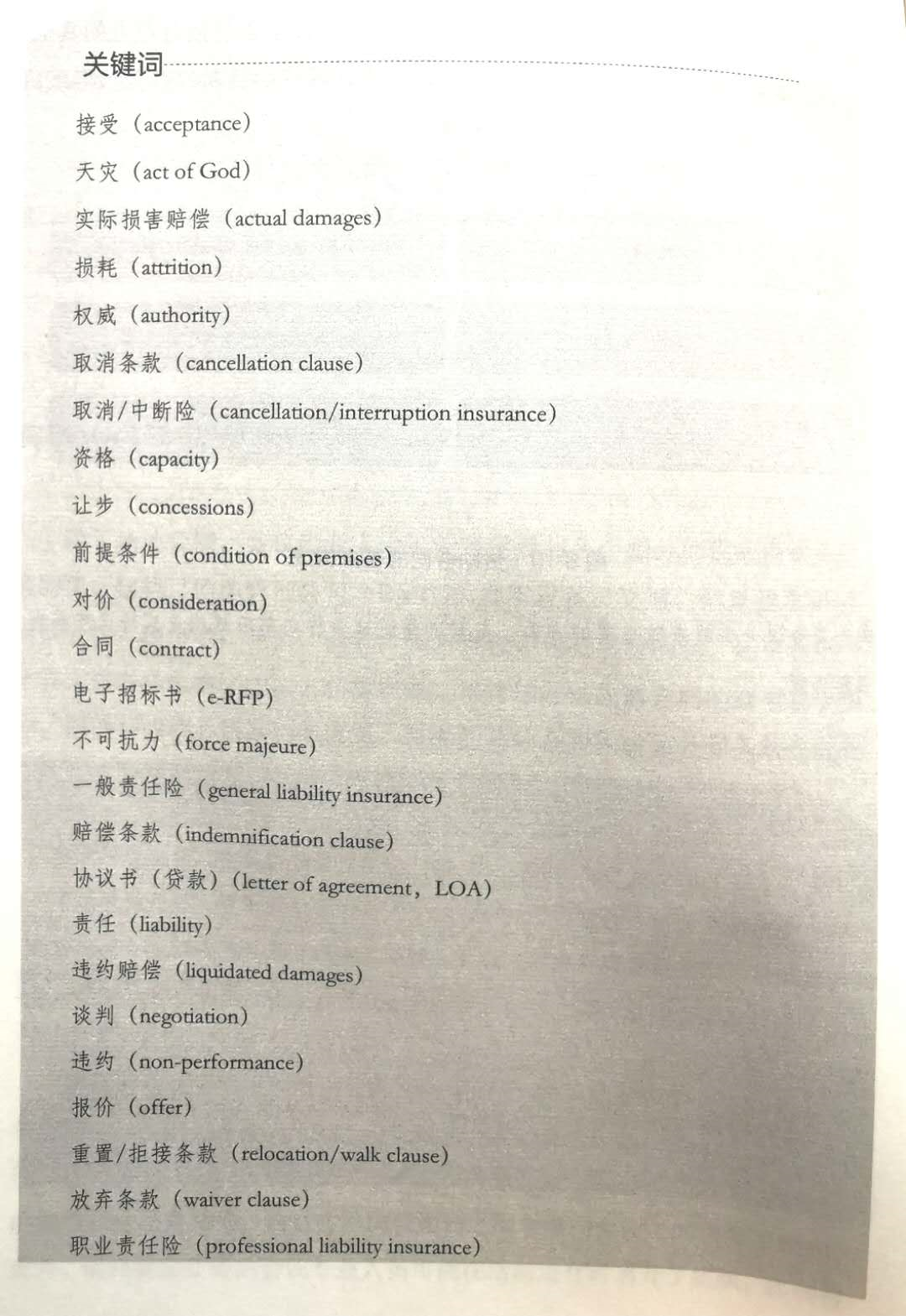
One of the most discussed contract clauses is attrition. Which is the “difference between the actual number of sleeping rooms occupied (or food and beverage covers) or revenue projection and the number or formulas agreed to in the terms of the facility’s contract. Damages may be calculated according to an estimated amount of lost revenue or lost profit.
Within a contract there is also a Cancellation Clause. This is a type of contract provision that outlines the damages to be paid to the non-cancelling party in the event that a breach of contract by the other party occurs.
The Force Majeure clause (also known as an “Act of God” clause) applies to any disruptive occurrence that cannot be anticipated or avoided, relieving the parties of their obligation to perform the contract. An example of a disruption include; civil war, rebellion, terrorist activities, or an embargo.
Liability and the need for insurance happens because there are potential liabilities for a meeting professional and their organizations. The Indemnification clause, also known as the hold harmless clause, where one party agrees to pay damages of claims that the other party may be required to pay another. The reciprocal indemnification clause is also written into the contract. Similarly, a hotel may get sued for something that was the fault of the client. This clause is actually standard in most meeting contracts.
Insurance is tied to indemnification clauses and is an important component of risk management. The three most common types of insurance are:
1. General liability
2.Professional liability
3.Cancellation/Interruption
Other supplier contracts that a meeting professional will enter into include but are not limited to:
1.DMC
2.A/V firms
3.Transportation companies
4.IT/Communication companies
5.Entertainers
6.Exhibitors
7.Official Service Contractors (Associated with exhibitors)
Sponsorships are an essential component of meeting and events and they act as strategic partners with the meeting organizer. In addition, a sponsor may provide additional revenue towards the meeting.
Sponsorship also requires an agreement. This agreement should contain the five elements that validate a contract. In this type of contract there may me additional items written into the document to protect the parties.
The earlier the meeting professional includes the sustainability requirement in a RFP, the easier it will be to find vendors who can partner on these activities. If sustainability is a high priority, direct the RFP to green destinations with recognized green certification. Those green certifications include:
1.L.E.E.D
2.Green Seal
3.Green Leader
4.Green Key
5.Green Globe
Refer to the Green Meeting Industry Council for future updating.

